Hay's bridge | Circuit | Electrical Instruments ( EIM ) | Lec - 49
TL;DR
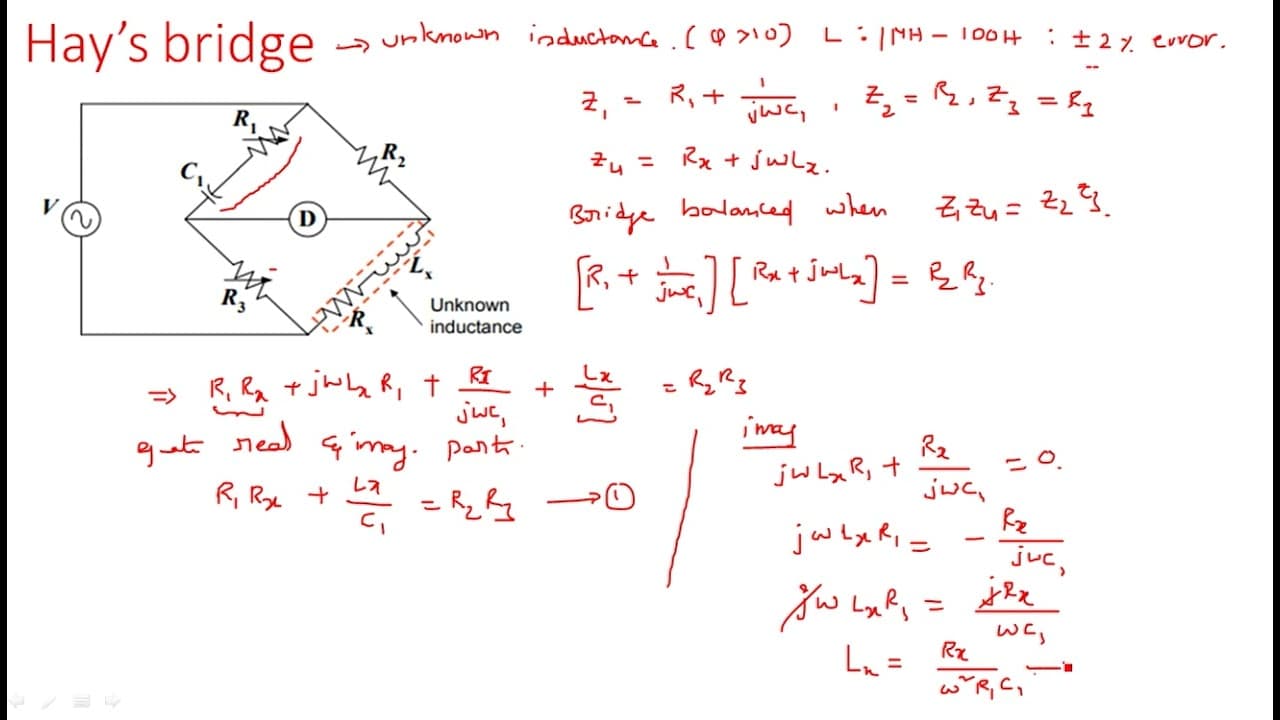
The Hays Bridge is a precise tool for measuring unknown inductance values with advantages over the Maxwell Bridge.
Transcript
in this video i am going to start the haze bridge has bridge is also used to measure the unknown inductance like your maxwell's bridge okay it is also used to measure the unknown unknown inductance okay what is the drawback of the what is the what are the not you cannot say drawback what are the limitations of the maxwell's bridge maxwell's bridge ... Read More
Key Insights
- 💄 The Hays Bridge measures inductance from 1 microhenry to 100 henries, making it suitable for applications requiring fine measurements.
- ✋ With a quality factor threshold of greater than 10, the Hays Bridge excels in high-frequency scenarios where the Maxwell Bridge's limitations become apparent.
- 🔨 The error margin of plus or minus 2% ensures accurate assessments with the Hays Bridge, providing a reliable tool for various electrical applications.
- ❓ The contrast between series and parallel configurations affects calculations, with the Hays Bridge offering a systematic approach to resolving complex impedance.
- 🈸 The Hays Bridge's formula outputs require memorization due to their complexity, beneficial in practical applications for inductance measurement.
- 🌉 Understanding the balance condition in bridges is crucial, influencing how equations are derived and results interpreted in Hays Bridge applications.
- 🌉 The clear distinction in connections and measurement techniques highlights the significance of configuration in bridge circuits, impacting their overall performance.
Install to Summarize YouTube Videos and Get Transcripts
Explore YouTube Video Summarizer or Get YouTube Transcript Extractor
Questions & Answers
Q: What advantages does the Hays Bridge offer over the Maxwell Bridge?
The Hays Bridge features a broader range for measuring unknown inductance, specifically from 1 microhenry to 100 henries. Additionally, it accommodates quality factors greater than 10, unlike the Maxwell Bridge, which is limited to less than 10. This allows the Hays Bridge to be more versatile in various applications.
Q: How does the Hays Bridge differ in its configuration from the Maxwell Bridge?
The key difference lies in the series and parallel configurations of their components. In the Hays Bridge, resistance and capacitance are connected in series, while in the Maxwell Bridge, they are connected in parallel. This affects their impedance calculations, making the Hays Bridge more suitable for certain inductance measurements.
Q: What type of errors can be expected when using the Hays Bridge?
When measuring with the Hays Bridge, the expected margin of error is typically around plus or minus 2%. This relatively low error rate enhances the reliability of measurements compared to other bridges, making it suitable for precise inductance assessments.
Q: What is the formula for calculating the quality factor of the Hays Bridge?
The quality factor (Q) for the Hays Bridge can be calculated using the formula Q = 1 / (omega * R1 * C1). This formula simplifies the relationship between the inductance and resistance in the circuit, allowing for effective quality factor computations in various scenarios.
Summary & Key Takeaways
-
The Hays Bridge can measure unknown inductance values ranging from 1 microhenry to 100 henries, boasting a lower error margin compared to the Maxwell Bridge.
-
Unlike the Maxwell Bridge, which only measures quality factors below 10, the Hays Bridge operates effectively with quality factors greater than 10.
-
The configuration differences between the Hays and Maxwell Bridges, specifically the series versus parallel connections of components, influence their respective measurement capabilities.
Read in Other Languages (beta)
Share This Summary 📚
Summarize YouTube Videos and Get Video Transcripts with 1-Click
Try YouTube Summary with ChatGPT & Claude or YouTube Transcript Generator