Converting CFG to CNF | Example | TOC | Lec-71 | Bhanu Priya
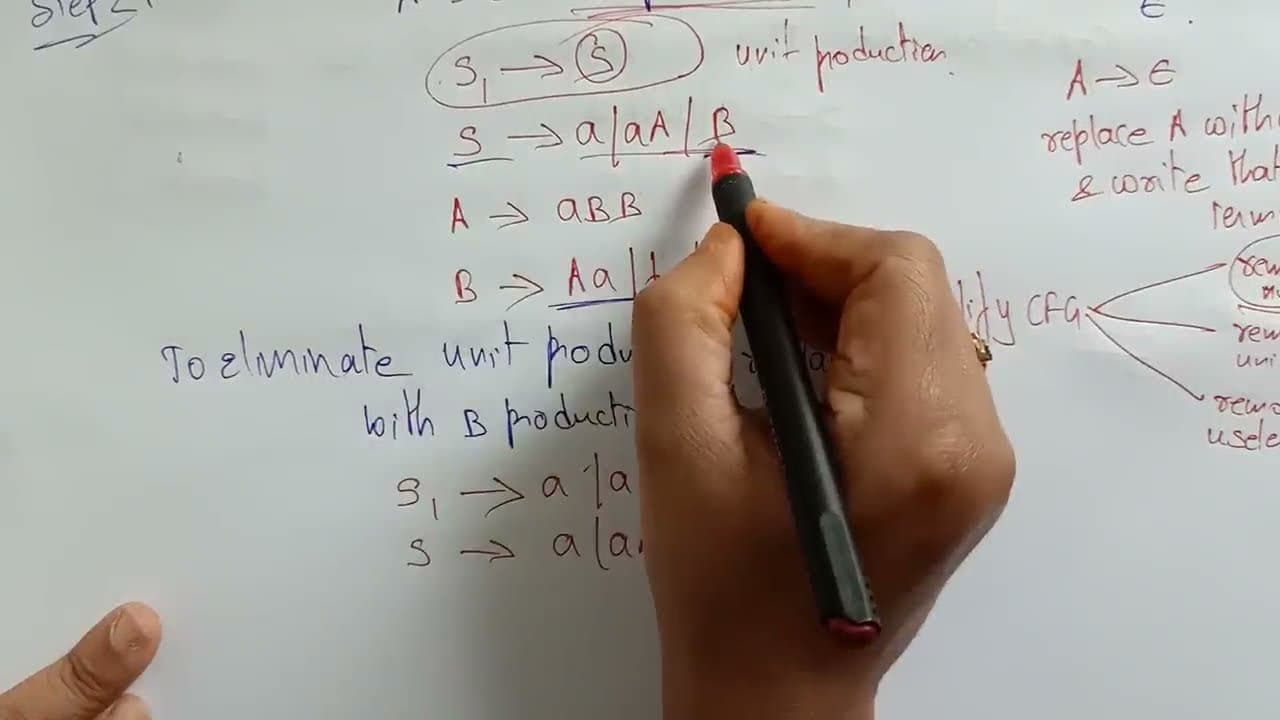
TL;DR
Detailed steps to convert context-free grammar to Chomsky Normal Form.
Transcript
as students let's continue with the Chomsky normal form in the previous video I explained what is a chance key number from and what are the steps that you need to consider by to convert the context-free grammar into Chomsky normal form so now apply those steps in this example so here they are given an example like convert the given grammar that is ... Read More
Key Insights
- 🌲 Chomsky Normal Form simplifies the grammar structure, making it easier to analyze properties like parse trees and derivations.
- 📏 The conversion process is systematic, involving steps to eliminate problems with null and unit productions before applying CNF rules.
- 🤬 Each production in CNF can either yield a terminal or consist of two non-terminal symbols, significantly restricting the form of grammar.
- 👶 By introducing new non-terminals and productions, one can transform complex productions into valid CNF structures.
- 🦻 The conversion enhances the efficiency of parsing algorithms, aiding computational linguistics and automata theory.
- 💄 Understanding the step-by-step conversion process can demystify the complexities surrounding CFG and CNF, making it accessible for learners.
- 📏 Potential confusion in the rules can be mitigated with careful attention to details during conversion, especially for beginners.
Install to Summarize YouTube Videos and Get Transcripts
Explore YouTube Video Summarizer or Get YouTube Transcript Extractor
Questions & Answers
Q: What are the essential rules for a grammar to be in Chomsky Normal Form?
For a grammar to be considered in Chomsky Normal Form (CNF), it must adhere to specific rules: the start symbol can generate epsilon only if it is the sole production allowing that, each production must either consist of one terminal or two non-terminals, and productions cannot yield more than two symbols.
Q: How do null productions affect the conversion process to CNF?
Null productions pose a challenge during the conversion to CNF since they can violate the requirement that productions generate at most one terminal or two non-terminals. To address this, null productions must be identified and removed from the grammar, ensuring that the start symbol is the only exception, if necessary.
Q: What are unit productions and how are they handled in the conversion?
Unit productions occur when a non-terminal directly generates another non-terminal. In the conversion process, these productions must be eliminated, typically by replacing the unit production with the corresponding rules of the non-terminal it produces. This simplifies the grammar, bringing it closer to CNF compliance.
Q: Why is simplifying context-free grammar crucial in the CNF conversion?
Simplifying context-free grammar is crucial because it streamlines the conversion process to Chomsky Normal Form. By removing null productions, unit productions, and any useless productions, the grammar can more easily meet the structural requirements of CNF, where productions have limited forms.
Q: What does it mean to decompose a production, and why is it necessary?
Decomposing a production involves breaking down a complex production that generates more than two symbols into simpler productions that comply with CNF rules. This step is necessary to ensure that each production adheres to the constraint of producing either a terminal or two non-terminals, leading to a valid CNF structure.
Q: Can you provide an example of a production that needs to be decomposed to meet CNF requirements?
An example of a production that requires decomposition is one where a non-terminal generates three symbols, such as A -> xyz. To convert this to CNF, it might be broken down into two separate productions, like A -> X1Y and Y -> z, where X1 can produce terminal or non-terminal combinations consistent with CNF.
Q: What is the final step once all productions comply with CNF rules?
The final step, after ensuring that all productions meet CNF requirements, involves reviewing the entire grammar for any remaining issues, confirming that each production consists solely of one terminal or two non-terminals, thus affirming the grammar has been successfully converted to Chomsky Normal Form.
Summary & Key Takeaways
-
The process of converting context-free grammar (CFG) to Chomsky Normal Form (CNF) involves adhering to specific rules for productions, including restrictions on epsilon and unit productions.
-
Key steps in the conversion include introducing a new start symbol, eliminating null productions, and replacing unit productions to simplify the grammar and align with CNF rules.
-
The transformation requires meticulous checking of the productions to ensure compliance with CNF, mainly that each production consists of either a terminal or two non-terminals.
Read in Other Languages (beta)
Share This Summary 📚
Summarize YouTube Videos and Get Video Transcripts with 1-Click
Try YouTube Summary with ChatGPT & Claude or YouTube Transcript Generator