Switching characteristics of diode | Pulse Digital Circuits ( PDC ) | Lec-36
TL;DR
The video explains diode switching characteristics including forward and reverse recovery times.
Transcript
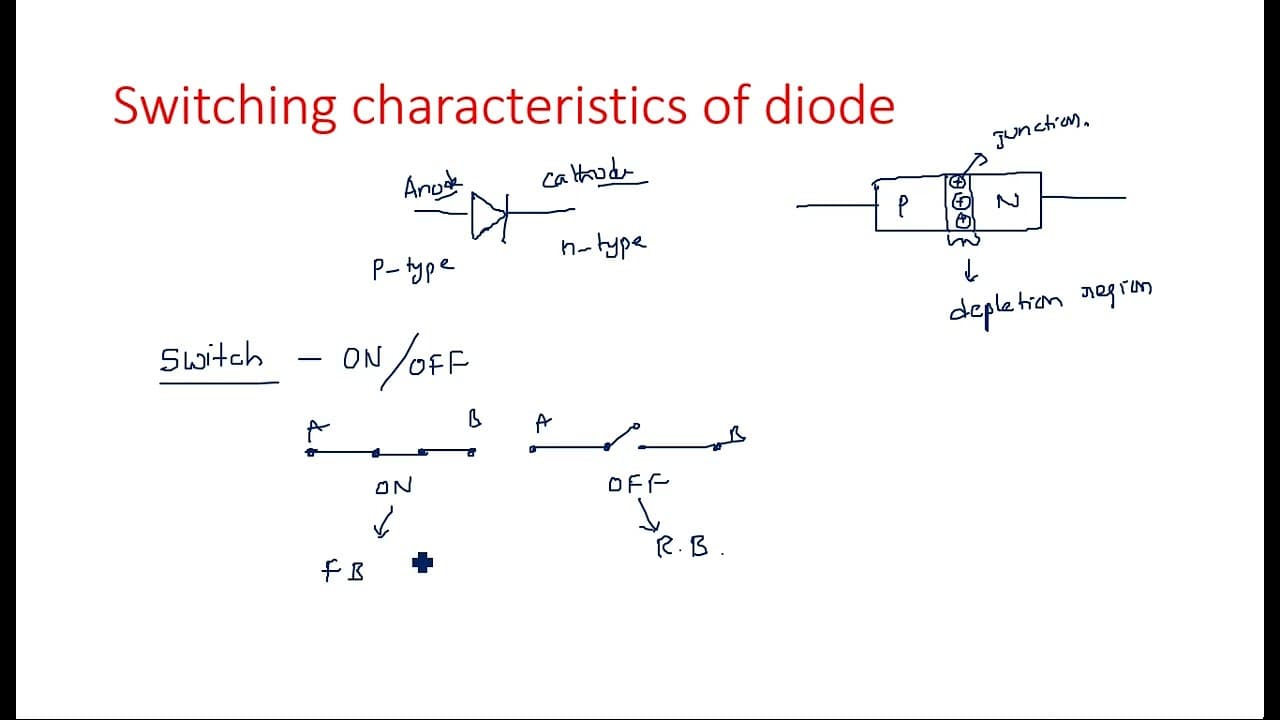
hi everyone in this video I am going to explain about switching characteristics of diode so you may know diode is nothing but two electrodes if you see the symbol of a diode it is having two electrodes anode on cathode so anode is made up of P type semiconducting material and the cathode is made up of n-type semiconducting material when P type and ... Read More
Key Insights
- 🅰️ Diodes are crucial semiconductors formed from P-type and N-type materials creating a depletion region that affects current flow.
- 💄 Switching characteristics of diodes determine their functionality as electronic switches in circuits, making them vital in various applications.
- ◀️ Forward biasing causes the diode to conduct, while reverse bias ideally blocks current, though some reverse leakage can occur.
- ✊ Forward recovery time directly influences the response speed of diodes in operational circuits, affecting power efficiency and signal integrity.
- ⏪ Reverse recovery time provides essential information about a diode's performance when switching states, crucial for designing fast electronic devices.
- 🥺 Current behavior in diodes is significantly impacted by their internal capacitance, leading to gradual changes during bias transitions.
- 🎴 Minority charge carriers play a substantial role in understanding current flow characteristics during both forward and reverse bias conditions.
Install to Summarize YouTube Videos and Get Transcripts
Explore YouTube Video Summarizer or Get YouTube Transcript Extractor
Questions & Answers
Q: What is the basic construction of a diode?
A diode consists of two electrodes: the anode, made of P-type material, and the cathode, made of N-type material. When these materials are placed side by side, they form a junction where holes from the P-type and electrons from the N-type combine, creating a depletion region which restricts current flow until an external voltage is applied.
Q: How does a diode operate in forward and reverse bias?
In forward bias, the diode permits current flow when the positive terminal is connected to the P-type and the negative to the N-type, creating a closed circuit. In reverse bias, the connections are swapped, causing the diode to act as an open circuit, preventing current flow except for a small reverse leakage current due to minority charge carriers.
Q: What is the significance of forward recovery time?
Forward recovery time refers to the duration a diode takes to switch from reverse bias to forward bias after applying the correct voltage. It measures how quickly the diode allows current to flow after being reversed, typically defined by the time taken for voltage to rise from 10% to 90% of its maximum value, which is influenced by the internal capacitance of the diode.
Q: What is reverse recovery time and why is it important?
Reverse recovery time is the period a diode requires to transition from conducting in forward bias to blocking in reverse bias when the voltage orientation changes. It indicates how quickly a diode can stop current flow, affecting the efficiency in digital circuits and devices, especially in high-speed applications.
Summary & Key Takeaways
-
The video details the construction of a diode, highlighting its P-type and N-type materials, and how they create a depletion region that prevents current flow until a voltage is applied.
-
It discusses the switching characteristics, defining terms like forward and reverse bias conditions, where the diode functions as an open or closed circuit based on applied voltage polarity.
-
Key timings such as forward recovery time and reverse recovery time are explained, focusing on how long it takes for a diode to switch from reverse to forward bias and vice versa.
Read in Other Languages (beta)
Share This Summary 📚
Summarize YouTube Videos and Get Video Transcripts with 1-Click
Try YouTube Summary with ChatGPT & Claude or YouTube Transcript Generator