EEVblog #600 - OpAmps Tutorial - What is an Operational Amplifier?
TL;DR
Explains operational amplifiers, their functions, and configurations.
Transcript
hi welcome to fundamentals Friday today we're going to take a look at the operational amplifier or better known as the opamp really important building block absolutely essential that you understand how they work now there are two ways to learn about opamps one is this way the hard way we don't want to do it that way that sucks so le... Read More
Key Insights
- Operational amplifiers (OpAmps) are crucial components in electronics, initially developed for analog computers to perform mathematical operations.
- OpAmps function as differential amplifiers but require external circuitry to be practical, as their internal gain is extremely high.
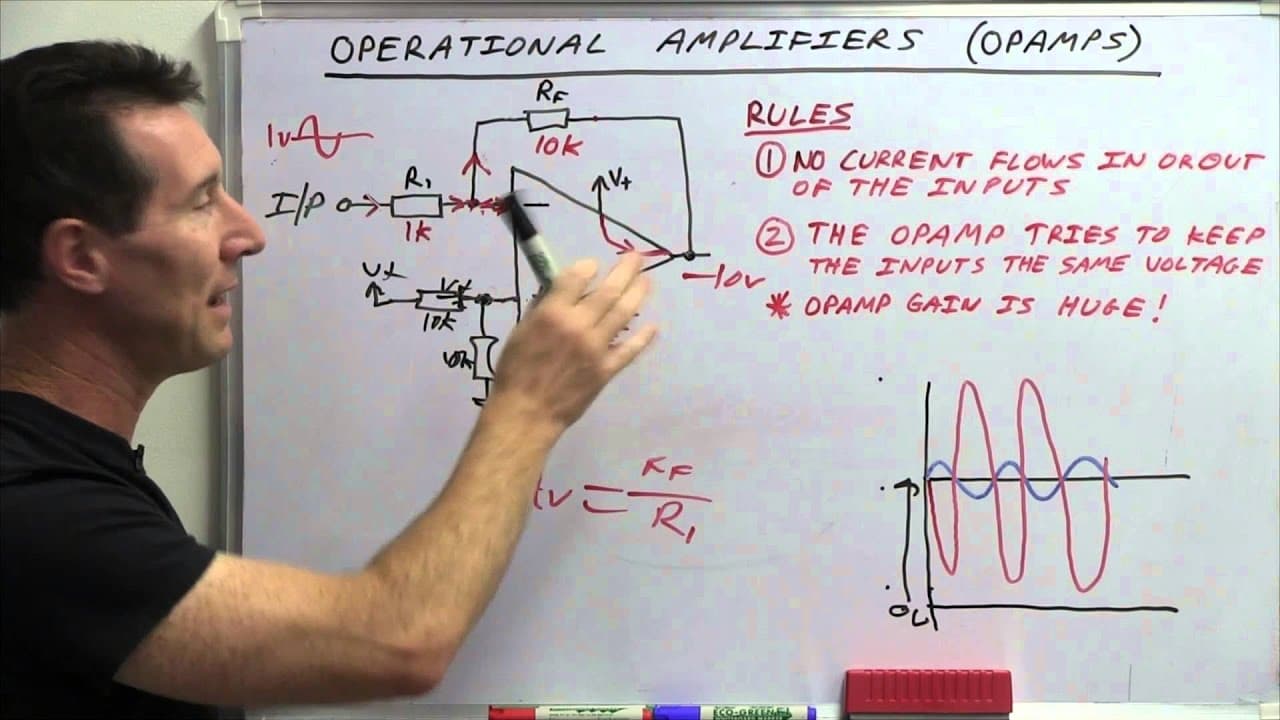
- The two fundamental rules of OpAmp circuits are: no current flows in or out of the input pins, and the OpAmp adjusts to keep input voltages equal when in closed loop.
- A comparator is a basic application of an OpAmp, where it operates in an open loop configuration, comparing input voltages without feedback.
- Negative feedback is essential for controlling the gain of an OpAmp, allowing it to function effectively as an amplifier.
- The inverting and non-inverting amplifier configurations are fundamental OpAmp applications, each with specific gain formulas and characteristics.
- Virtual ground is a key concept in OpAmp circuits, where an input pin is maintained at a constant voltage, typically ground, without direct connection.
- Practical limitations of OpAmps include input bias currents and voltage rail constraints, which affect performance and require careful consideration in design.
Install to Summarize YouTube Videos and Get Transcripts
Explore YouTube Video Summarizer or Get YouTube Transcript Extractor
Questions & Answers
Q: What are operational amplifiers and how are they used?
Operational amplifiers, or OpAmps, are versatile electronic components used to perform mathematical operations and amplify signals. Initially developed for analog computers, they are now used in various applications, including amplifiers, comparators, and filters. Understanding their behavior, especially their high internal gain, is crucial for effective circuit design.
Q: Why can't OpAmps be used as differential amplifiers on their own?
OpAmps have an extremely high internal gain, making them impractical as standalone differential amplifiers. Without external circuitry, even small input differences can lead to excessively large output voltages, saturating the OpAmp. Therefore, they require feedback mechanisms to control and stabilize their gain for practical applications.
Q: What are the two fundamental rules for analyzing OpAmp circuits?
The two fundamental rules for analyzing OpAmp circuits are: 1) No current flows in or out of the input pins, ensuring high impedance inputs, and 2) In closed loop configurations, the OpAmp adjusts its output to keep the input voltages equal, maintaining stability and desired functionality in the circuit.
Q: How does negative feedback affect OpAmp performance?
Negative feedback is crucial for stabilizing OpAmp performance by controlling its gain. By feeding a portion of the output back to the input, negative feedback reduces the effective gain, allowing for precise amplification and preventing saturation. This feedback mechanism makes OpAmps versatile and reliable in various applications.
Q: What is a virtual ground in OpAmp circuits?
A virtual ground in OpAmp circuits is a point that maintains a constant voltage, typically ground, without a direct connection. It is a result of the OpAmp's feedback mechanism, which adjusts the output to keep the input voltages equal. This concept is essential for understanding inverting amplifier configurations and other OpAmp applications.
Q: What practical limitations should be considered when using OpAmps?
Practical limitations of OpAmps include input bias currents, which can affect precision, and voltage rail constraints, which limit the range of input and output voltages. Designers must consider these factors, along with the OpAmp's bandwidth and slew rate, to ensure optimal performance in their circuits.
Q: How do inverting and non-inverting amplifier configurations differ?
Inverting and non-inverting amplifier configurations differ in signal input and gain calculation. In an inverting amplifier, the input is applied to the inverting terminal, resulting in an output that is 180 degrees out of phase with the input. The gain is determined by the feedback and input resistors. In a non-inverting amplifier, the input is applied to the non-inverting terminal, and the output is in phase with the input, with gain calculated differently, typically involving a plus one in the formula.
Q: What role do OpAmps play in integrator circuits?
OpAmps in integrator circuits perform mathematical integration of the input signal. By using a capacitor in the feedback loop instead of a resistor, the OpAmp produces an output voltage proportional to the integral of the input voltage over time. This configuration is used in analog signal processing for applications like waveform generation and filtering.
Summary & Key Takeaways
-
Operational amplifiers, or OpAmps, are fundamental components in electronics, originally developed for analog computers to perform mathematical operations. They are versatile, functioning as differential amplifiers, but require external circuitry to manage their high internal gain effectively.
-
The tutorial covers key concepts such as negative feedback, open loop gain, and virtual grounds, which are essential for understanding OpAmp behavior. It explains various configurations, including comparators, buffers, inverting and non-inverting amplifiers, differential amplifiers, and integrators.
-
A practical demonstration on a breadboard illustrates the virtual ground concept and the impact of voltage rail limitations on OpAmp performance. The tutorial emphasizes the importance of understanding these principles for effective circuit design and troubleshooting.
Read in Other Languages (beta)
Share This Summary 📚
Summarize YouTube Videos and Get Video Transcripts with 1-Click
Try YouTube Summary with ChatGPT & Claude or YouTube Transcript Generator
Explore More Summaries from EEVblog 📚

Summarize YouTube Videos and Get Video Transcripts with 1-Click
Try YouTube Summary with ChatGPT & Claude or YouTube Transcript Generator