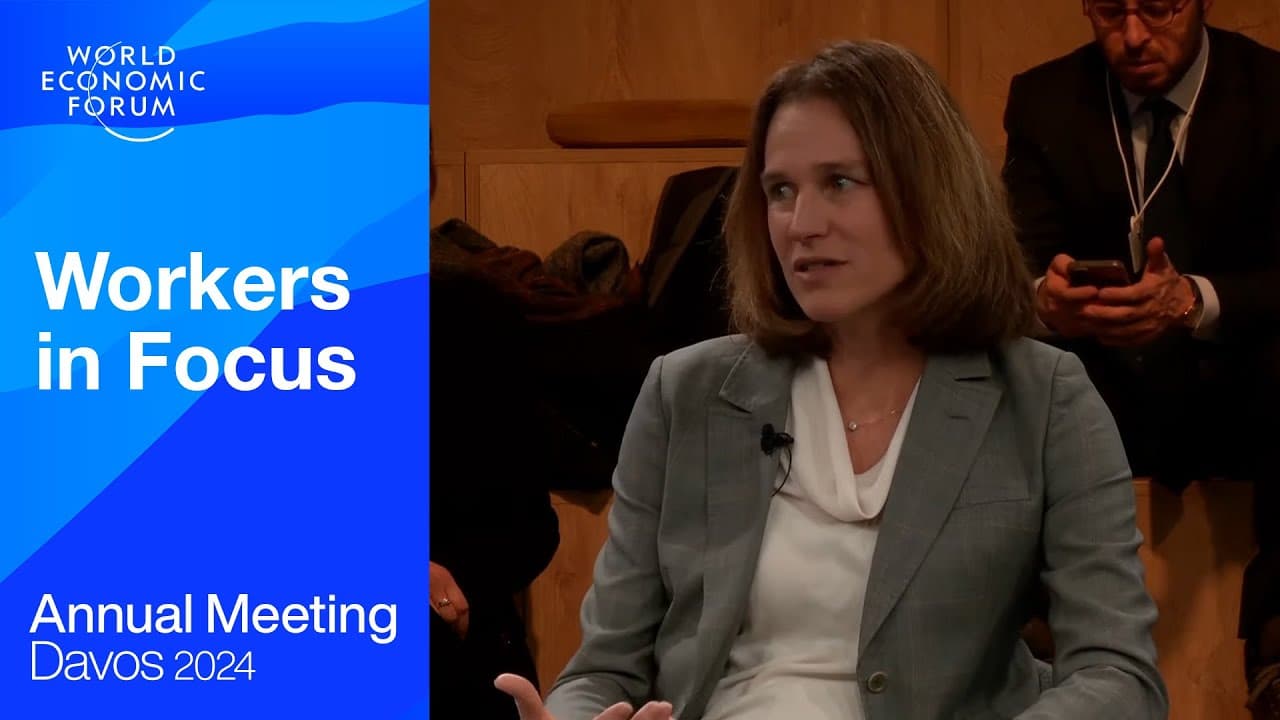
Workers in Focus | Davos 2024 | World Economic Forum
TL;DR
Experts discuss the implications of AI on jobs, with differing perspectives on its level of impact and the importance of labor advocacy in shaping the future of work.
Transcript
you know hello everybody thank you so much for being with us here at the world economic Forum we're talking about workers in Focus my name is Jamie heler I'm the business editor of the Wall Street Journal and I'd like to introduce uh the other members of our panel here Judith whis Weiss forgive me Chief people and sustainability officer and member ... Read More
Key Insights
- 💦 AI technology presents both challenges and opportunities for the future of work.
- 🗯️ Labor advocacy and collective bargaining are crucial in shaping the terms of AI implementation and protecting workers' rights.
- 🧚 Transparency, risk assessment, and fair compensation should be integral to AI implementation plans.
- ❓ The impact of AI on different industries and job roles may vary, but concerns about displacement and workplace surveillance are common.
- 🇨🇫 Public policy and regulations should complement collective bargaining in addressing AI-related challenges.
- 🧑⚕️ Customization of AI implementation plans to individual workforces and workplaces is essential to ensure worker satisfaction and productivity.
- 🗯️ The role of unions and labor leaders is evolving to address the impact of AI and protect workers' rights.
Install to Summarize YouTube Videos and Get Transcripts
Explore YouTube Video Summarizer or Get YouTube Transcript Extractor
Questions & Answers
Q: Is the impact of AI on jobs different from previous technological advancements?
The panelists have varying opinions, with some noting that AI presents new opportunities for transforming work, while others see it as a continuation of ongoing technological changes. However, they agree that the speed and potential breadth of AI's impact make it distinct.
Q: How do workers in the creative industries perceive the impact of AI?
AI, particularly generative AI, is already being used in creative fields such as acting and voice acting. This use has prompted labor negotiations to protect workers' rights and ensure fair compensation. Workers want a say in the decision-making process and the implementation of AI technologies.
Q: What are the key concerns of labor advocates regarding AI implementation?
Labor advocates seek transparency and notice regarding AI implementation plans. They advocate for risk assessment, addressing issues of job security, workplace surveillance, and fair compensation. The goal is to ensure that workers benefit from the productivity gains brought by AI.
Q: How should labor negotiations address the potential displacement of workers due to AI?
Negotiations should focus on informed consent, fair compensation, and opportunities for upskilling and reskilling. It is essential for workers to be involved in the decision-making process and to have confidence in the long-term relationship between workers and employers.
Summary & Key Takeaways
-
Technological progress and the use of AI in various industries have already brought about changes in the world of work, but there is a debate on whether the current advancements are different and more transformative.
-
The impact of AI on jobs is already visible in some industries, such as call centers and creative fields, but its full potential is yet to be realized.
-
Labor unions and advocates play a crucial role in negotiating the terms of AI implementation, addressing concerns such as displacement, workplace surveillance, and fair compensation.
Read in Other Languages (beta)
Share This Summary 📚
Summarize YouTube Videos and Get Video Transcripts with 1-Click
Try YouTube Summary with ChatGPT & Claude or YouTube Transcript Generator
Explore More Summaries from World Economic Forum 📚

Summarize YouTube Videos and Get Video Transcripts with 1-Click
Try YouTube Summary with ChatGPT & Claude or YouTube Transcript Generator