How Farmers Reshaped a Region and Solved Drought
TL;DR
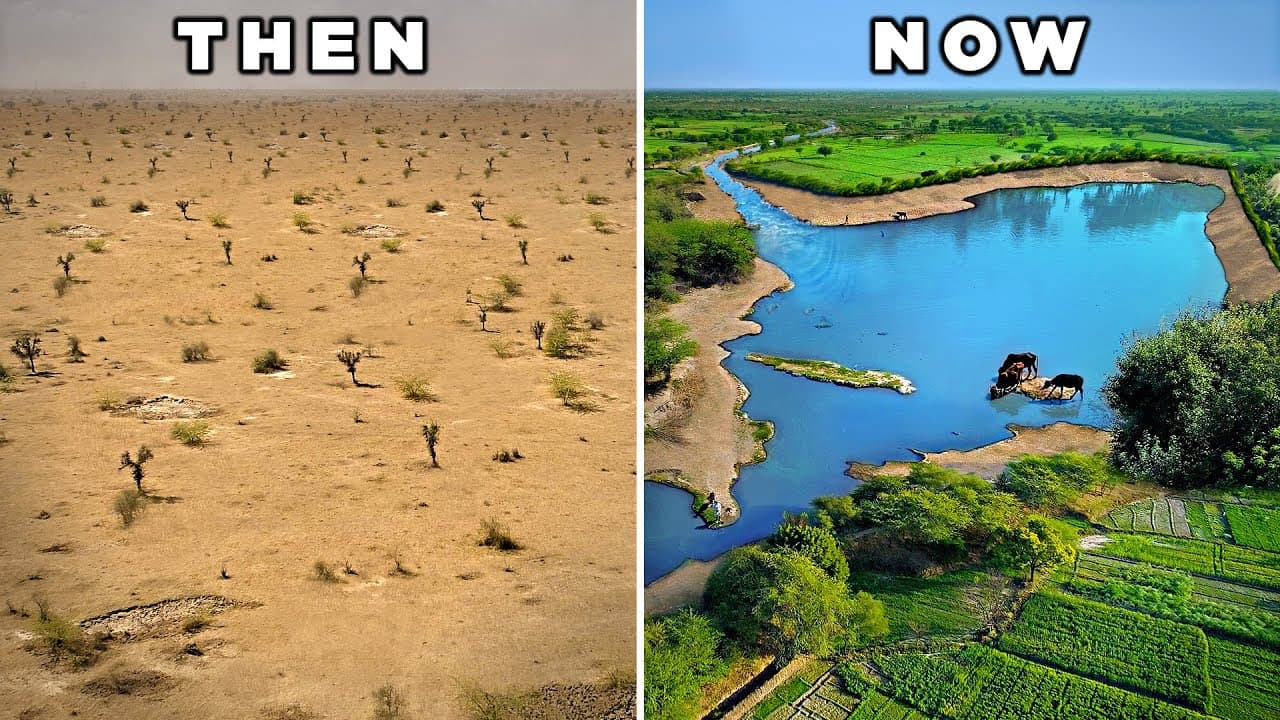
Rajasthan, once an arid land suffering from water scarcity, now thrives due to successful water harvesting techniques and community efforts.
Transcript
this is rajastan this is an arid land where brief Monsoon rains were washing the soil away but now they're harvesting extreme amounts of water throughout an entire region and are thriving their way through the long 9month dry season we have ample amount of groundwater to see us through three consecutive drought years here we get to see the war of a... Read More
Key Insights
- 💦 Rajasthan has transformed from a water-scarce region to thriving through successful water harvesting techniques and community efforts.
- 🚰 The Chala system, designed for flat terrain, maximizes percolation and builds water table storage for irrigation, wildlife, and livestock.
- 💦 Waterman Lakshman Singh and the village of Loria demonstrate the power of collective community efforts in achieving sustainable water management.
- 🤩 Tree planting, watershed restoration, and groundwater recharge are key elements of Rajasthan's successful water harvesting project.
- 🚰 The increased water table has improved agriculture production and productivity, leading to prosperity in the region.
- 🚰 Visible changes in the form of new houses and stable water tables signify the success of Rajasthan's water harvesting efforts.
- 💦 The participatory and community-driven approach to water management has bonded the villagers and contributed to the collective wellbeing.
Install to Summarize YouTube Videos and Get Transcripts
Explore YouTube Video Summarizer or Get YouTube Transcript Extractor
Questions & Answers
Q: How did Lakshman Singh and the village of Loria bring about such a successful water harvesting project?
Lakshman Singh, inspired by the water scarcity in his village, rallied the community and neighboring villages to implement various techniques such as tree planting, water collection, and the Chala system. The project was a result of collective community efforts over 45 years.
Q: How does the Chala system work in flat terrain like Rajasthan?
The Chala system involves excavating a series of pits that fill with stormwater runoff. The water is held back by bunds and completely fills the compartments, allowing it to seep into the ground and recharge the aquifer. Grasses grow abundantly, making the area suitable for grazing animals.
Q: How has the water table improved in Rajasthan due to these water harvesting efforts?
Prior to the interventions, the groundwater level had dropped to a depth of 60 to 70 feet. With recharge and infiltration, the water table has significantly risen, and even open dug wells are almost at overflow levels during the monsoon. The ample groundwater ensures three consecutive drought years can be endured.
Q: How has the abundance of water impacted agriculture and livelihoods in Rajasthan?
The availability of groundwater has allowed for irrigation, increasing agriculture production and productivity. Currently, the village of Loria supports the families and residents with enough agriculture, and the fields are temporarily flooded during the monsoon to feed the crops.
Summary & Key Takeaways
-
Rajasthan, a previously drought-ridden region, now harvests extreme amounts of water and thrives during the 9-month dry season.
-
The village of Loria, led by Waterman Lakshman Singh, developed an abundance of water through tree planting, watershed restoration, and groundwater recharge.
-
The Chala system, a unique flatland design, allows for maximum percolation and builds the water table storage for irrigation, wildlife, and livestock.
Read in Other Languages (beta)
Share This Summary 📚
Summarize YouTube Videos and Get Video Transcripts with 1-Click
Try YouTube Summary with ChatGPT & Claude or YouTube Transcript Generator
Explore More Summaries from Andrew Millison 📚




Summarize YouTube Videos and Get Video Transcripts with 1-Click
Try YouTube Summary with ChatGPT & Claude or YouTube Transcript Generator