Bi-stable Multi-vibrators | Self Bias | Part-3/3 | Pulse Digital Circuits ( PDC ) | Lec-45
TL;DR
Explores self biasing in vegetable multivibrator circuits, emphasizing differences from fixed bias.
Transcript
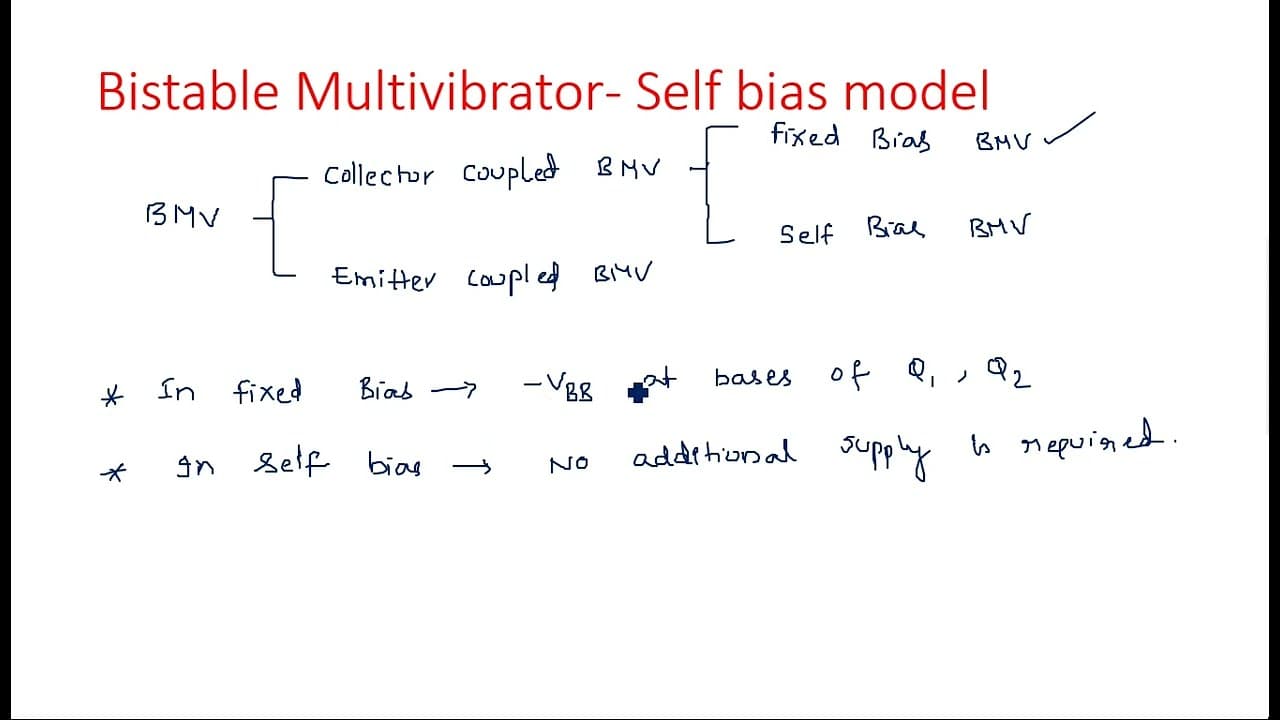
hi everyone in this video I am going to explain about the vegetable multivibrator secondary type which is a self bias Network our self bias model so already we know by stable multivibrator if you if you see the classifications of bistable multivibrator by stable multivibrator there are two types of bi-stable multivibrator one is collector coupled c... Read More
Key Insights
- 🤳 Self biasing in multivibrators simplifies circuit design by negating the need for external voltage supplies.
- 🧑🤝🧑 Bistable multivibrators can be categorized into collector coupled and emitter coupled types, each with distinct configurations.
- 🤩 The emitter resistor plays a key role in self biasing by creating the necessary voltage drop for biasing.
- ⚡ Fixed bias systems require careful voltage management to maintain transistor operation, which can complicate designs.
- 🤳 Understanding the operation of both fixed and self bias configurations is crucial for effective circuit design and troubleshooting.
- 👻 The dynamic nature of the self biasing process allows for automatic adjustment based on the states of the transistors.
- ❓ Proper diagram representation is critical for demonstrating a solid understanding of multivibrator principles in academic settings.
Install to Summarize YouTube Videos and Get Transcripts
Explore YouTube Video Summarizer or Get YouTube Transcript Extractor
Questions & Answers
Q: What are the two main types of bistable multivibrators discussed in the video?
The video highlights two types of bistable multivibrators: collector coupled and emitter coupled. Collector coupled configurations connect the transistor collectors together, while emitter coupled configurations use resistors to set the bias conditions and ensure proper operation between the two transistors in a push-pull arrangement.
Q: What is the primary difference between fixed bias and self bias in multivibrators?
The primary difference lies in the voltage supply requirements. In fixed bias configurations, an additional supply voltage, typically negative, is required to maintain biasing at the transistor bases. In contrast, self bias configurations generate the necessary bias voltage internally, making it more efficient and eliminating the need for an external power source.
Q: How does a resistor impact the self biasing process in a multivibrator?
The resistor at the emitter in self bias configurations plays a crucial role by creating a voltage drop when current flows through it. This voltage drop serves as the bias supply automatically adjusting based on the on/off states of the transistors, thus stabilizing their operation without requiring external voltage inputs.
Q: Why is it important to distinguish between fixed bias and self bias in circuit diagrams?
Properly distinguishing between fixed bias and self bias in circuit diagrams is essential to demonstrate a clear understanding of the circuit's functionality. Misrepresentation can lead examiners to conclude that the student lacks knowledge about the specific configurations and their principles.
Q: What happens to the voltage drop across the emitter resistor as transistor states change?
When one transistor is in the on state while the other is off, the current flowing through the emitter resistor creates a voltage drop that acts as the biasing voltage. This dynamic adjustment of voltage based on transistor states is fundamental to self biasing, ensuring consistent operation across varying conditions.
Q: Can you explain the role of the ground connections in fixed and self bias configurations?
In fixed bias, both transistor emitters connect directly to ground without additional components, allowing for stable reference points. In self bias configurations, emitters connect to ground through a resistor, which influences biasing levels based on current flow, effectively integrating feedback into the circuit.
Q: What is the significance of V_E in the self biasing process?
V_E is the voltage developed across the emitter resistor when current flows through it, which serves as the necessary biasing voltage in self bias multivibrator circuits. This voltage adjusts dynamically according to the states of the transistors, thereby enabling efficient self-biasing functionality without external voltage supplies.
Q: In what scenarios would an engineer prefer to use self bias over fixed bias in circuit design?
Engineers may prefer self bias circuits in scenarios where simplicity and reduced power requirements are needed. Since self biasing eliminates the need for additional voltage supplies, it can lead to more compact designs, lower energy consumption, and increased reliability in various electronic applications.
Summary & Key Takeaways
-
The video explains the concept of self biasing in vegetable multivibrator circuits, distinguishing it from fixed biasing. Self biasing does not require an additional voltage supply, allowing for more efficient circuit operation.
-
It details the configurations of bistable multivibrators, including collector and emitter coupled types, emphasizing the role of resistors in establishing biasing conditions in the self bias network.
-
The differences in circuit diagrams between fixed and self bias multivibrators are highlighted, demonstrating how the biasing voltage is automatically generated through the voltage drop across the emitter resistor.
Read in Other Languages (beta)
Share This Summary 📚
Summarize YouTube Videos and Get Video Transcripts with 1-Click
Try YouTube Summary with ChatGPT & Claude or YouTube Transcript Generator