What Are Binary Trees and How Do They Work?
TL;DR
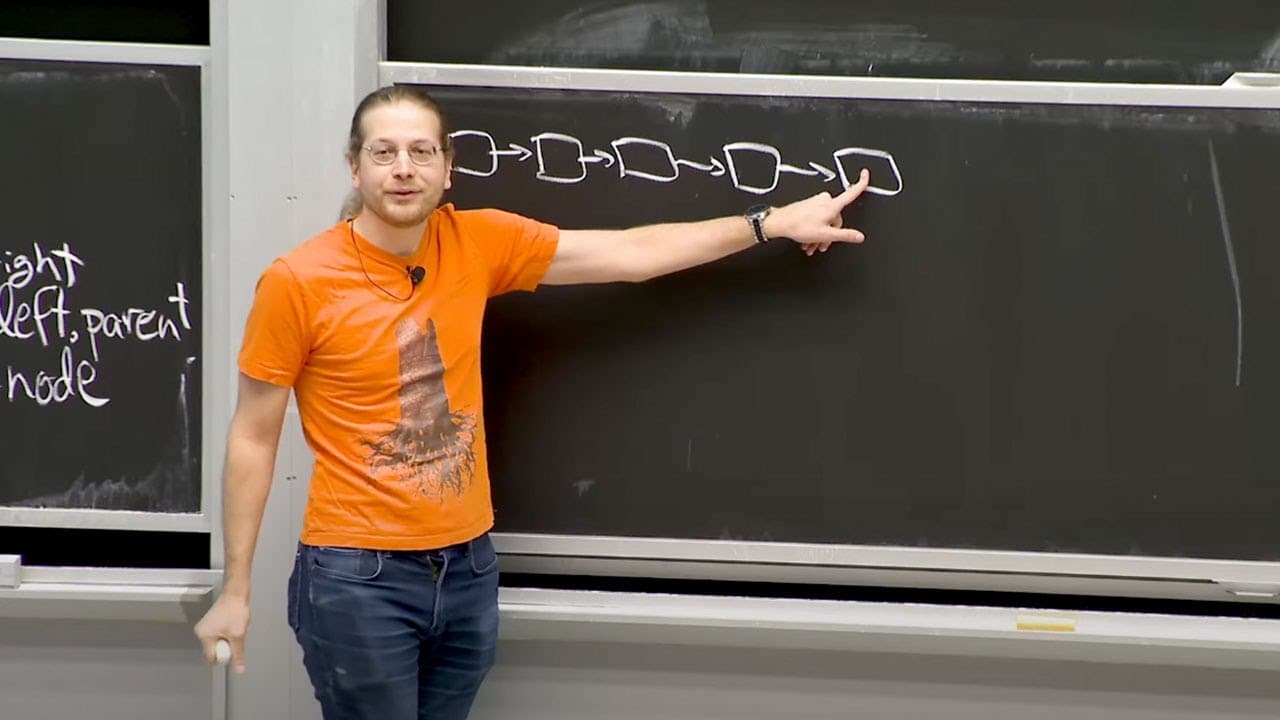
Binary trees are a powerful data structure that enables efficient insertion, deletion, and searching of items. They maintain an ordered traversal, allowing fast access to elements and their neighbors. Understanding how to manipulate nodes within these trees is essential for various applications in computer science.
Transcript
all right let's get started welcome back to double06 today we are doing some of the coolest data structures we will see in this class maybe some of the coolest data structures ever binary trees uh you've certainly seen trees in many forms uh in the past including in this class we've talked to use trees as a lower bound tool for uh in the decision t... Read More
Key Insights
- 🌲 Binary trees provide efficient operations for maintaining items in an ordered manner.
- 🌲 The traversal order of a binary tree is crucial for efficient searching and neighboring queries.
- 👶 Inserting new nodes and deleting existing nodes in a binary tree require rearranging the structure while maintaining the order.
Install to Summarize YouTube Videos and Get Transcripts
Explore YouTube Video Summarizer or Get YouTube Transcript Extractor
Questions & Answers
Q: How are binary trees superior to other data structures for maintaining items in a specified order?
Binary trees allow for efficient insertion, deletion, and searching operations, making them suitable for maintaining items in an ordered manner. They provide a logarithmic time complexity for these operations, whereas other data structures like arrays or linked lists have linear time complexity.
Q: What is the purpose of the traversal order in binary trees?
The traversal order of binary trees is based on the properties of the keys stored in the tree, such as increasing order. It allows for efficient searching operations by finding the appropriate path to locate a specific item or its neighboring items.
Q: How can find previous and find next operations be performed in a binary tree?
To find the previous item of a given key, we can perform a find operation and then find the predecessor of the found node using the successor of the left child of the node. Similarly, to find the next item, we can find the successor of the node.
Q: How are nodes inserted and deleted in a binary tree?
For inserting a node after a given node, we check if the given node has a right child. If it does, we insert the new node as the left child of the right child. Otherwise, we insert the new node as the right child of the given node. For deletion, if the node is a leaf, it can be easily detached from its parent. If it has a left child or right child, we swap it with its predecessor or successor and recursively delete the predecessor or successor.
Summary & Key Takeaways
-
Binary trees are a data structure that allows for efficient insertion, deletion, and searching of items in an ordered manner.
-
The traversal order of a binary tree is based on the properties of the keys stored in the tree, such as increasing order.
-
Operations like find, find previous, and find next can be performed on binary trees to locate specific items or their neighboring items.
-
Inserting a new node in a binary tree involves placing it in the appropriate position based on the traversal order.
-
Deleting a node from a binary tree requires rearranging the tree and swapping nodes while preserving the order.
Read in Other Languages (beta)
Share This Summary 📚
Summarize YouTube Videos and Get Video Transcripts with 1-Click
Try YouTube Summary with ChatGPT & Claude or YouTube Transcript Generator
Explore More Summaries from MIT OpenCourseWare 📚


Summarize YouTube Videos and Get Video Transcripts with 1-Click
Try YouTube Summary with ChatGPT & Claude or YouTube Transcript Generator