Products
Features
YouTube Video Summarizer
Summarize YouTube videos
Web & PDF Highlighter
Highlight web pages & PDFs
Chat with PDF
Ask any PDF questions with AI
Ask AI Clone
Chat with your highlights & memories
Audio Transcriber
Transcribe audio files to text
Glasp Reader
Read and highlight articles
Kindle Highlight Export
Export your Kindle highlights
Idea Hatch
Hatch ideas from your highlights
Integrations
Obsidian Plugin
Notion Integration
Pocket Integration
Instapaper Integration
Medium Integration
Readwise Integration
Snipd Integration
Hypothesis Integration
Apps & Extensions
Chrome Extension
Safari Extension
Edge Add-ons
Firefox Add-ons
iOS App
Android App
Discover
Discover
Ideas
Discover new ideas and insights
Articles
Curated articles and insights
Books
Book recommendations by great minds
Posts
Essays and notes from readers
Quotes
Inspiring quotes collection
Videos
Curated videos and summaries
Explore Glasp
Glasp Newsletter
Weekly insights and updates
Glasp Talk
Interview series with great minds
Glasp Blog
Latest news and articles
Glasp Use Cases
Learn how others use Glasp
Build & Support
Glasp API
Access Glasp's API for developers
MCP Connector
Connect Glasp to Claude & ChatGPT
Community
Glasp Reddit Community
Students
Student discount and benefits
FAQs
Frequently Asked Questions
AboutPricing
DashboardLog inSign up

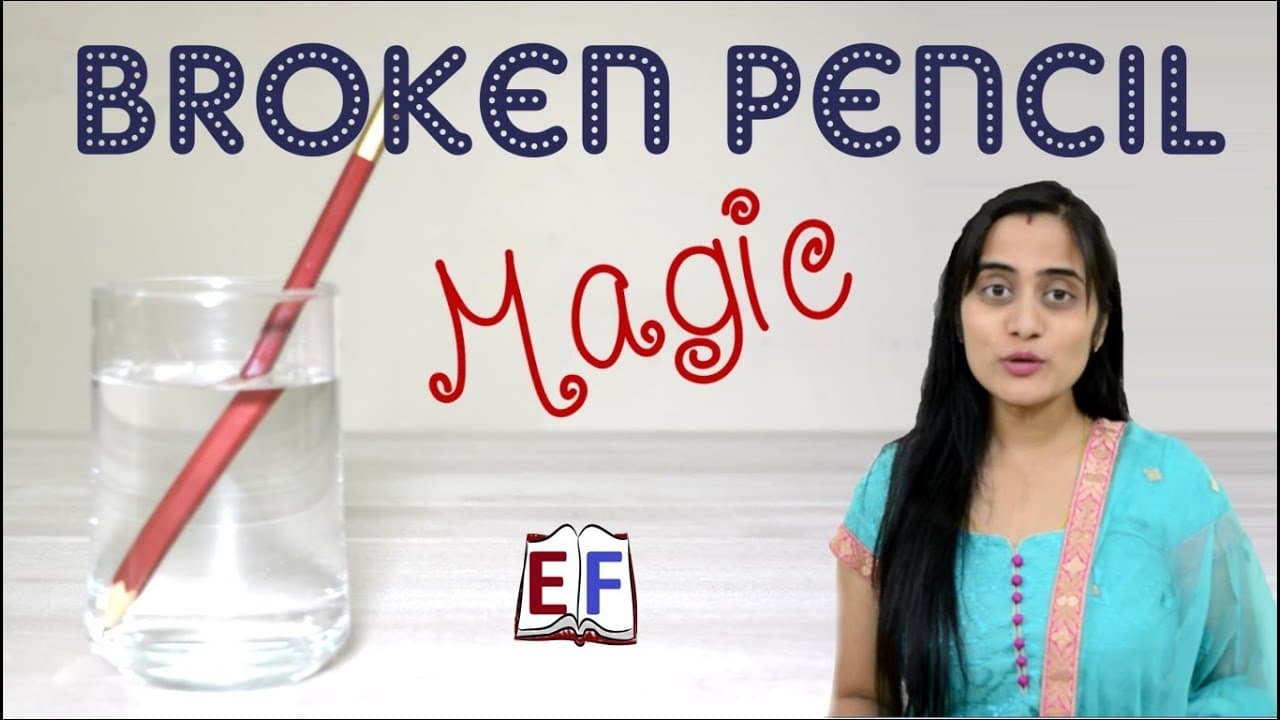
Break a Pencil Magic: School Science Physics Experiment
December 13, 2017
by
LearnoHub - Class 11, 12
YouTube video player
Break a Pencil Magic: School Science Physics Experiment

TL;DR

When a pencil is dipped into water, it appears broken due to the bending of light as it travels from water to air.

Transcript

we can make a pencil look broken even without breaking it interesting right all you need to do is dip a pencil into a glass of water and you see a broken pencil let us try to understand the science behind this broken pencil the science behind this broken pencil is based on one simple fact whenever light encounters a change in medium it bends so her... Read More

Key Insights

  • 🙂 Light bends when it encounters a change in medium, which is why the pencil appears broken when submerged in water.
  • 🙂 The brain interprets the rays of light as coming straight, leading to the perception of a bent pencil.
  • 🙂 The thickness of the submerged part of the pencil appears to increase due to the convergence of light rays.
  • 🙂 Refractive indices play a role in determining the degree of bending in the light rays.

Install to Summarize YouTube Videos and Get Transcripts

Explore YouTube Video Summarizer or Get YouTube Transcript Extractor

Questions & Answers

Q: Why does a pencil dipped in water appear broken?

The light from the submerged part of the pencil bends as it leaves the water and enters the air, creating the illusion of a broken pencil.

Q: How does the brain interpret the bent appearance of the pencil?

Our brain assumes that the rays of light reaching our eyes must be coming straight, so it interprets the bent rays as indicating that the pencil is actually bent.

Q: Why does the submerged part of the pencil appear thicker in water?

The rays of light from the submerged part converge as they leave the water, creating the illusion of an increased thickness.

Q: What determines the degree of bending in the light rays?

The degree of bending depends on the refractive indices of the two mediums, with light bending away from the normal as it goes from a denser medium (water) to a less dense medium (air).

Summary & Key Takeaways

  • When light encounters a change in medium, such as from water to air, it bends.

  • For the parts of the pencil above water, the light travels straight and reaches our eyes without bending.

  • For the parts of the pencil below water, the light bends as it travels from water to air, creating the illusion of a broken pencil.


Read in Other Languages (beta)

English

Share This Summary 📚

Summarize YouTube Videos and Get Video Transcripts with 1-Click

Download browser extensions on:

Try YouTube Summary with ChatGPT & Claude or YouTube Transcript Generator

Explore More Summaries from LearnoHub - Class 11, 12 📚

Biology Getting to Know Plants Part 3 (Creepers, Climbers, Plant parts) Class 6 VI thumbnail
Biology Getting to Know Plants Part 3 (Creepers, Climbers, Plant parts) Class 6 VI
LearnoHub - Class 11, 12
Maths Mensuration part 2 (Perimeter of Rectangle and Square) CBSE Class 6 Mathematics VI thumbnail
Maths Mensuration part 2 (Perimeter of Rectangle and Square) CBSE Class 6 Mathematics VI
LearnoHub - Class 11, 12
NEET Biology Ecology : Multiple Choice Previous Years Questions MCQs 2 thumbnail
NEET Biology Ecology : Multiple Choice Previous Years Questions MCQs 2
LearnoHub - Class 11, 12
Maths Fraction part 12 (Numericals) CBSE Class 6 Mathematics VI thumbnail
Maths Fraction part 12 (Numericals) CBSE Class 6 Mathematics VI
LearnoHub - Class 11, 12
Biology Ecosystem part 5 (Components : Decomposers) class 12 XII thumbnail
Biology Ecosystem part 5 (Components : Decomposers) class 12 XII
LearnoHub - Class 11, 12

Summarize YouTube Videos and Get Video Transcripts with 1-Click

Download browser extensions on:

Try YouTube Summary with ChatGPT & Claude or YouTube Transcript Generator

Apps & Extensions

  • Chrome Extension
  • Safari Extension
  • Edge Add-ons
  • Firefox Add-ons
  • iOS App
  • Android App

Key Features

  • YouTube Video Summarizer
  • Web & PDF Summarizer
  • Web & PDF Highlighter
  • Chat with PDF
  • Ask AI Clone
  • Audio Transcriber
  • Glasp Reader
  • Kindle Highlight Export
  • Idea Hatch

Integrations

  • Obsidian Plugin
  • Notion Integration
  • Pocket Integration
  • Instapaper Integration
  • Medium Integration
  • Readwise Integration
  • Snipd Integration
  • Hypothesis Integration

More Features

  • APIs
  • MCP Connector
  • Blog & Post
  • Embed Links
  • Image Highlight
  • Personality Test
  • Quote Shots

Company

  • About us
  • Blog
  • Community
  • FAQs
  • Job Board
  • Newsletter
  • Pricing
Terms

•

Privacy

•

Guidelines

© 2026 Glasp Inc. All rights reserved.