23. New Directions in Crypto
TL;DR
Future developments in Bitcoin include the use of block filters for SPV filtering, sharding to improve scalability, accumulators for cryptographic sets, and UTXO commitments to simplify synchronization.
Transcript
The following content is provided under a Creative Commons license. Your support will help MIT OpenCourseWare continue to offer high quality educational resources for free. To make a donation or to view additional materials from hundreds of MIT courses, visit MIT OpenCourseWare at ocw.mit.edu. TADGE DRYJA: So today will be some sort of future techn... Read More
Key Insights
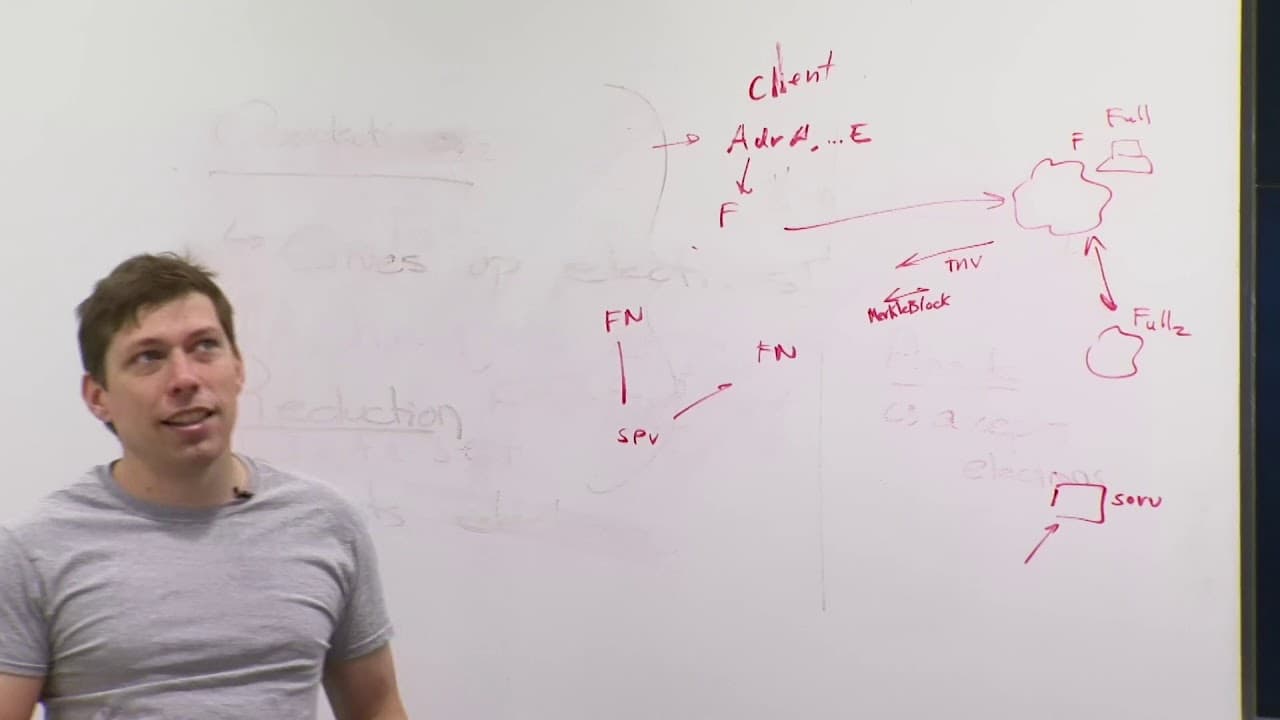
- 👻 Block filters are commonly used in Bitcoin for SPV filtering to allow clients to download only the necessary transactions, reducing their storage and bandwidth requirements.
- 🛟 Sharding is being explored as a potential solution to improve scalability in blockchain networks by distributing data across multiple servers or shards.
- 😫 Accumulators have the potential to reduce the storage requirements for UTXO sets in Bitcoin and can be used to prove inclusion or non-inclusion of a transaction or UTXO.
Install to Summarize YouTube Videos and Get Transcripts
Explore YouTube Video Summarizer or Get YouTube Transcript Extractor
Questions & Answers
Q: What are block filters used for in Bitcoin?
Block filters, such as Bloom filters, are used in Bitcoin for Simplified Payment Verification (SPV) filtering to allow clients to download and verify only the necessary transactions for their UTXOs.
Q: How does sharding work in blockchain networks?
Sharding involves distributing the data in a blockchain network across multiple servers or shards to improve scalability. Each server holds a portion of the data set, reducing the storage requirements for each individual server.
Q: What are accumulators and how can they be used in Bitcoin?
Accumulators are cryptographic sets that support operations like adding and removing objects, as well as proving inclusion or non-inclusion of an object. In Bitcoin, accumulators can potentially reduce the storage requirements for UTXO sets.
Q: What are UTXO commitments and how do they simplify synchronization?
UTXO commitments involve hashing the UTXO set and including the hash in the block header. By providing the UTXO set hash, new nodes can synchronize faster by downloading a snapshot of the UTXO set at a specific block height, simplifying their initial synchronization process.
Summary & Key Takeaways
-
Block filters, such as Bloom filters, are currently used in Bitcoin for Simplified Payment Verification (SPV) filtering, allowing clients to download and verify only the necessary transactions for their UTXOs.
-
Sharding, a technique also being explored in Ethereum, aims to scale blockchain networks by distributing the data across multiple servers or shards, reducing the storage requirements for each server.
-
Accumulators are cryptographic sets that support operations like add, remove, prove inclusion, and prove non-inclusion. They have potential applications in reducing the storage requirements for UTXO sets in Bitcoin.
-
UTXO commitments involve hashing the UTXO set and including the hash in the block header, allowing for efficient synchronization and simplified validation by new nodes.
Read in Other Languages (beta)
Share This Summary 📚
Summarize YouTube Videos and Get Video Transcripts with 1-Click
Try YouTube Summary with ChatGPT & Claude or YouTube Transcript Generator
Explore More Summaries from MIT OpenCourseWare 📚



Summarize YouTube Videos and Get Video Transcripts with 1-Click
Try YouTube Summary with ChatGPT & Claude or YouTube Transcript Generator