Anton Teaches Packy AI | E1
TL;DR
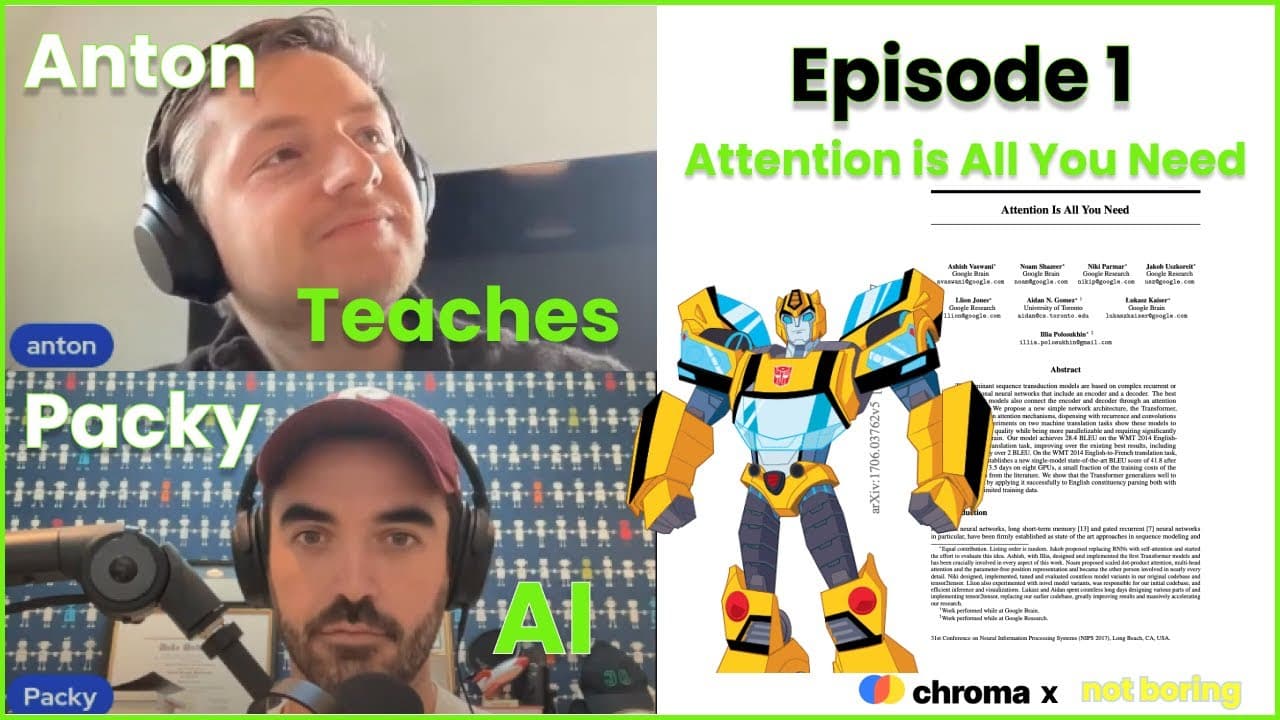
This video discusses the foundational paper "Attention is All You Need" and explains the transformer architecture, which revolutionized text modeling with its parallel processing and attention mechanism.
Transcript
welcome to Anton teaches Packy AI this is an experiment that we're running I guess it was two weeks ago at this point I tweeted some meme of Tim Cook looking at a chip when he was on a tour of one of Apple's offices or factories or something saying that this is me when I try to read an AI research paper Anton replied saying that he'd be happy to do... Read More
Key Insights
- 🤝 Anton is the co-founder of a company called chroma, specializing in machine learning tooling. He has a background in computer science, applied mathematics, and robotics, with a focus on perception and machine learning. He stays updated on research and models in the field.
- 💡 The "Attention is All You Need" paper, published in 2017, brought a significant shift in text modeling by introducing the Transformer architecture. It replaced recurrent networks with attention mechanisms, enabling parallel processing and better model understanding of relationships.
- 🌍 Prior to the Transformer architecture, text modeling mostly relied on recurrent networks, limiting the computation to sequential processing. The Transformer's parallel-processing capability allows for the ingestion of a wider context and facilitates better learning of relationships.
- 💻 Transformers are a type of neural network architecture that excels in working with text sequences. They have been widely adopted in large language models like GPT-3. Transformers can also be applied to other domains like image generation by tokenizing images and using the same architecture.
- 📚 The "Attention is All You Need" paper focused on English to German translation tasks to showcase the power and improvement of the Transformer architecture. Translation tasks have long been a challenging problem, and the success of the Transformer demonstrated its effectiveness.
- 🔁 The Transformer architecture follows an encoder-decoder structure. The encoder processes the input sequence, converting it into numerical representations using input embeddings and positional encoding. The encoder layers consist of multi-head attention and feed-forward layers. The decoder uses auto-regressive methods for sequential prediction and leverages the encoder's output for relevant context.
- ➕ The Transformer architecture leverages attention mechanisms to weight the importance of different input tokens during predictions. It stacks encoder and decoder layers, each containing multiple attention heads and feed-forward layers, to capture contextual information and improve learning.
- 🔒 The mask in the decoder ensures that the model doesn't pay attention to tokens that haven't been predicted yet, preventing it from considering "future" information. The output layer generates a distribution of probabilities for the next token, and the highest probability is selected.
- 🚧 While the core architecture of Transformers has remained relatively unchanged, ongoing research focuses on improving efficiency, model interpretability, and training methods. Transformers have proven their potential but may need further architectural innovations in the future.
- 🔃 Inference from large language models like GPT-3 can be influenced by various factors, including training processes, data, and fine-tuning. The noise parameter allows for probabilistic predictions rather than strictly adhering to the most likely output. Fine-tuning and specific prompts can also shape the model's outputs.
Install to Summarize YouTube Videos and Get Transcripts
Explore YouTube Video Summarizer or Get YouTube Transcript Extractor
Questions & Answers
Q: How does the transformer architecture improve upon the traditional recurrent network models?
The transformer architecture improves traditional recurrent network models by enabling parallel processing, reducing the distance between input tokens and model predictions, and improving the model's ability to learn complex relationships in the input sequence.
Q: What is the purpose of positional encoding in the transformer architecture?
Positional encoding in the transformer architecture helps the model understand the order and context of words in the input sequence, ensuring it can effectively predict the next token and maintain coherence in the generated text.
Q: Can the transformer architecture be applied to domains other than text modeling?
Yes, the transformer architecture can be extended to other domains. For example, there are image transformers that tokenize images and use the transformer architecture to perform image-related tasks. The flexibility of the architecture allows for its adaptation to different data types.
Q: How does the transformer model handle the prediction of the next token?
The transformer model predicts the next token in an autoregressive manner, meaning it uses the previously predicted tokens as input to predict the next token. It generates a probability distribution over the vocabulary and selects the most likely token as the output. The process continues until the desired output sequence is generated.
Summary & Key Takeaways
-
The video explores the significance of the "Attention is All You Need" paper and its impact on the field of natural language processing.
-
The transformer architecture introduced in the paper replaced traditional recurrent networks and allowed for parallel processing and better contextual understanding.
-
The video walks through the different components of the transformer architecture, including input embedding, positional encoding, multi-head attention, and feed-forward layers.
Read in Other Languages (beta)
Share This Summary 📚
Summarize YouTube Videos and Get Video Transcripts with 1-Click
Try YouTube Summary with ChatGPT & Claude or YouTube Transcript Generator
Explore More Summaries from Age of Miracles by Packy McCormick 📚


Summarize YouTube Videos and Get Video Transcripts with 1-Click
Try YouTube Summary with ChatGPT & Claude or YouTube Transcript Generator