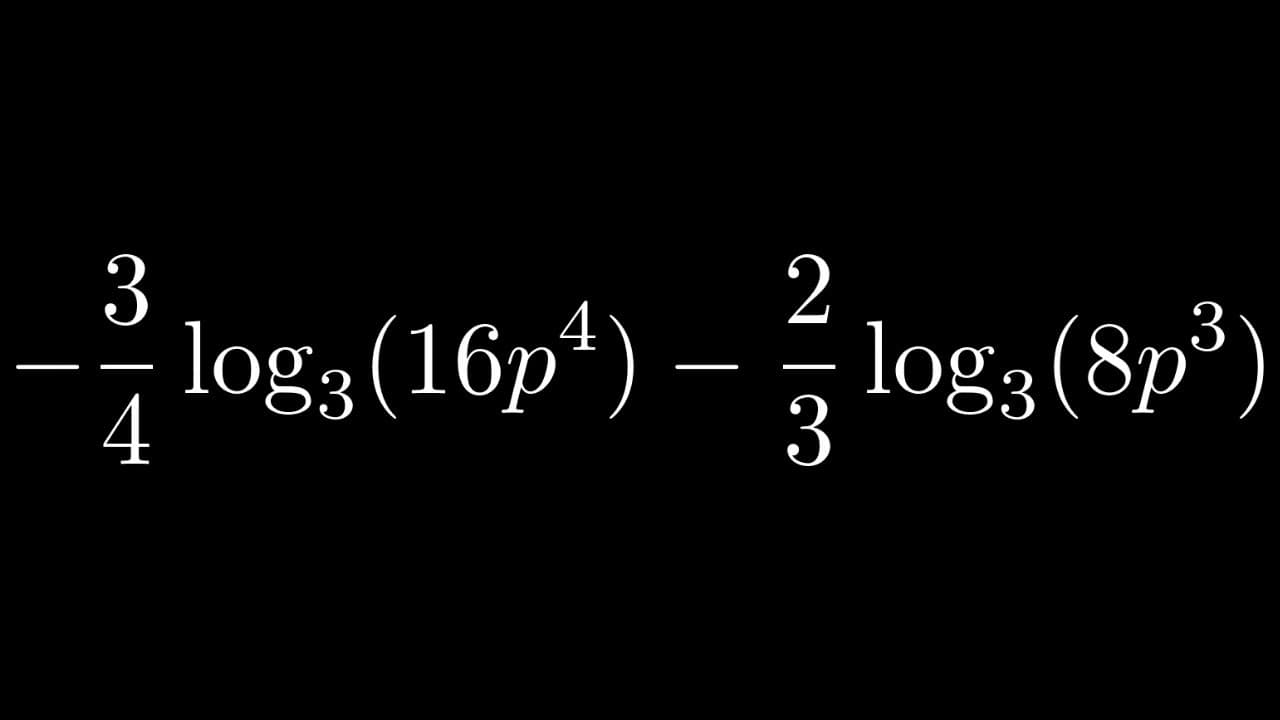
How to Write as a Single Log whose Coefficient is 1 using the Laws of Logarithms
TL;DR
Learn how to simplify logarithmic expressions using the quotient rule, with step-by-step examples.
Transcript
in this problem we have two logarithms and they look quite messy and we have to write the answer as a single logarithm so we have to use properties of logs to write this as one log and we want to make sure the number in front of that one log is a one so the coefficient is one so the main rule that we're going to be aiming to use in this problem is ... Read More
Key Insights
- ✊ Coefficients in front of logarithmic terms can be simplified by applying the power rule to make them exponents.
- 😑 The quotient rule allows the subtraction of logarithmic expressions to be written as a division inside a single logarithm.
- 😑 Implied parentheses in logarithmic expressions help to maintain clarity and ensure proper calculation order.
- 😑 Understanding the properties and rules of logarithms is essential for simplifying complex expressions.
- 🤘 Paying attention to negative signs is crucial to avoid mistakes in logarithmic simplification.
- 😑 Logarithmic simplification problems may require knowledge beyond basic algebra, such as pre-calculus level concepts.
- ❓ Step-by-step calculations are necessary to reach the correct answer in logarithmic simplification.
Install to Summarize YouTube Videos and Get Transcripts
Explore YouTube Video Summarizer or Get YouTube Transcript Extractor
Questions & Answers
Q: What is the first step in simplifying a logarithmic expression using the quotient rule?
The first step is to remove the coefficients in front of the logs by applying the power rule for logarithms. This involves making the coefficients the exponents of the respective bases.
Q: How does the quotient rule in logarithms work?
The quotient rule states that the subtraction of logarithmic expressions can be simplified as the logarithm of the division of the corresponding values. For example, log base b of x - log base b of y is equivalent to log base b of (x/y).
Q: What is the purpose of implied parentheses in logarithmic expressions?
Implied parentheses help clarify the order of operations and ensure the correct application of logarithmic rules. They are necessary when performing calculations involving multiple logarithmic terms.
Q: How does the power rule for logarithms work?
The power rule states that if a coefficient exists in front of a logarithm, it can be written as the exponent of the term inside the logarithm. For example, log base b of a^n is equivalent to n times log base b of a.
Summary & Key Takeaways
-
The problem involves simplifying a logarithmic expression with messy and multiple logarithms by using the quotient rule.
-
The strategy is to remove the coefficients in front of the logs and apply the power rule for logarithms to simplify the expression.
-
After simplifying the inside pieces, the expression is further simplified using the quotient rule to obtain the final answer.
Read in Other Languages (beta)
Share This Summary 📚
Summarize YouTube Videos and Get Video Transcripts with 1-Click
Try YouTube Summary with ChatGPT & Claude or YouTube Transcript Generator
Explore More Summaries from The Math Sorcerer 📚


Summarize YouTube Videos and Get Video Transcripts with 1-Click
Try YouTube Summary with ChatGPT & Claude or YouTube Transcript Generator