Locking Protocol
TL;DR
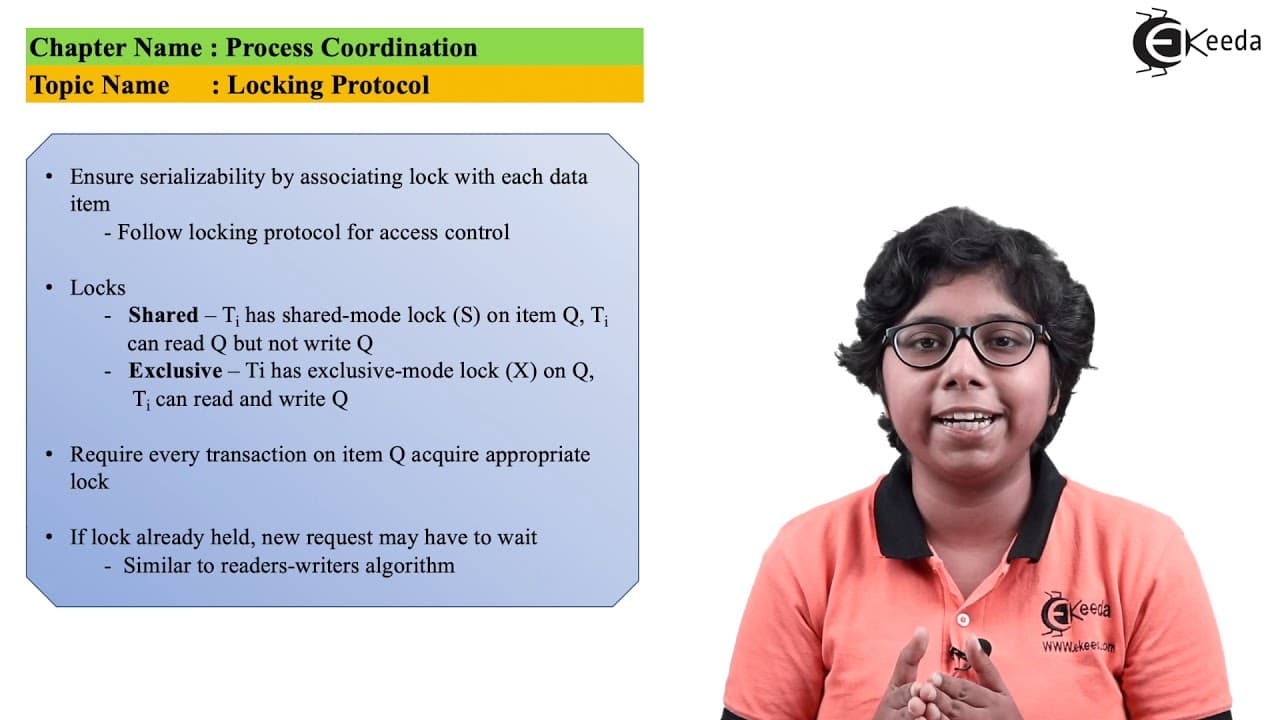
This video discusses the locking protocol for ensuring serializability in atomic transactions, including the types of locks and their modes.
Transcript
click the bell icon to get latest videos from akira hello friends today we are going to discuss about a mechanism called locking critical which can thus ensure serializability in the atomic transactions how to implement that protocol and what are the types of modes of locks that can be provided by that protocol one way to ensure serializability of ... Read More
Key Insights
- ⏰ Locking protocol ensures serializability in atomic transactions by governing lock acquisition and release.
- ⏰ Two types of locks, shared and exclusive locks, provide different levels of access to data items.
- ⏰ The locking protocol follows two phases: growing phase (acquiring locks) and shrinking phase (releasing locks).
Install to Summarize YouTube Videos and Get Transcripts
Explore YouTube Video Summarizer or Get YouTube Transcript Extractor
Questions & Answers
Q: What is the purpose of a locking protocol in atomic transactions?
The locking protocol ensures serializability in atomic transactions by governing how locks are acquired and released for data items, preventing conflicts.
Q: What are the two types of locks in the locking protocol?
The two types of locks are shared and exclusive locks. Shared locks allow read access to a data item, while exclusive locks allow both read and write access.
Q: Can a transaction acquire a lock on a data item if it is already locked?
If a data item is already locked, a transaction may have to wait depending on the lock mode. If it has a shared lock, it may have to wait for an exclusive lock, and vice versa.
Q: How does the locking protocol ensure serializability?
The locking protocol follows two phases: the growing phase, where locks are acquired, and the shrinking phase, where locks are released. This ensures proper ordering of transactions and prevents conflicts.
Summary & Key Takeaways
-
Locking protocol is a mechanism used to ensure serializability in atomic transactions.
-
Two types of locks are shared and exclusive locks, allowing different levels of access to data items.
-
The locking protocol follows two phases, the growing phase where locks are acquired, and the shrinking phase where locks are released.
Read in Other Languages (beta)
Share This Summary 📚
Summarize YouTube Videos and Get Video Transcripts with 1-Click
Try YouTube Summary with ChatGPT & Claude or YouTube Transcript Generator
Explore More Summaries from Ekeeda 📚



Summarize YouTube Videos and Get Video Transcripts with 1-Click
Try YouTube Summary with ChatGPT & Claude or YouTube Transcript Generator