The equation that explains life | Lee Cronin and Lex Fridman
TL;DR
Assembly Theory explains and quantifies selection and evolution, allowing for the measurement of complexity and abundance of molecules in different environments.
Transcript
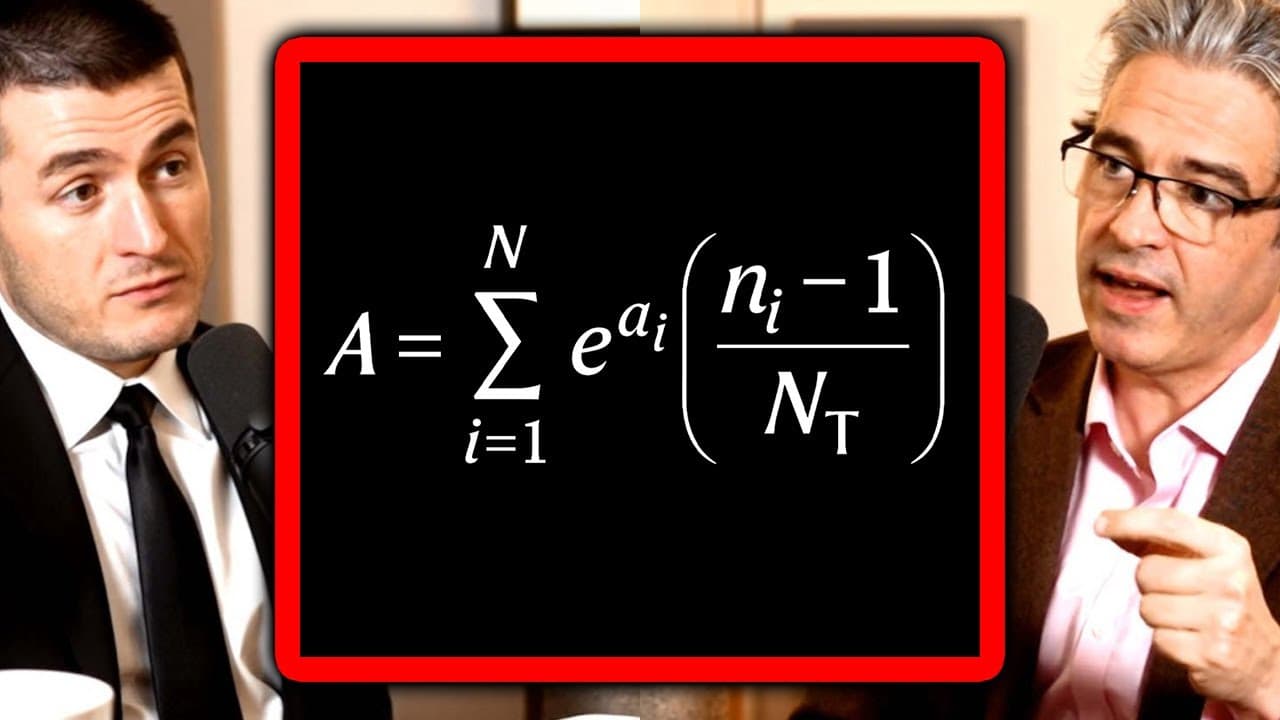
let's talk about the assembly equation okay how should we do this all let me just even read that part of the paper we Define assembly as the total amount of selection necessary to produce an ensemble of observed objects Quantified using equation one the equation basically has a on one side which is the Assembly of The Ensemble MH and then a sum fro... Read More
Key Insights
- ❓ Assembly Theory quantifies the process of selection and evolution in the emergence of complexity.
- 🛟 The theory acknowledges the potential disconnect between physics and biology in explaining the origin of life.
- 🕵️ Mass spectrometry and the assembly equation can be used to detect complexity and abundance of molecules, helping to identify life on other planets.
- 👾 Assembly Theory challenges traditional methods of understanding the tree of life, offering an alternative approach through fingerprinting and assembly space analysis.
Install to Summarize YouTube Videos and Get Transcripts
Explore YouTube Video Summarizer or Get YouTube Transcript Extractor
Questions & Answers
Q: What is the definition of selection in Assembly Theory?
In Assembly Theory, selection refers to the ability of an object to persist in an environment, surviving while weaker or less robust objects are destroyed. Selection occurs when objects can form and persist over time in the face of environmental challenges.
Q: How is the concept of a factory related to the theory of assembly?
The "factory" in Assembly Theory refers to the environment where selection takes place. It is where objects are continually created and produced, leading to the emergence of complexity. The factory is not autonomous or redundant, but it plays a crucial role in the overall assembly process.
Q: How can Assembly Theory be used to discover alien life on other planets?
Using mass spectrometry and the assembly equation, scientists can measure the complexity and abundance of molecules on other planets. By looking for high assembly index molecules with a copy number of two or greater, they can identify artifacts that can only be produced by life.
Q: How can the assembly index and copy number be used to distinguish between random complexity and advanced selection?
The copy number represents the number of identical copies of a molecule, indicating the presence of structure and selection. Objects with high copy numbers and assembly indices are considered more complex and show evidence of advanced selection, distinguishing them from random complexity.
Summary & Key Takeaways
-
Assembly Theory defines assembly as the total amount of selection required to produce observed objects.
-
The assembly equation quantifies the assembly index and copy number, which are important factors in determining the complexity of objects.
-
The paper discusses the reaction of different scientific disciplines to the theory, including evolutionary biologists, computational complexity scientists, physicists, prebiotic chemists, and creationists.
Read in Other Languages (beta)
Share This Summary 📚
Summarize YouTube Videos and Get Video Transcripts with 1-Click
Try YouTube Summary with ChatGPT & Claude or YouTube Transcript Generator
Explore More Summaries from Lex Clips 📚



Summarize YouTube Videos and Get Video Transcripts with 1-Click
Try YouTube Summary with ChatGPT & Claude or YouTube Transcript Generator