What Is the Role of Angular Momentum in Spectroscopy?
TL;DR
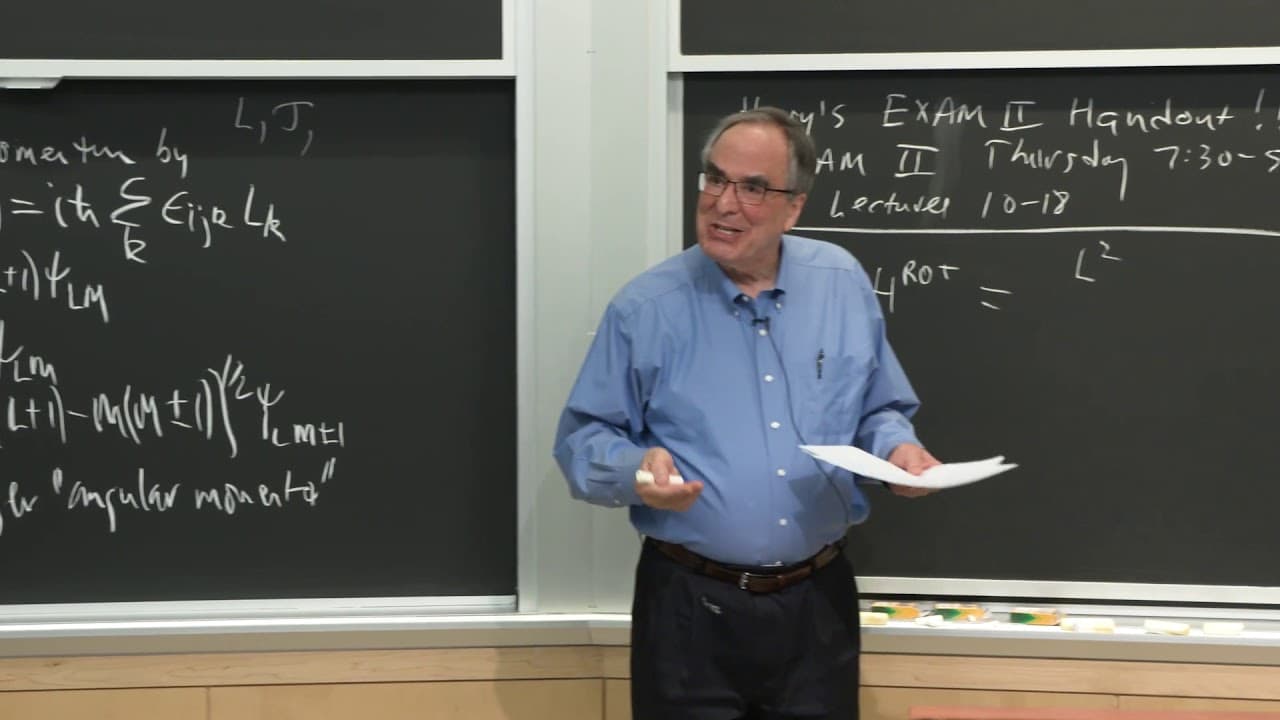
Angular momentum plays a crucial role in spectroscopy by enabling the calculation of energy levels and the prediction of selection rules in quantum mechanics. The rotational spectrum of diatomic molecules reveals evenly spaced energy levels, which can be analyzed to infer molecular structure. Additionally, the presence of isotopes and vibrational states introduces variations in the spectrum, offering insights into molecular dynamics.
Transcript
The following content is provided under a Creative Commons license. Your support will help MIT OpenCourseWare continue to offer high-quality educational resources for free. To make a donation or to view additional materials from hundreds of MIT courses, visit MIT OpenCourseWare at ocw.mit.edu. ROBERT FIELD: Now the main topic of this lecture is so ... Read More
Key Insights
- 📐 The abstract concept of angular momentum in quantum mechanics allows for the calculation of energy levels, prediction of selection rules, and determination of matrix elements without direct reference to wave functions or differential operators.
- 👾 The rotational spectrum of a diatomic molecule is determined by the energy levels given by the rotational Hamiltonian, which are evenly spaced and can be used to determine molecular structure.
- 📳 Isotopes and vibrations can introduce additional features in the rotational spectrum, providing information about isotope ratios and molecular vibrations.
- 📐 The abstract concept of angular momentum encompasses both integer and half-integer values, allowing for the existence of different types of angular momenta.
Install to Summarize YouTube Videos and Get Transcripts
Explore YouTube Video Summarizer or Get YouTube Transcript Extractor
Questions & Answers
Q: What is the significance of the abstract concept of angular momentum in quantum mechanics?
The abstract concept of angular momentum allows for the calculation of energy levels and prediction of selection rules without directly looking at wave functions or differential operators. It simplifies the process of calculating matrix elements and holds great importance in central force problems and spectroscopy.
Q: How is the rotational spectrum of a diatomic molecule determined?
The rotational spectrum of a diatomic molecule is determined by the energy levels given by the rotational Hamiltonian. These energy levels are evenly spaced, and the lines in the spectrum are determined by the transitions between these levels.
Q: What are the effects of isotopes and vibrations on the rotational spectrum?
Isotopes can cause small splittings in the spectrum, while vibrations can lead to vibrational satellites in the spectrum. These additional features provide information about isotope ratios and molecular vibrations, respectively.
Q: How does the abstract concept of angular momentum enable the calculation of matrix elements in quantum mechanics?
By defining operators that obey commutation rules related to angular momentum, such as Lx, Ly, and Lz, various matrix elements can be derived and calculated. These operators can be used to describe the angular part of every operator without directly looking at wave functions or differential operators.
Summary & Key Takeaways
-
The lecture emphasizes the importance and beauty of the abstract concept of angular momentum, showcasing its applications in calculating energy levels and predicting selection rules in central force problems and spectroscopy.
-
The lecture focuses on rotational spectra of diatomic molecules, explaining how the energy levels are given by the rotational Hamiltonian and how the spectrum appears as evenly spaced lines.
-
The lecture also briefly mentions the effects of isotopes and vibrations on the rotational spectrum and their significance in determining molecular structure and vibrational levels.
Read in Other Languages (beta)
Share This Summary 📚
Summarize YouTube Videos and Get Video Transcripts with 1-Click
Try YouTube Summary with ChatGPT & Claude or YouTube Transcript Generator
Explore More Summaries from MIT OpenCourseWare 📚


Summarize YouTube Videos and Get Video Transcripts with 1-Click
Try YouTube Summary with ChatGPT & Claude or YouTube Transcript Generator