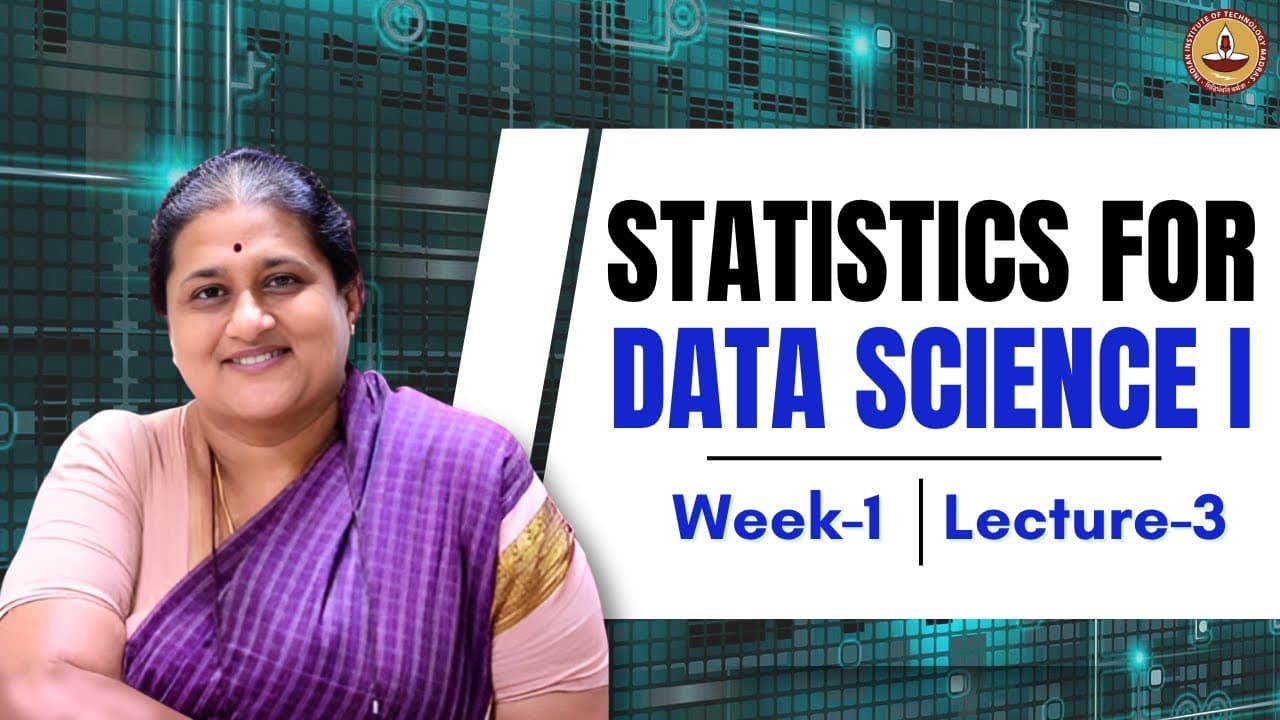
Lecture 1.3 - Introduction and Types of Data - Classification of data
TL;DR
This video provides an introduction to categorizing and classifying data into categorical and numerical variables, highlighting the importance of understanding the data type for effective analysis.
Transcript
आणि जेव्हा मी म्हणतो की ते एक डेटा टेबल दर्शवितात. आता, एकदा आपण याकडे परत गेल्यावर, तुम्ही पाहू शकता की पुन्हा डेटासेटकडे पाहता, तुम्ही पाहू शकता की जेव्हा मी नावे पाहतो तेव्हा ती फक्त अंजली, प्रदीप, वर्षा, दिव्या आहेत, माझे लिंग आहे. जेव्हा मी लिंग पाहतो तेव्हा माझ्याकडे दोन श्रेणी आहेत: महिला आणि पुरुष. जेव्हा माझ्याकडे गुण असतील तेव्हा तुम्ही त... Read More
Key Insights
- 📍 The content discusses the concept of categorizing data into two types: categorical data and numerical data.
- 🔑 One key insight is that numerical data can be further divided into subcategories, such as blood types or weight.
- 💡 Another insight is that categorical data can represent characteristics like gender, where only two categories, male and female, are mentioned.
- 🧩 Data can be classified into these categories to help with analysis and representation of information.
- 🔢 The data sets mentioned have specific numbers associated with them, such as 75, 57.5, 65, and 98, which fall under the category of numerical data.
- 🎯 Categorization allows for easier organization and analysis of data, making it easier to draw meaningful conclusions and insights.
- 💭 It's important to distinguish between categorical and numerical data, as they require different methods of classification and analysis.
- 📚 The content also highlights the importance of understanding the nature of the data before applying appropriate analytical techniques.
Install to Summarize YouTube Videos and Get Transcripts
Explore YouTube Video Summarizer or Get YouTube Transcript Extractor
Questions & Answers
Q: What is the difference between categorical and numerical data?
Categorical data represents qualities or characteristics and is divided into categories, while numerical data represents quantities or measurements and involves numerical values.
Q: How can categorical data be classified into different categories?
Categorical data can be classified by grouping similar data points into different categories based on their shared characteristics.
Q: What are some examples of categorical data?
Examples of categorical data include gender (male or female), colors (red, blue, green), and job titles (teacher, doctor, engineer).
Q: How can numerical data be analyzed?
Numerical data can be analyzed using mathematical operations such as calculating averages, performing statistical analysis, and creating visual representations like charts and graphs.
Q: Why is it important to understand the type of data before analysis?
Understanding the type of data is important as it determines the appropriate analysis techniques to be used. Categorical data requires different methods than numerical data, and using the wrong techniques can lead to inaccurate results.
Q: How can data classification help in data analysis?
Data classification helps in organizing and structuring data, making it easier to analyze and draw meaningful insights. It allows for efficient data management and targeted analysis based on specific categories.
Q: What are some examples of numerical data?
Examples of numerical data include age (25 years), temperature (30 degrees Celsius), and weight (70 kilograms).
Q: Can data be classified into both categorical and numerical variables?
No, data can only be classified into either categorical or numerical variables based on its nature. Categorical data represents qualities, while numerical data represents quantities.
Summary & Key Takeaways
-
Data can be classified as categorical or numerical, with categorical data representing qualities or characteristics and numerical data representing quantities or measurements.
-
Categorical data can be further grouped into different categories, and numerical data can be analyzed using mathematical operations.
-
Understanding the type of data is crucial for appropriate data analysis and classification, as it determines the methods and techniques used for analysis.
Read in Other Languages (beta)
Share This Summary 📚
Summarize YouTube Videos and Get Video Transcripts with 1-Click
Try YouTube Summary with ChatGPT & Claude or YouTube Transcript Generator
Explore More Summaries from IIT Madras - B.S. Degree Programme 📚




Summarize YouTube Videos and Get Video Transcripts with 1-Click
Try YouTube Summary with ChatGPT & Claude or YouTube Transcript Generator