What Are the Key Differences Between VHDL and Verilog?
TL;DR
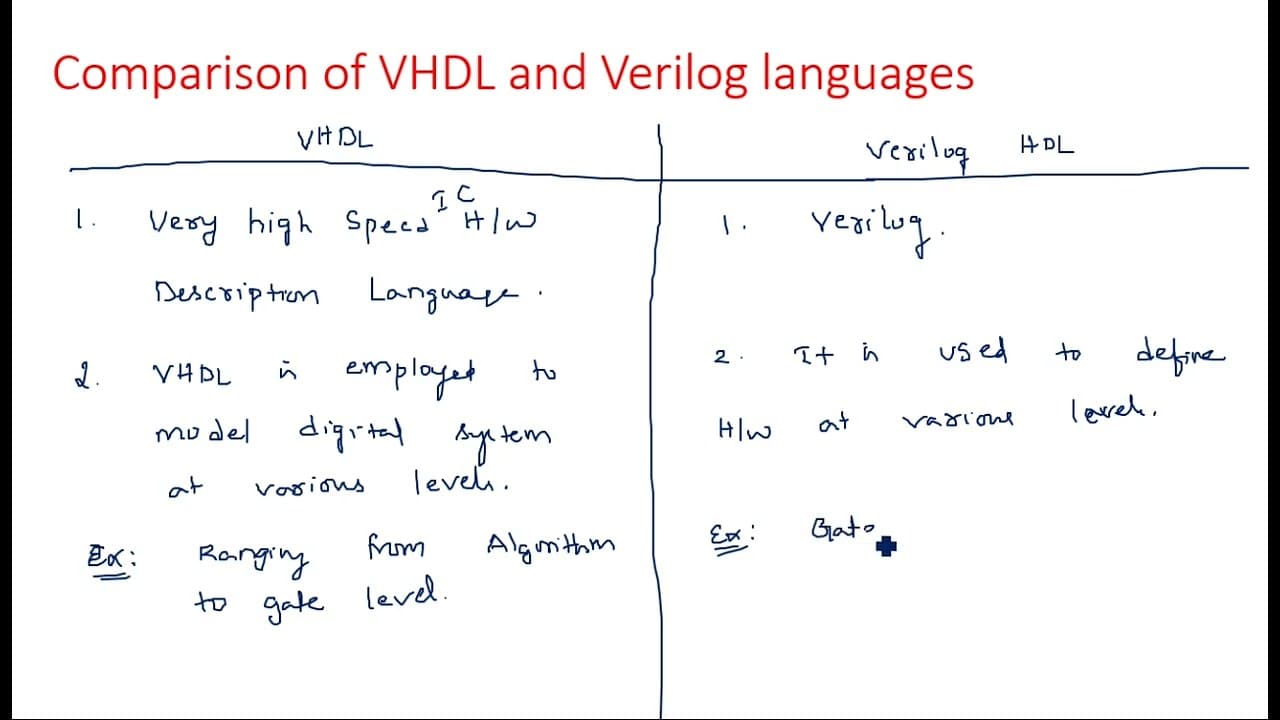
VHDL, or Very High-Speed Hardware Description Language, is more complex and employs user-defined data types, making it harder to compile, while Verilog is simpler and case insensitive. Both serve to model digital systems at various levels, but VHDL uses packages and libraries for organization, whereas Verilog relies on separate files.
Transcript
hi everyone in this video I'm going to give the details of the differences between vhdl and verog languages so both are very important languages in the design of digital systems but there are special importance in the very log compared to vhdl at few steps but vhdl somewhat basic and easy language compared to vog okay let us see the major differenc... Read More
Key Insights
- 🎚️ VHDL models digital systems at various levels, while Verilog is equally versatile but more concise.
- 👤 VHDL is inherently more complex due to its user-defined data types and case sensitivity.
- 📚 Verilog assembles functions and procedures in separate system files, while VHDL combines these in libraries.
- 😄 The presence of built-in libraries in VHDL enables ease of project management, which is absent in Verilog.
- 👻 Verilog's modular structure allows for more concise code due to the absence of separate architectural definitions.
- ❓ VHDL is preferred in academia for its rigor, while Verilog is popular in industry for its simplicity.
- 🛟 Both languages serve vital functions in digital system design, facilitating modeling from algorithm to gate levels.
Install to Summarize YouTube Videos and Get Transcripts
Explore YouTube Video Summarizer or Get YouTube Transcript Extractor
Questions & Answers
Q: What does VHDL stand for, and how is it different from Verilog?
VHDL stands for Very High-Speed Hardware Description Language. It differs from Verilog in that VHDL is more structured with concepts of libraries and packages, making it somewhat more complex to compile compared to Verilog, which utilizes a simpler syntax and is more straightforward in its coding structure.
Q: Why is VHDL considered more difficult to compile than Verilog?
VHDL is often seen as more difficult to compile due to its support for user-defined data types and its distinction between different parts of a program. This complexity requires more computational overhead. In contrast, Verilog simplifies this process by using data types defined solely within its framework, making it generally easier to compile.
Q: How does the case sensitivity differ between VHDL and Verilog?
VHDL is case insensitive, meaning that keywords can be written in any case without altering their meaning. In contrast, Verilog is case sensitive, requiring that keywords be written exactly as defined, with attention paid to uppercase and lowercase letters, which can affect compilation and functionality.
Q: What are the main organizational structures for coding in VHDL and Verilog?
In VHDL, code is organized into distinct entities and architectures, separating the definition of inputs/outputs from the behavioral description. Conversely, Verilog simplifies this by utilizing a single module structure, which encapsulates both the definitions and behavioral components, resulting in a more streamlined coding process.
Summary & Key Takeaways
-
VHDL, which stands for Very High-Speed Hardware Description Language, models digital systems at various levels, while Verilog, lacking a full form, serves a similar function but with different syntax.
-
VHDL is more challenging to compile due to its use of user-defined data types and its case sensitivity, whereas Verilog is easier to compile and is case insensitive.
-
Organizationally, VHDL employs packages and libraries for functions and procedures, while Verilog packages everything in separate files without such concepts, aiding simpler coding.
Read in Other Languages (beta)
Share This Summary 📚
Summarize YouTube Videos and Get Video Transcripts with 1-Click
Try YouTube Summary with ChatGPT & Claude or YouTube Transcript Generator