Steady State Error | Unit step input | | Control Systems | Lec-38
TL;DR
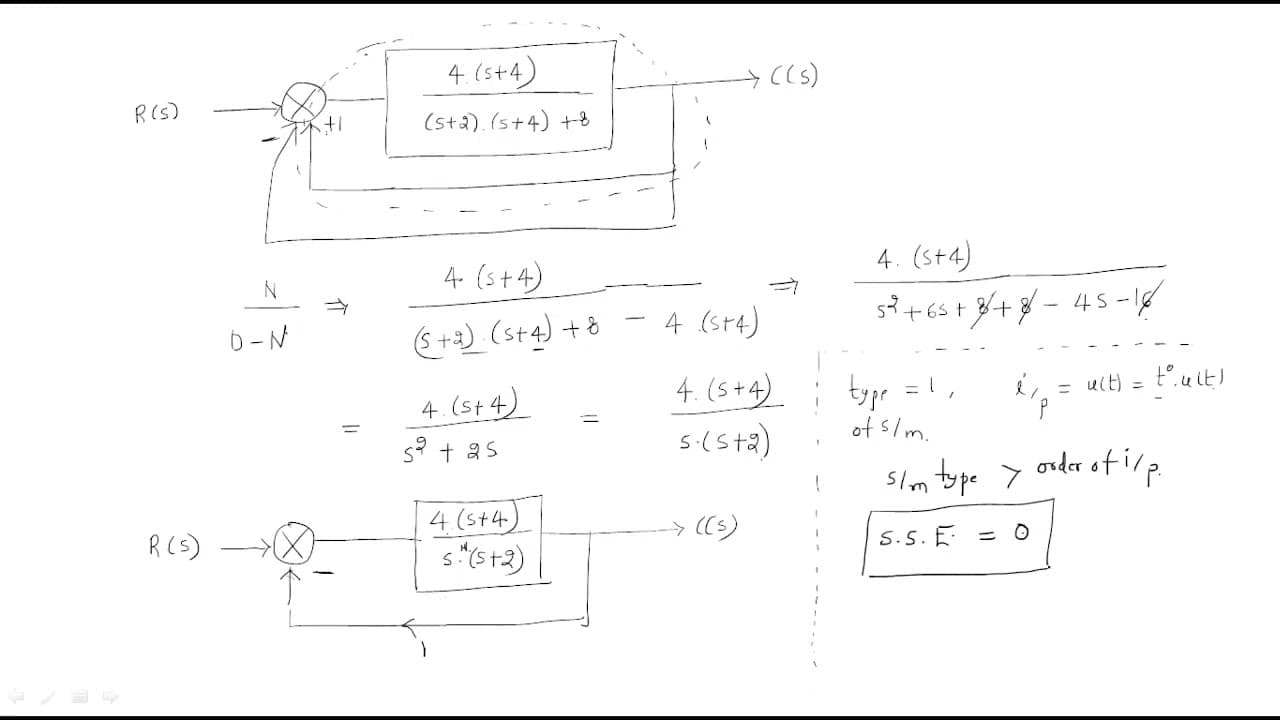
This content explains the steady-state error in a non-unity feedback system with unit step input.
Transcript
hello everyone this is the problem here the problem is this is a non-unity feedback system and find the sse with unit step input so he is giving the unit step input and find the ssa so it is not a it is not a unity feedback system it's look like a non-unity feedback system so in that systems already we discussed we have to convert into the unity fe... Read More
Key Insights
- 🚱 Non-unity feedback systems require specific conversion methods to analyze performance effectively.
- 😚 The closed-loop transfer function is essential for assessing system dynamics and response.
- 🔠 Applying a unit step input simplifies the evaluation of steady-state error and system behavior.
- 🪈 Understanding system type versus input order is crucial for predicting steady-state error outcomes.
- 🎮 Feedback mechanisms in control systems significantly influence output accuracy.
- ❓ Different calculation methodologies can provide consistent results for steady-state error.
- 🥺 Accurate analysis of control systems can lead to better design and implementation outcomes.
Install to Summarize YouTube Videos and Get Transcripts
Explore YouTube Video Summarizer or Get YouTube Transcript Extractor
Questions & Answers
Q: What is a non-unity feedback system?
A non-unity feedback system is a type of control system where the feedback gain is not equal to one. This means the output is not fed back in its entirety, which can complicate the analysis compared to unity feedback systems. In the discussed content, the system combines open-loop gains and feedback components to address this complexity.
Q: How do you convert a non-unity feedback system into a unity feedback system?
To convert a non-unity feedback system into a unity feedback system, one combines the gains of the system and adjusts the feedback paths accordingly. The open-loop and feedback gains are mathematically manipulated to formulate a new transfer function that represents a unity feedback loop for easier analysis of the system's behavior.
Q: What is the steady-state error in control systems?
The steady-state error is the difference between the desired final output and the actual output of a control system when given a steady-state input. In many scenarios, especially with unity and non-unity feedback systems, the steady-state error can be characterized based on the system type and the order of the input, which could vary between zero and other specific values.
Q: How is the closed-loop transfer function derived in the context of this content?
The closed-loop transfer function is derived by taking the open-loop gain of the system and incorporating the feedback policy. Specifically, it is presented as the ratio of the output transfer function to the total input modified by feedback considerations, formulated as G(s) / (1 + G(s)H(s)), where G(s) is the open-loop gain and H(s) is the feedback gain.
Q: What does the calculation of steady-state error reveal about system performance?
The calculation reveals how efficient the system is in reaching the desired output over time in response to a given input. In this scenario, the analysis shows that when the type of system is greater than the order of the input, the steady-state error is zero, indicating perfect tracking of the input signal under steady conditions.
Q: What methods can be used to calculate steady-state error?
Two common methods to calculate steady-state error include using the error function directly (input minus output) to determine how much the system deviates from the desired output, and applying the limit approach where you evaluate the limit as s approaches zero in the error equation. Both methods provide insights into system accuracy.
Q: What impact does system order have on steady-state error?
The system order plays a critical role in steady-state error. Generally, if the system type is greater than the input order, the steady-state error can be zero, meaning the system perfectly tracks the input. Conversely, if the input order exceeds the system type, the steady-state error may not be zero, indicating some form of tracking error.
Summary & Key Takeaways
-
The video discusses a non-unity feedback system and how to convert it into a unity feedback system for analysis. This conversion involves determining the open-loop gain and establishing the closed-loop transfer function.
-
A step input is applied to the system, and the steady-state error is calculated using two different methods. The results indicate that the steady-state error becomes zero when the system type exceeds the input order.
-
The derivation of the closed-loop transfer function is detailed, including the combination of open-loop and feedback components, ultimately leading to a practical formula for evaluating system performance.
Read in Other Languages (beta)
Share This Summary 📚
Summarize YouTube Videos and Get Video Transcripts with 1-Click
Try YouTube Summary with ChatGPT & Claude or YouTube Transcript Generator