L22.7: What Is the Distribution of the Time of the K-th Arrival?
TL;DR
The time of the kth arrival in a Poisson process follows an Erlang distribution of order k, while the first-arrival time follows an exponential distribution with arrival-rate parameter lambda. The derivation uses the Poisson PMF, independence of arrivals in separate intervals, and the CDF-to-PDF method. Read on to see how these ideas connect and why later arrival-time distributions shift toward higher values.
Transcript
We now follow a program that parallels our development for the case of the Bernoulli process. We will study the time until the first arrival, a random variable that we denote by T1. We're interested in finding the probability distribution of this random variable. And later on, we will continue and try to study the time until the kth arrival. Now T1... Read More
Key Insights
- "The first arrival occurring is the same as saying that there interval from 0 to little t." (1:01)
- "A basic assumption about is the independence assumption." (6:21)
- "Therefore, having k minus and having one arrival are independent events." (6:25)
- "The distribution of the is different from of the 10th arrival." (9:41)
Install to Summarize YouTube Videos and Get Transcripts
Explore YouTube Video Summarizer or Get YouTube Transcript Extractor
Questions & Answers
Q: What is the distribution of the time of the kth arrival in a Poisson process?
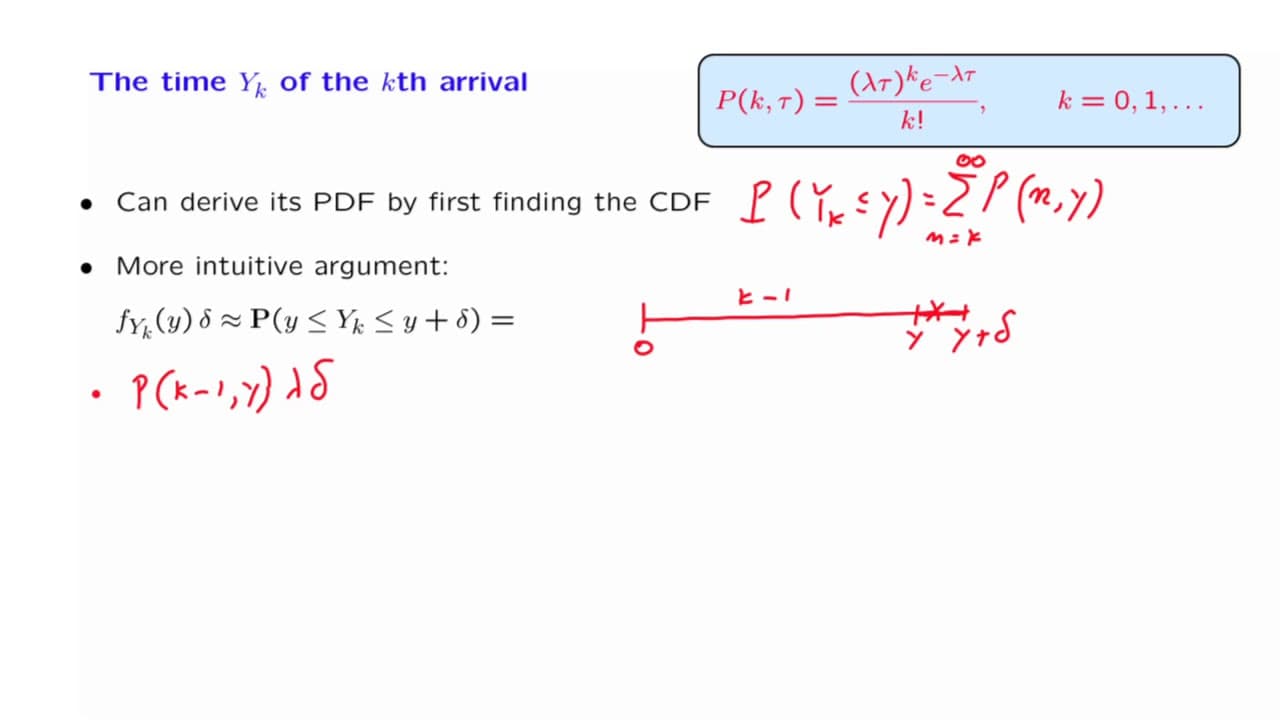
The time of the kth arrival, denoted Yk, follows an Erlang distribution of order k. Different values of k produce different distributions, so the time of the third arrival and the time of the 10th arrival do not have the same distribution.
Q: What is the distribution of the time until the first arrival?
The time until the first arrival, T1, follows an exponential distribution with parameter lambda, the arrival rate. Its PDF is lambda times e raised to negative lambda t for nonnegative t.
Q: How is the CDF of the first-arrival time found?
Fix a time t and consider the probability that the first arrival occurs by that time. Its complement is the event that no arrivals occur between 0 and t, whose probability comes from the Poisson PMF.
Q: What does the memoryless property mean for the first-arrival time?
If no arrival has occurred by a given time, the remaining wait until the first arrival is still exponentially distributed. The elapsed waiting time does not change the distribution of the additional wait.
Q: How can the distribution of Yk be derived from its CDF?
The event Yk being at most y means that at least k arrivals have occurred by time y. This probability is calculated with the Poisson PMF, and differentiating the resulting CDF gives the PDF.
Q: What is the intuitive derivation of the PDF of Yk?
For the kth arrival to fall in a short interval after y, there can be k minus 1 arrivals by time y and one arrival in the short interval. Independence lets these probabilities be multiplied, while scenarios with two or more arrivals in that short interval have higher-order terms that are ignored in the linear approximation.
Q: How does the Erlang distribution relate to the exponential distribution?
The exponential distribution is the k equals 1 case of the Erlang family. When k is 1, the Erlang PDF reduces to the previously derived first-arrival PDF.
Q: How does increasing k affect the distribution of the kth arrival time?
As k increases, the arrival-time distributions shift toward higher values. This matches the idea that a third arrival generally occurs later than a first arrival.
Summary & Key Takeaways
-
The video focuses on the time until the first arrival (T1) in a Poisson process and explains how to find its probability distribution.
-
The video then discusses the memoryless property of the exponential distribution, which is the probability distribution of T1.
-
The video also explores the time of the kth arrival (Yk) and how to find its probability distribution using the Poisson probability mass function.
Read in Other Languages (beta)
Share This Summary 📚
Summarize YouTube Videos and Get Video Transcripts with 1-Click
Try YouTube Summary with ChatGPT & Claude or YouTube Transcript Generator
Explore More Summaries from MIT OpenCourseWare 📚


Summarize YouTube Videos and Get Video Transcripts with 1-Click
Try YouTube Summary with ChatGPT & Claude or YouTube Transcript Generator