Transfer of respiratory pathogens: Droplet formation
TL;DR
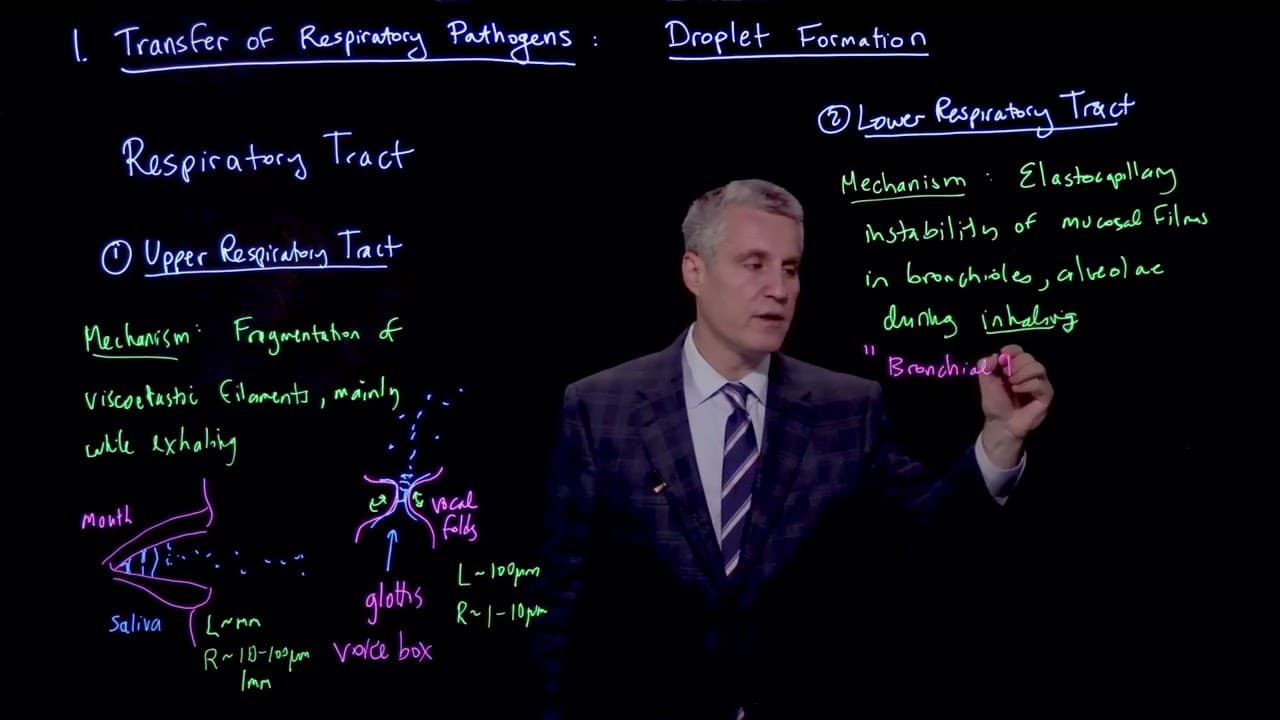
Respiratory droplets form when airflow breaks up mucus, saliva, and surfactant films throughout the respiratory tract. Viscoelastic filament fragmentation is the main mechanism described for the upper tract, while film bursting is more common in the lower tract. Speaking produces more emissions than breathing, and louder speech or singing increases them significantly. Read on to understand the mechanisms, locations, and factors involved.
Transcript
PROFESSOR: So the transfer of respiratory pathogens is primarily accomplished through droplets that are emitted by an infected person and then either breathed in or ending up on surfaces and touched and incorporated into the body in some other way by a susceptible person. So let's begin by talking about the formation of droplets during respiration.... Read More
Key Insights
- 🥳 Different parts of the respiratory tract contribute to the formation and emission of respiratory droplets.
- 🚜 Filament breakup is the primary mechanism in the upper respiratory tract, while film bursting is more common in the lower respiratory tract.
- 🔊 Vocalization, such as speaking and singing, correlates with higher droplet emissions.
- 💦 Droplet sizes vary based on respiratory activity, individual factors, and the presence of pathogens.
- 💦 Understanding the mechanisms of droplet formation is crucial for infection control and prevention measures.
Install to Summarize YouTube Videos and Get Transcripts
Explore YouTube Video Summarizer or Get YouTube Transcript Extractor
Questions & Answers
Q: How are respiratory droplets formed in the upper respiratory tract?
The main mechanism is the fragmentation of viscoelastic filaments made from fluids such as mucus or saliva. As air flows past these stretched filaments in the mouth, nose, larynx, and related passages, they bend, break apart, and can be emitted as droplets.
Q: What is the primary mechanism for droplet formation in the lower respiratory tract?
In the lower respiratory tract, droplets are primarily formed through the bursting of mucosal films. These films line areas such as the lungs and bronchioles, where their rupture creates droplets.
Q: How does vocalization affect respiratory droplet emissions?
Speaking produces many more emissions than simply breathing. The emission rate rises significantly when a person speaks more loudly or sings, linking droplet production strongly with vocalization.
Q: How do the vocal folds generate droplets during speech?
Air flows through folds in the glottis, or voice box, while those folds vibrate together. This motion can create fluid filaments that break apart and release droplets; the transcript gives 100 hertz as an example vibration frequency depending on speech tone and sounds.
Q: Are more respiratory droplets emitted during inhalation or exhalation?
Droplet creation and emission occur mainly during exhalation. Some droplets may also form during inhalation, but they can enter the lungs or deposit on airway surfaces before potentially coming back out.
Q: Which fluids in the respiratory tract contribute to droplet formation?
The airways contain surfactant film and mucus, while the mouth contains saliva with a similar but less mucin-rich composition. Mucus includes large macromolecules, mucin proteins, and dissolved ions such as sodium and chloride.
Q: What factors influence respiratory droplet size?
Droplet size varies with the respiratory activity, including breathing and speaking, as well as individual differences and the presence of pathogens. The existing page content describes sizes ranging from microns to millimeters.
Q: How can respiratory droplets transfer pathogens between people?
An affected person emits droplets that may then be breathed in by a susceptible person. Droplets can also land on surfaces, be touched, and enter the susceptible person’s body by another route.
Summary & Key Takeaways
-
Respiratory droplets are created in different parts of the respiratory tract, including the lungs, bronchial tubes, and nasal passages.
-
Filament breakup is the primary mechanism for droplet formation in the upper respiratory tract, while film bursting is more common in the lower respiratory tract.
-
Vocalization, such as speaking and singing, leads to significant droplet emissions in the upper respiratory tract.
-
Droplet size can vary based on respiratory activity, individual variations, and the presence of pathogens.
Read in Other Languages (beta)
Share This Summary 📚
Summarize YouTube Videos and Get Video Transcripts with 1-Click
Try YouTube Summary with ChatGPT & Claude or YouTube Transcript Generator
Explore More Summaries from MIT OpenCourseWare 📚


Summarize YouTube Videos and Get Video Transcripts with 1-Click
Try YouTube Summary with ChatGPT & Claude or YouTube Transcript Generator