Fermat Spirals for Layered 3D Printing | Two Minute Papers #77
TL;DR
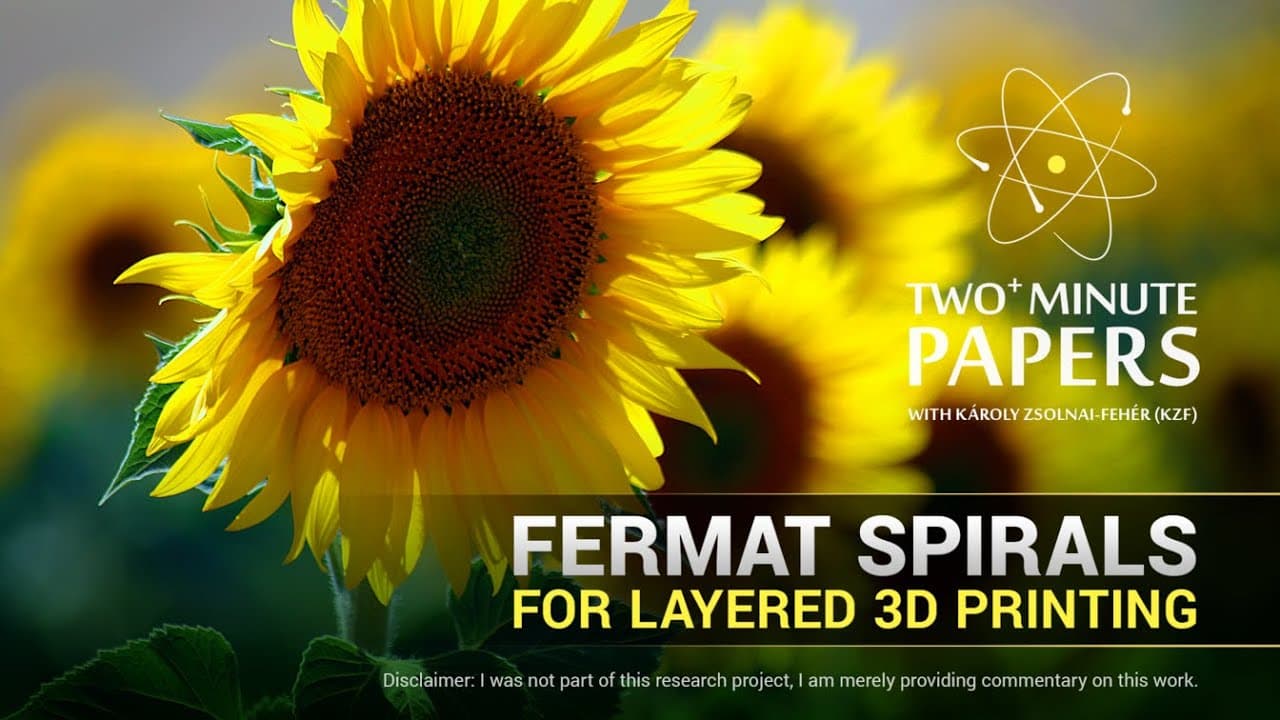
Fermat spirals improve layered 3D printing by filling prescribed shapes with long, low-curvature paths that produce fairer surfaces, print more quickly, and deliver higher quality than other possible shape-filling curves. The same mathematical pattern appears in sunflowers, where growing seeds exert forces on one another and cannot be arranged arbitrarily. Read on to see how this connection between mathematics, nature, and manufacturing works.
Transcript
Dear Fellow Scholars, this is Two Minute Papers with Károly Zsolnai-Fehér. What are Hilbert curves? Hilbert curves are repeating lines that are used to fill a square. Such curves, so far, have enjoyed applications like drawing zigzag patterns to prevent biting in our tail in a snake game. Or, jokes aside, it is also useful in, for instance, choosin... Read More
Key Insights
- 🙂 Hilbert curves are not just limited to game patterns but can be applied to diverse situations, including IP address assignments and light simulations.
- 😵💫 Fermat spirals are found in nature, such as sunflower growth patterns, and can be explained by the forces exerted by growing seeds.
- 🖐️ Nature's ability to find mathematically optimized solutions is awe-inspiring, proving that mathematics plays a role in natural phenomena.
- 😵💫 Fermat spirals have practical applications in 3D printing, leading to higher quality and faster printing results.
- 🥺 Research involves finding connections between different fields, which not only leads to beautiful discoveries but also contributes to useful inventions.
- 👻 The support of Patreon contributors allows for the growth and continuation of educational content on Two Minute Papers.
- 😵💫 Hilbert curves and Fermat spirals demonstrate the power and versatility of mathematical structures in practical applications.
Install to Summarize YouTube Videos and Get Transcripts
Explore YouTube Video Summarizer or Get YouTube Transcript Extractor
Questions & Answers
Q: How do Fermat spirals improve layered 3D printing?
A Fermat spiral can fill a prescribed shape using a long journey of low-curvature curves that returns almost exactly to its starting point. When a 3D printer creates layered material this way, the surface has greater fairness, prints more quickly, and is generally higher quality than surfaces made with other possible shapes.
Q: What is a Fermat spiral?
A Fermat spiral is essentially a long line formed as a collection of low-curvature spirals. It is generated by a remarkably simple mathematical expression and can also be observed in nature.
Q: Can Fermat spirals approximate different shapes?
Yes. They can approximate a number of shapes while satisfying the constraint of starting at a given point, following an enormously long low-curvature path, and returning almost exactly to the starting point.
Q: Why are Fermat spirals useful for filling a 3D-printed object?
A prescribed object can be filled with curves in a stupendously large number of ways before those curves form its final shape. The discussed research found that using Fermat spirals yields the highest-quality print possible at that point in time, with results demonstrated across shapes of varying complexity.
Q: Why do Fermat spiral patterns appear in sunflowers?
As sunflower seeds grow, they exert forces on one another, so they cannot be arranged arbitrarily. Solving equations that maximize the concentration of growth hormones while accounting for this force constraint produces an arrangement almost identical to a Fermat spiral.
Q: What are Hilbert curves?
Hilbert curves are repeating lines used to fill a square. They demonstrate how a seemingly simple mathematical structure can support applications in games, light simulations, and computer networks.
Q: What practical applications do Hilbert curves have?
Hilbert curves can create zigzag patterns that prevent a snake from biting its tail in a snake game. They can also help choose which pixels to begin tracing rays from in light simulations and support strategies for assigning IP addresses to computers in a network.
Q: What broader research lesson comes from Fermat spirals and 3D printing?
The example shows how research can connect different fields, including mathematical patterns, natural growth, and layered manufacturing. Such connections can be both beautiful and useful, enriching everyday life through inventions.
Summary & Key Takeaways
-
Hilbert curves are repeating lines used to fill a square, with applications ranging from snake game patterns to IP address assignments.
-
Fermat spirals are low-curvature spirals that can be found in nature, such as in sunflower growth patterns.
-
Nature follows mathematical principles, as sunflower seeds exert forces on each other, leading to a mathematically optimized arrangement.
Read in Other Languages (beta)
Share This Summary 📚
Summarize YouTube Videos and Get Video Transcripts with 1-Click
Try YouTube Summary with ChatGPT & Claude or YouTube Transcript Generator
Explore More Summaries from Two Minute Papers 📚




Summarize YouTube Videos and Get Video Transcripts with 1-Click
Try YouTube Summary with ChatGPT & Claude or YouTube Transcript Generator