Hydraulic vs electric actuation in robotics | Marc Raibert and Lex Fridman
TL;DR
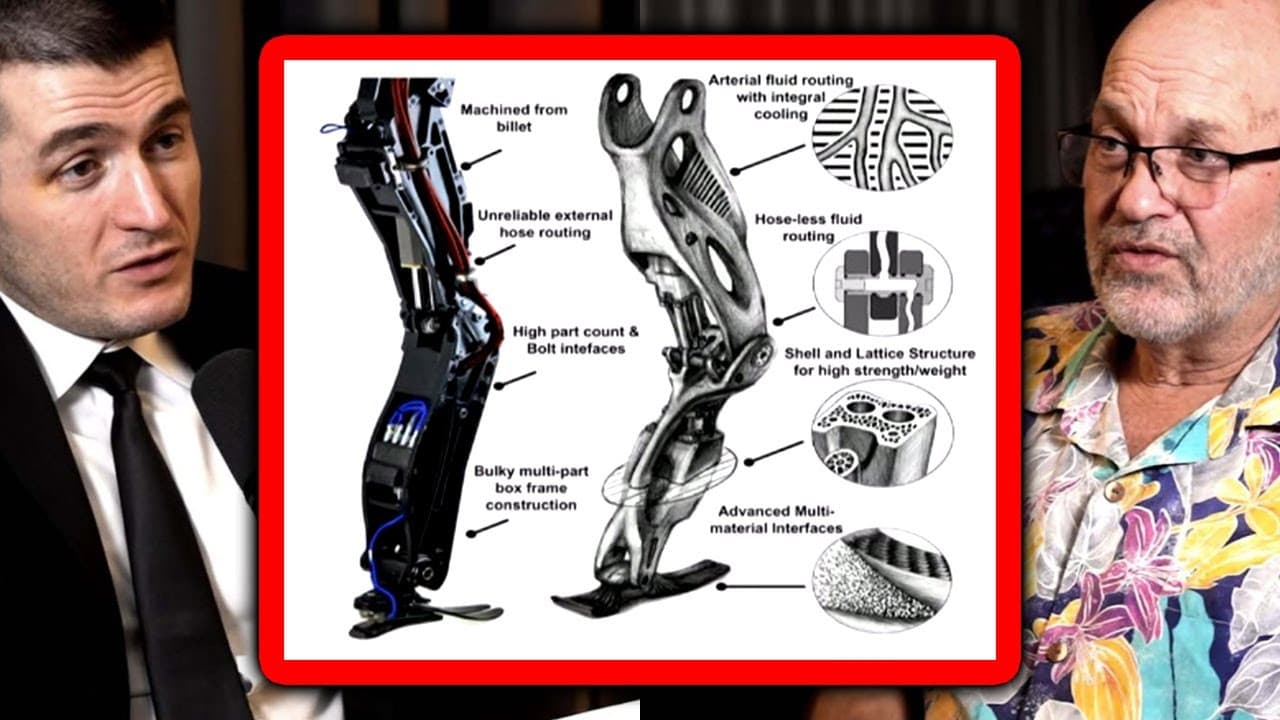
Boston Dynamics discusses the technical challenges of transitioning from hydraulic to electric systems and the importance of hardware innovation in achieving natural movement in robots.
Transcript
is there a lot of technical challenges to go from hydraulic to Electric you know I had been in love with hydraulics and still uh love Hydraulics uh you know it's it's a great technology it's too bad that the somehow the the world out there looks at it like it's oldfashioned or that it's um icky and it's true that you do it is very hard to keep it f... Read More
Key Insights
- 🥳 Hydraulics can still offer significant advantages in terms of performance and strength-to-weight ratio in robotics.
- 🤖 Hardware innovation is crucial for achieving natural movement in robots.
- 🤖 Predictive algorithms and the ability to look ahead contribute to the natural movement of robots.
- 💋 Sticking landings require careful consideration of momentum, rotation, and feet placement.
- 👻 Building robots allows for a better understanding of human movement, but replicating it exactly remains challenging.
- 🤖 Running is more naturally replicated in robots than walking, showcasing the importance of leaping into the unknown.
- 🤖 Compliance and spring-like designs play a role in achieving natural movement and efficiency in robots.
Install to Summarize YouTube Videos and Get Transcripts
Explore YouTube Video Summarizer or Get YouTube Transcript Extractor
Questions & Answers
Q: What advancements did Boston Dynamics make in hydraulic controls for robots?
Boston Dynamics designed valves with new kinds of circuits, improving the efficiency, size, and weight of hydraulic systems. They also integrated multiple components into compact hydraulic power supplies.
Q: How does Boston Dynamics achieve natural movement in their robots?
Boston Dynamics takes a dynamic approach, predicting future motion, and providing signals based on those predictions. This allows the robots to adapt to obstacles, coordinate movements, and maintain balance.
Q: How difficult is it to stick a landing with a robot?
Sticking a landing requires considering factors such as jump height, rotation rate, and coordinating feet placement. While the calculations for basic landings are not complicated, complex 3D maneuvers require balancing in multiple degrees of freedom.
Q: How does building robots help in understanding human movement?
By building robots, Boston Dynamics gains insights into how humans achieve natural and efficient movement. However, understanding human movement remains a challenge as most humans are not fully aware of the physical and physics aspects of their own movements.
Summary & Key Takeaways
-
Hydraulics, despite their reputation, offer great performance with the ability to provide strength in a lightweight package. Boston Dynamics innovated hydraulic controls and created compact, powerful hydraulic power supplies.
-
Achieving natural movement in robots involves taking a dynamic approach, predicting future motion, and giving signals to the robot based on these predictions. Looking a couple of seconds ahead is sufficient for basic movements, while complex maneuvers require looking further ahead.
-
Sticking a landing requires coordination of momentum and rotation, and timing is crucial. Boston Dynamics has successfully executed somersaults and developed algorithms to stabilize complex maneuvers, drawing inspiration from human gymnasts.
Read in Other Languages (beta)
Share This Summary 📚
Summarize YouTube Videos and Get Video Transcripts with 1-Click
Try YouTube Summary with ChatGPT & Claude or YouTube Transcript Generator
Explore More Summaries from Lex Clips 📚




Summarize YouTube Videos and Get Video Transcripts with 1-Click
Try YouTube Summary with ChatGPT & Claude or YouTube Transcript Generator