What Do Infants Understand About Object Motion and Goals?
TL;DR
Infants as young as five months can grasp basic principles of object motion and agent goals, but this understanding develops significantly between three and seven months. Studies with controlled-reared chicks and infants using sticky mittens suggest that even before they can interact physically, infants can exhibit early knowledge of goal-directed actions and efficient movement in agents.
Transcript
The following content is provided under a Creative Commons license. Your support will help MIT OpenCourseWare continue to offer high-quality educational resources for free. To make a donation or view additional materials from hundreds of MIT courses, visit MIT OpenCourseWare at ocw.mit.edu. LIZ SPELKE: I want to talk about-- you asked about develop... Read More
Key Insights
- ⌛ Infants' understanding of object motion and agent actions develops over time and can be influenced by early experiences.
- ⚾ Infants may attribute goals to agents based on their actions and perceive efficient actions as the norm.
- ⛑️ Infants are sensitive to social cues, such as gaze direction and imitation, which are important for social interactions and communication.
Install to Summarize YouTube Videos and Get Transcripts
Explore YouTube Video Summarizer or Get YouTube Transcript Extractor
Questions & Answers
Q: How do infants understand object motion and the goals of agents?
Infants represent object motion as being caused by self-propelled objects and understand that agents have specific goals in their actions, which can be inferred from their movements and interactions with objects.
Q: What are the limitations of infants' understanding of agents?
Infants do not attribute visual perception to agents, and their understanding of agents is limited to first-order goals. They may not understand higher-order goals or the effects of an agent's actions on objects.
Q: Can infants distinguish between efficient and inefficient actions?
Infants have a basic understanding of efficient actions and expect agents to move in the most direct path to achieve their goals. This understanding develops around 12 months of age.
Q: Do infants imitate the actions of agents?
Infants show a pro-social response to agents' gaze and engage in eye contact and imitation of gestures when agents are looking at them. This behavior suggests an early ability to engage and communicate with others.
Summary & Key Takeaways
-
Infants as young as five months old can understand object motion and the goals of agents.
-
However, younger infants, such as three-month-olds, may not yet have these abilities.
-
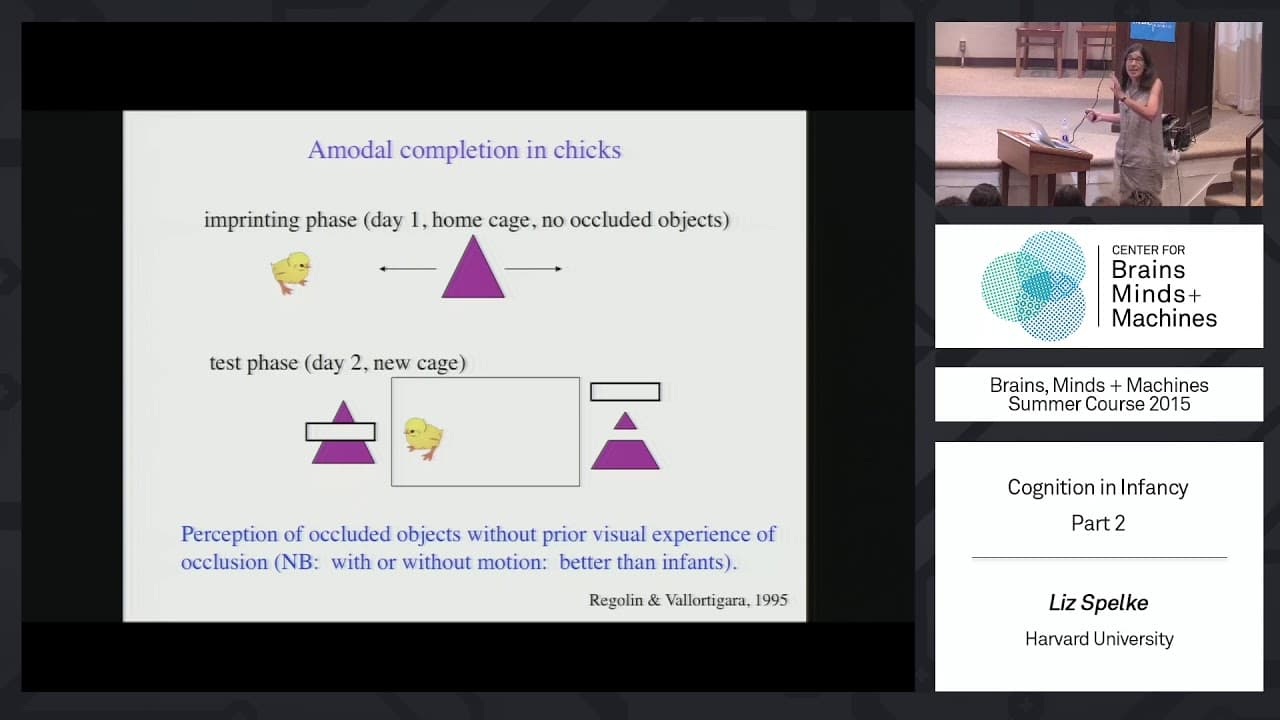
Studies with controlled reared chicks and sticky mitten experiments with infants show that these abilities can be elicited before infants can physically interact with objects themselves.
Read in Other Languages (beta)
Share This Summary 📚
Summarize YouTube Videos and Get Video Transcripts with 1-Click
Try YouTube Summary with ChatGPT & Claude or YouTube Transcript Generator
Explore More Summaries from MIT OpenCourseWare 📚


Summarize YouTube Videos and Get Video Transcripts with 1-Click
Try YouTube Summary with ChatGPT & Claude or YouTube Transcript Generator