Virtual Memory: 7 Address Translation Example Walkthrough
TL;DR
Virtual memory translation involves mapping virtual addresses to physical addresses using page tables.
Transcript
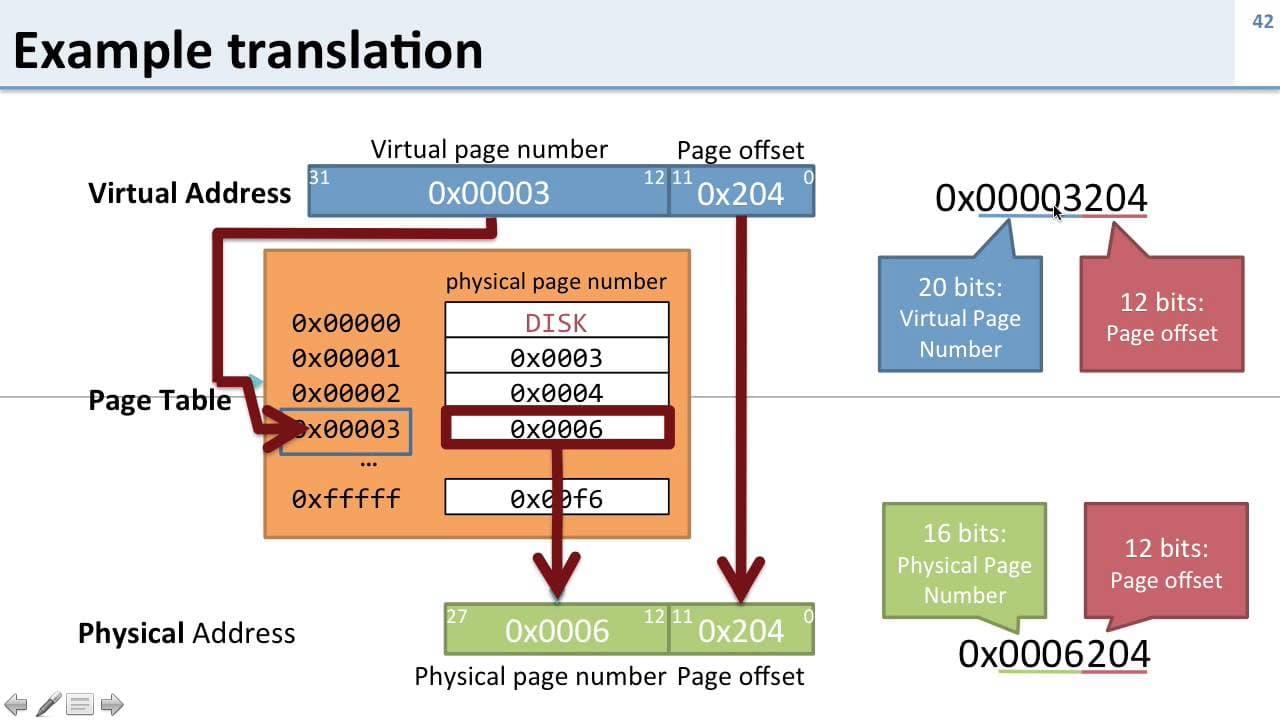
now let's walk through how we actually do this translation and what bits go where so how do we do a page table look up to translate from a virtual address to a physical address so here's our page table here's our virtual address and our physical address so our virtual address size is set by the ISA and our physical address i... Read More
Key Insights
- Virtual memory translation involves converting a virtual address to a physical address, utilizing a page table to manage the mapping.
- The virtual address is divided into a page offset and a virtual page number, with the offset remaining unchanged during translation.
- The page table stores entries that map each virtual page number to a corresponding physical page number or indicate if the page is on disk.
- In systems with limited physical memory, the number of virtual pages exceeds the number of physical pages, necessitating efficient page table management.
- A larger page size, such as 64 kilobytes, reduces the number of page table entries but requires handling larger data chunks.
- When a page is not in memory, a page fault occurs, prompting the system to retrieve the data from disk.
- The translation process involves checking the page table entry for the virtual page number to determine the physical page location.
- The page offset remains constant during translation, ensuring consistency in data access across virtual and physical memory.
Install to Summarize YouTube Videos and Get Transcripts
Explore YouTube Video Summarizer or Get YouTube Transcript Extractor
Questions & Answers
Q: What is the role of a page table in virtual memory translation?
The page table plays a crucial role in virtual memory translation by mapping virtual page numbers to corresponding physical page numbers. It stores entries for each virtual page, indicating either the physical page location or if the page is on disk. This mapping is essential for systems with more virtual pages than physical pages, enabling efficient memory management.
Q: How does the page offset affect the translation process?
The page offset remains constant during the translation process, ensuring that the data access remains consistent across both virtual and physical memory. This means that the lower bits of the virtual address, which represent the page offset, are not altered during translation. This consistency allows for straightforward data retrieval once the virtual page number has been mapped to a physical page.
Q: What happens when a page is not in memory during translation?
When a page is not in memory during translation, a page fault occurs. This situation requires the system to retrieve the data from disk, as indicated by the page table entry for that virtual page number. Page faults are a critical aspect of virtual memory management, as they ensure that data is accessible even when not immediately available in physical memory.
Q: How does increasing the page size impact the page table?
Increasing the page size, such as from 4 kilobytes to 64 kilobytes, reduces the number of entries in the page table. This is because each page now covers a larger portion of the virtual address space, requiring fewer entries to manage the mapping. However, it also means that data is handled in larger chunks, which can affect system performance and resource management.
Q: Why is it important to maintain a consistent page offset?
Maintaining a consistent page offset is important because it ensures uniformity in data access across virtual and physical memory. By keeping the page offset unchanged during translation, the system can reliably locate data within a page, regardless of its position in virtual or physical memory. This consistency is crucial for efficient memory management and optimal system performance.
Q: What is the significance of the virtual page number in translation?
The virtual page number is significant in translation as it identifies the specific page within the virtual address space that needs to be mapped to a physical page. It is the part of the virtual address that is translated using the page table. The virtual page number determines which entry in the page table is accessed to find the corresponding physical page number, facilitating the translation process.
Q: How does the system handle a page fault?
When a page fault occurs, the system must retrieve the required data from disk to complete the translation process. This involves accessing the disk storage where the data is stored, loading it into physical memory, and updating the page table to reflect the new physical page location. Handling page faults efficiently is essential for maintaining system performance and ensuring data availability.
Q: What are the advantages of using larger pages in memory management?
Using larger pages in memory management offers several advantages, including a reduction in the number of page table entries, which simplifies the management of virtual to physical address mappings. Larger pages also reduce the frequency of page faults by covering more data in a single page. However, they require handling larger data chunks, which can impact system performance and resource allocation.
Summary & Key Takeaways
-
Virtual memory translation involves mapping virtual addresses to physical addresses using a page table. The virtual address comprises a page offset and a virtual page number, with the offset remaining unchanged. The page table maps virtual pages to physical pages or indicates if a page is on disk, essential for systems with limited physical memory.
-
A larger page size, such as 64 kilobytes, reduces the number of page table entries but requires handling larger data chunks. Page faults occur when a page is not in memory, necessitating data retrieval from disk. The translation process involves checking the page table entry for the virtual page number to determine the physical page location.
-
The virtual memory translation process is crucial for efficient memory management, particularly in systems with more virtual pages than physical pages. By maintaining a consistent page offset during translation, the system ensures reliable data access across virtual and physical memory, optimizing performance and resource utilization.
Read in Other Languages (beta)
Share This Summary 📚
Summarize YouTube Videos and Get Video Transcripts with 1-Click
Try YouTube Summary with ChatGPT & Claude or YouTube Transcript Generator
Explore More Summaries from David Black-Schaffer 📚
Summarize YouTube Videos and Get Video Transcripts with 1-Click
Try YouTube Summary with ChatGPT & Claude or YouTube Transcript Generator