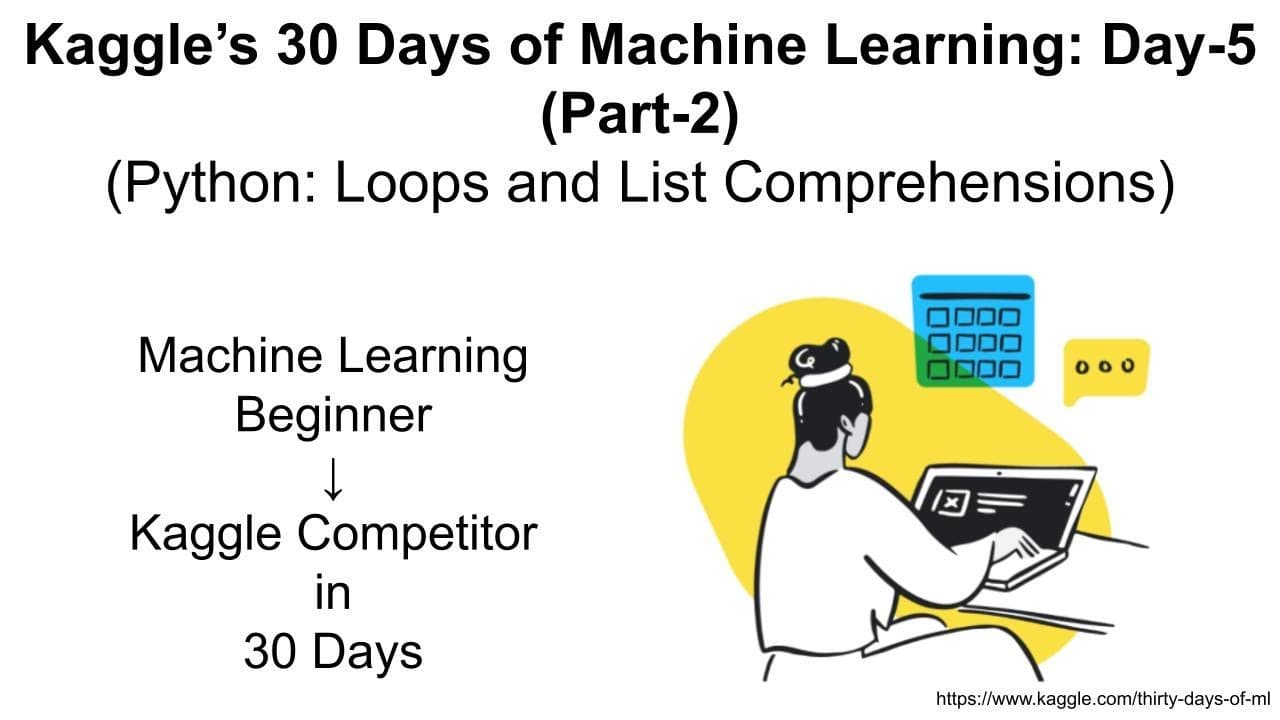
Kaggle's 30 Days Of ML (Day-5, Part-2): Python Loops and List Comprehension
TL;DR
Learn how to use loops and list comprehensions in Python to iterate over lists, perform operations, and generate new lists.
Transcript
hello everyone and welcome to day five part two in this part we are going to learn about loops and list comprehensions so what are these uh actually it's not very difficult loops you will end up using again um a lot of times a number of times so let's see what we have done we have created a list of planets so we have this list of planets and if we ... Read More
Key Insights
- 👂 Loops are essential in programming to perform repetitive tasks on lists of elements.
- 👂 List comprehensions offer a more concise and efficient way to create new lists based on existing ones.
- 🧡 The range function is useful for generating a sequence of numbers to iterate over.
- 🔁 The while loop is suitable when the number of iterations is not predetermined.
- 👂 It is important to consider readability and performance when using loops and list comprehensions in Python code.
- ✋ Break and continue statements are useful for controlling the flow of loops and stopping or skipping iterations as needed.
- 👂 List comprehensions can be combined with conditional statements to apply specific operations to certain elements of a list.
Install to Summarize YouTube Videos and Get Transcripts
Explore YouTube Video Summarizer or Get YouTube Transcript Extractor
Questions & Answers
Q: What is the difference between a for loop and a while loop?
A for loop is used when you know the number of iterations in advance, while a while loop is used when the number of iterations is unknown and depends on a certain condition.
Q: How can you break out of a loop before all iterations are completed?
You can use the "break" keyword to exit the loop prematurely. This is useful when you want to stop the loop based on a certain condition.
Q: What is the purpose of list comprehensions?
List comprehensions provide a concise way to generate new lists based on existing lists. They can be used to apply transformations, filtering, and other operations to list elements.
Q: How can you check if a certain condition is true for any element in a list?
You can use the "any" function with a list comprehension. It will return True if at least one element satisfies the condition, and False otherwise.
Summary & Key Takeaways
-
Loops are used to iterate over a list and perform actions on each element. The "for" loop is commonly used, with the "in" keyword linking the variable and the list.
-
List comprehensions provide a concise way to generate new lists based on existing lists. It involves specifying an expression and a looping condition in a single line of code.
-
Range function is used to generate a range of numbers, which can be looped over using a for loop.
-
While loop is used to execute a block of code as long as a certain condition is true.
Read in Other Languages (beta)
Share This Summary 📚
Summarize YouTube Videos and Get Video Transcripts with 1-Click
Try YouTube Summary with ChatGPT & Claude or YouTube Transcript Generator
Explore More Summaries from Abhishek Thakur 📚
Summarize YouTube Videos and Get Video Transcripts with 1-Click
Try YouTube Summary with ChatGPT & Claude or YouTube Transcript Generator