8.2.4 An Introduction to Linear Optimization - Video 3: The Problem Formulation
TL;DR
This video explains how to maximize airline revenue by determining the optimal number of discount seats and regular seats to sell, using a linear optimization problem.
Transcript
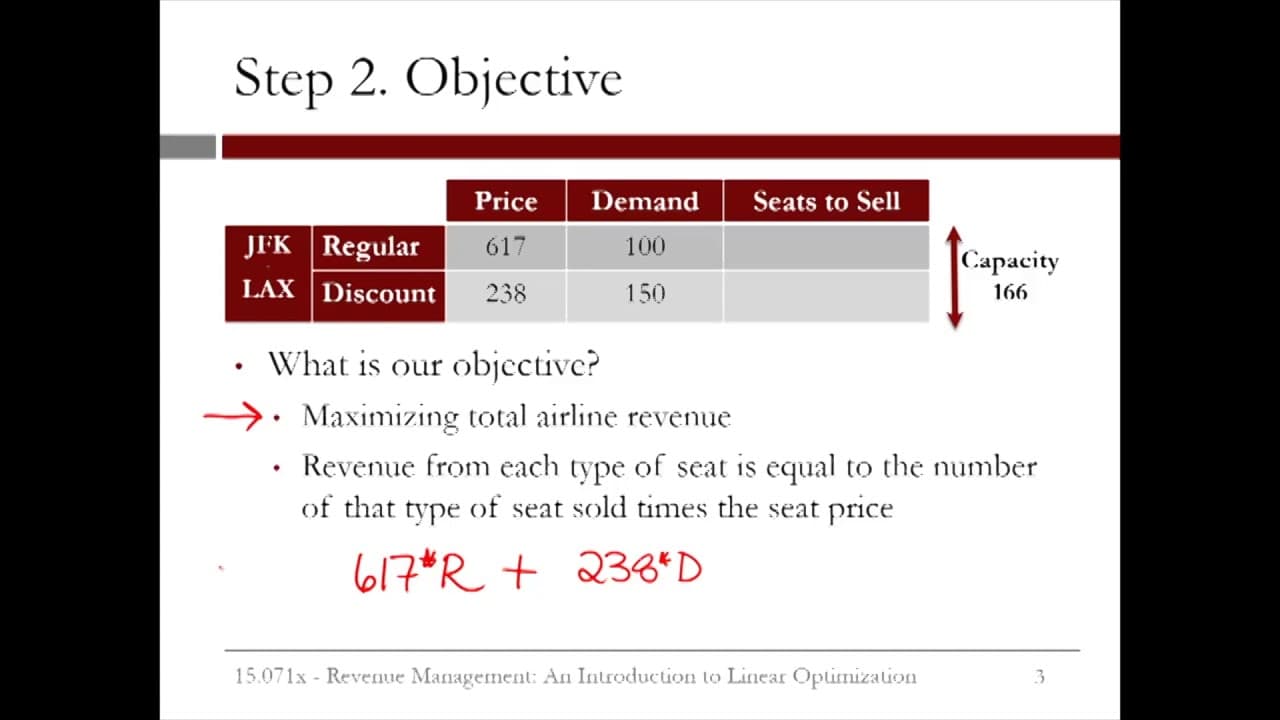
For a single route example, our problem is to find the optimal number of discount seats and regular seats to sell to maximize revenue. We'll assume that the price of regular seats is $617, and the price of discount seats is $238. Also, let's assume that we forecasted the demand of regular seats to be 100, and the demand of discount seats to be 150.... Read More
Key Insights
- 🤢 The objective is to maximize airline revenue by determining the optimal number of discount seats and regular seats to sell.
- 🤢 The revenue for each seat type is calculated by multiplying the number of seats sold by their respective prices.
- 🤢 Constraints include the aircraft capacity, demand for each seat type, and non-negativity of seat sales.
- ❓ Linear optimization is used to formulate the problem mathematically.
- ❓ Mathematical formulation involves maximizing total revenue subject to capacity and demand constraints.
- 🤢 Reasonable values for seat sales must be ensured.
- ❓ The problem can be solved using software like LibreOffice.
Install to Summarize YouTube Videos and Get Transcripts
Explore YouTube Video Summarizer or Get YouTube Transcript Extractor
Questions & Answers
Q: What is the main goal in formulating the linear optimization problem?
The main goal is to maximize the total revenue to the airline by determining the optimal number of discount seats and regular seats to sell.
Q: How is the revenue calculated for each type of seat?
The revenue for regular seats is calculated by multiplying the number of regular seats sold (R) by the price of regular seats ($617). The revenue for discount seats is calculated similarly using the number of discount seats sold (D) and the price of discount seats ($238).
Q: What are the constraints in this optimization problem?
The constraints include the aircraft capacity (166 seats), the demand for regular seats (100 seats), and the demand for discount seats (150 seats). Additionally, both the number of regular seats (R) and the number of discount seats (D) cannot be negative.
Q: What is the mathematical formulation of this linear optimization problem?
The problem can be mathematically formulated as maximizing 617R + 238D (total revenue), subject to the constraints: R + D ≤ 166 (capacity constraint), R ≤ 100 (demand constraint for regular seats), D ≤ 150 (demand constraint for discount seats), R ≥ 0, and D ≥ 0.
Summary & Key Takeaways
-
The problem is to find the optimal number of discount seats and regular seats to sell, maximizing revenue.
-
The objective is to maximize total revenue, calculated by multiplying the number of each seat type sold by its respective price.
-
Constraints include the aircraft capacity, demand for each seat type, and the non-negativity of seat sales.
Read in Other Languages (beta)
Share This Summary 📚
Summarize YouTube Videos and Get Video Transcripts with 1-Click
Try YouTube Summary with ChatGPT & Claude or YouTube Transcript Generator
Explore More Summaries from MIT OpenCourseWare 📚



Summarize YouTube Videos and Get Video Transcripts with 1-Click
Try YouTube Summary with ChatGPT & Claude or YouTube Transcript Generator