How to Differentiate a Function Twice Using Notation
TL;DR
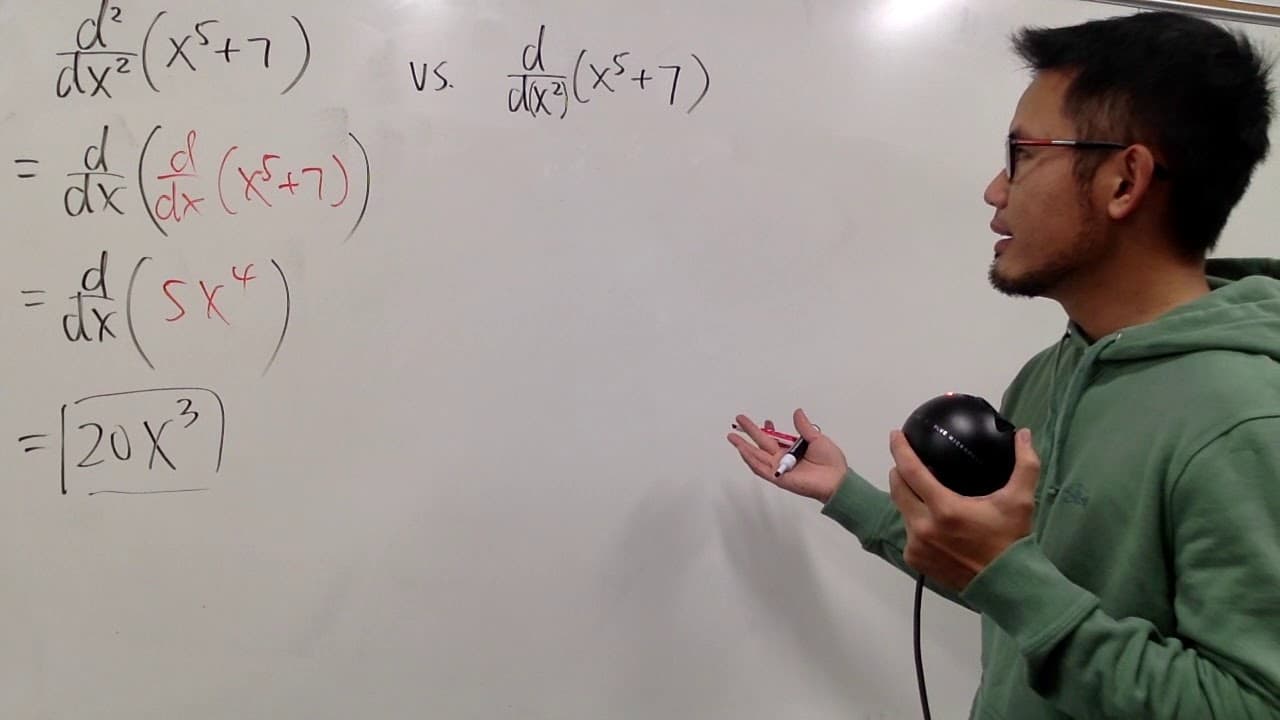
To differentiate a function twice using the notation D²/dx², apply the power rule sequentially for each differentiation. For example, the derivative of x⁵ is 5x⁴, and differentiating again results in 20x³. To differentiate with respect to x², use substitution to simplify the process, replacing x² with a new variable like T.
Transcript
okay we have to the rubbed questions on the spot the first one D 2 over DX 2 of X to the fifth power plus seven and the other one we just have a D and then over the parentheses x squared and then X to the fifth power plus seven okay yes they have the same function in the parentheses but this one right here has a tool and this is just e to the first... Read More
Key Insights
- ☺️ Differentiating a function twice, denoted by D^2/dx^2, involves differentiating it with respect to x twice.
- ✊ The power rule is used to differentiate functions, where the exponent is brought down and multiplied by the coefficient.
- 🫡 Substituting variables, such as using T instead of x^2, can simplify the process of differentiating with respect to x^2.
Install to Summarize YouTube Videos and Get Transcripts
Explore YouTube Video Summarizer or Get YouTube Transcript Extractor
Questions & Answers
Q: What does the notation D^2/dx^2 mean when differentiating a function?
D^2/dx^2 means differentiating the function with respect to x twice. It is used to calculate the second derivative of a function.
Q: How do you differentiate a function with respect to x^2?
To differentiate a function with respect to x^2, you can use the substitution method. Substitute x^2 with another variable, such as T, and differentiate the function with respect to T using the usual rules of differentiation. Then substitute back to the original variable.
Q: Why do we use 1/2 power instead of radical symbols in calculus?
In calculus, it is more common to use fractional exponents (e.g., 1/2 power) rather than radical symbols for differentiation and integration. Fractional exponents allow for easier application of the power rule and other calculus concepts.
Q: Should the plus or minus sign be kept when differentiating with substitution?
Whether to keep the plus or minus sign depends on the specific context of the problem and the instructions given by the teacher. It is best to consult your teacher or follow the proper guidelines provided.
Summary & Key Takeaways
-
The video demonstrates how to differentiate a function twice using the notation D^2/dx^2.
-
It explains that D^2/dx^2 means differentiating the function with respect to x twice.
-
The video also shows how to differentiate a function with respect to x^2 using substitution to simplify the process.
Read in Other Languages (beta)
Share This Summary 📚
Summarize YouTube Videos and Get Video Transcripts with 1-Click
Try YouTube Summary with ChatGPT & Claude or YouTube Transcript Generator
Explore More Summaries from blackpenredpen 📚
Summarize YouTube Videos and Get Video Transcripts with 1-Click
Try YouTube Summary with ChatGPT & Claude or YouTube Transcript Generator