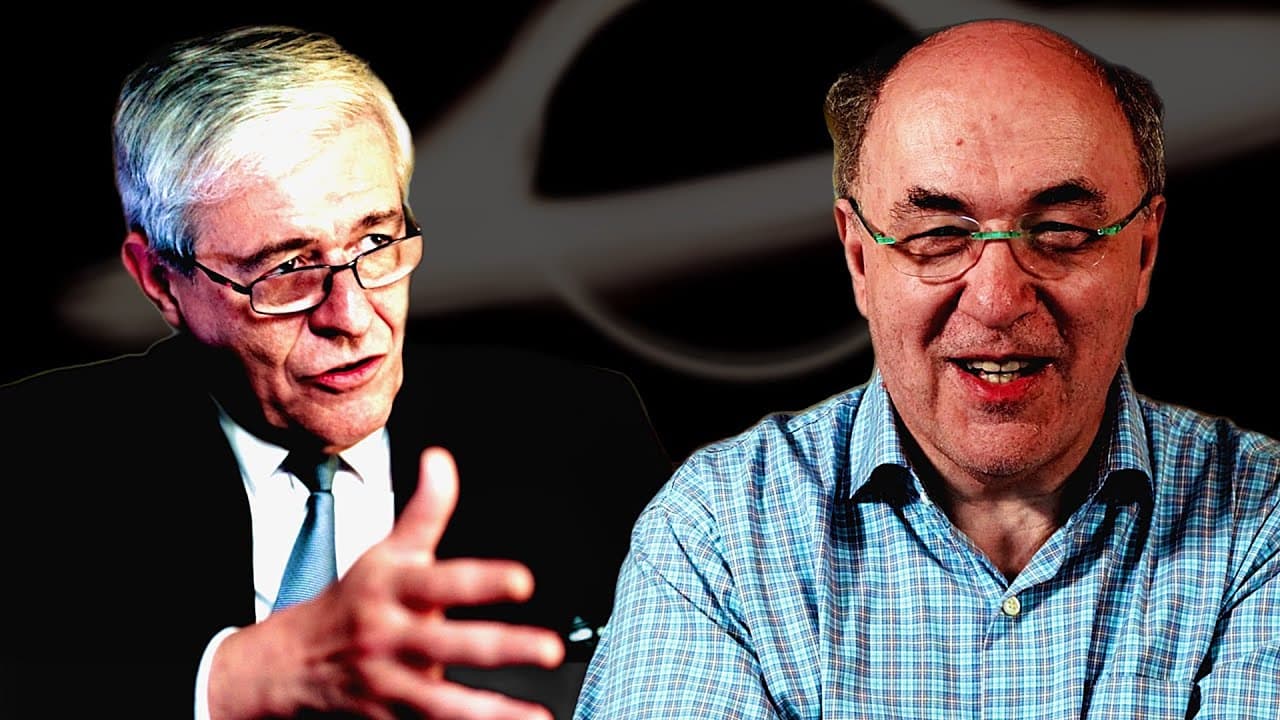
STEPHEN WOLFRAM + KARL FRISTON - OBSERVERS [SPECIAL EDITION]
TL;DR
Computation plays a crucial role in understanding observers and predictability in the universe, allowing for the emergence of intelligence and the ability to minimize surprise by seeking predictability.
Transcript
for much of human history we were kind of like the llms figuring things out by kind of matching patterns in our minds but then came more systematic formalization and eventually computation and with that we got a whole other level of power to truly create new things and to in effect go wherever we want in the ruad but the challenge is to do that in ... Read More
Key Insights
- 🌍 The power of computation has given humans the ability to create new things and explore the universe.
- 💡 Formalization through language, mathematics, logic, and computation allows us to understand and interpret the world.
- 🖥️ Computation is the ultimate formalization tool for our universe and plays a key role in understanding and interacting with it.
- 🧠 Human observers are computationally bounded and can only process aggregated, large-scale information due to finite minds. ⏳ The persistence of an observer in time is an assumption that allows for the perception of intelligence and sentience.
- 🌌 The ruad, the entangled limit of all possible computations, contains everything in the universe and is the ultimate object of our physics project.
- 💥 The emergence of observers like us depends on sparsity and structured dependencies in the universe, making us unique in existence.
- 🔍 Observers actively seek predictability and use the free energy principle to make choices that minimize surprise and maximize predictability.
Install to Summarize YouTube Videos and Get Transcripts
Explore YouTube Video Summarizer or Get YouTube Transcript Extractor
Questions & Answers
Q: Is predictability essential for the existence and persistence of an observer in the universe?
Yes, predictability is crucial for the existence and persistence of an observer in the universe. Observers, like us, seek to minimize surprise and maximize predictability in order to maintain coherence, persistence, and control over their environment.
Q: Can a computationally-bound observer successfully navigate an unpredictable world?
A computationally-bound observer can navigate an unpredictable world by actively seeking predictability and minimizing surprise. This is achieved by building models, gathering sensory information, and making choices that lead to more predictable paths within the environment.
Q: How does the concept of thingness relate to the characteristics of an observer?
Thingness refers to the ability of an object or entity to maintain persistence and coherence. Similarly, an observer is characterized by its computational boundedness, persistence in time, and the ability to act back upon the observed environment. Both concepts rely on the existence of boundaries and the capacity to differentiate between internal and external states.
Q: Can an observer exist in a highly unpredictable world where control is limited?
In an extremely unpredictable world, the realization and persistence of an observer become challenging. The ability to maintain coherence and control necessitates the existence of sparse couplings and dependencies within the environment. If the world becomes too chaotic and unpredictable, the observer's ability to navigate and persist may be compromised.
Q: How does the principle of least action align with the free energy principle?
The principle of least action and the free energy principle share similarities, particularly in their optimization principles. Both principles aim to minimize surprise, maintain predictability, and find the most accurate explanations of sensory impressions. The free energy principle extends its application to a notion of the observer with computational boundedness, generating models for effective action and navigation in the world.
Q: How does the free energy principle account for persistent observers in a changing universe?
The free energy principle accounts for persistence by incorporating the idea of a Markov boundary, separating the internal states of the observer from the external environment. By perceiving and modeling the environment based on sparse sensory information, the observer maximizes predictability and minimizes surprise. Persistent observers can adapt and respond to changes in the universe by updating their models and behavior based on available information.
Summary & Key Takeaways
-
Computation has given humans the power to create new things and navigate the universe, but it's important to connect with what humans and AI understand.
-
Observers like us are computationally bounded and perceive the world through aggregated, large-scale features, which drives the need for predictability.
-
The concept of an observer depends on the existence of a non-equilibrium steady state solution in the dynamics of the universe.
-
The ruad, an entangled limit of all possible computations, contains everything and influences the perception of observers.
Read in Other Languages (beta)
Share This Summary 📚
Summarize YouTube Videos and Get Video Transcripts with 1-Click
Try YouTube Summary with ChatGPT & Claude or YouTube Transcript Generator
Explore More Summaries from Machine Learning Street Talk 📚
![The Mathematical Foundations of Intelligence [Professor Yi Ma] thumbnail](/_next/image?url=https%3A%2F%2Fi.ytimg.com%2Fvi%2FQWidx8cYVRs%2Fhqdefault.jpg&w=750&q=75)
![Why Every Brain Metaphor in History Has Been Wrong [SPECIAL EDITION] thumbnail](/_next/image?url=https%3A%2F%2Fi.ytimg.com%2Fvi%2FpO0WZsN8Oiw%2Fhqdefault.jpg&w=750&q=75)
![Can Outsourcing Thinking Make Us Dumber? [Prof. David Krakauer] thumbnail](/_next/image?url=https%3A%2F%2Fi.ytimg.com%2Fvi%2FjXa8dHzgV8U%2Fhqdefault.jpg&w=750&q=75)
Summarize YouTube Videos and Get Video Transcripts with 1-Click
Try YouTube Summary with ChatGPT & Claude or YouTube Transcript Generator