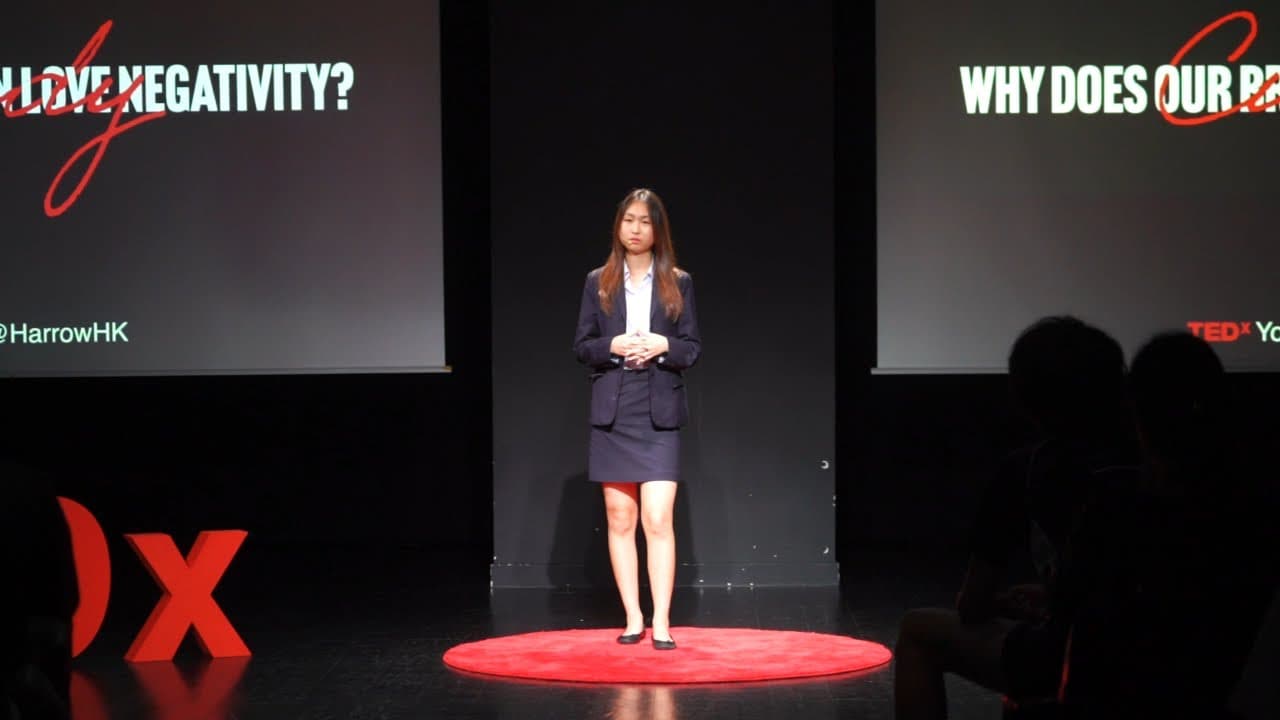
Why does our brain love negativity? | Cindy J | TEDxYouth@HarrowHK
TL;DR
Negativity bias is a social psychological phenomenon that causes individuals to focus more on negative experiences and emotions than positive ones, leading to detrimental effects on mental health and well-being.
Transcript
hello everyone so I've come across a lot of situation in which I'm surrounded by negativity and most of which come from myself forgetting to bring your umbrella on a raining day falling down the stairs in front of everyone things R not after a lineup in the long queue and missing my bus for just one minute was probably Sur surprising the situation ... Read More
Key Insights
- 👯 Negativity bias is a common tendency experienced by most people, where they focus more on negative experiences and emotions.
- ❎ Our brains respond more strongly to negative events and emotions, leading to a stronger recall of insults and negative stimuli.
- 🧑⚕️ Negativity bias can have a detrimental impact on mental health, contributing to depression, anxiety, chronic worry, and OCD.
- 🔉 The media and social media often exploit negativity bias to grab attention, focusing more on negative news and coverage.
Install to Summarize YouTube Videos and Get Transcripts
Explore YouTube Video Summarizer or Get YouTube Transcript Extractor
Questions & Answers
Q: What is negativity bias?
Negativity bias is a social psychological phenomenon where individuals tend to think more pessimistically and dwell on negative experiences and emotions, rather than focusing on the positive aspects of life.
Q: How does negativity bias affect mental health?
Negativity bias can have a detrimental impact on mental health, as it leads to a stronger recall of negative events and emotions. This can contribute to depression, anxiety, chronic worry, and OCD.
Q: Why do our brains respond more strongly to negative stimuli?
Our brains have developed a negativity bias as an evolutionary survival mechanism. In dangerous situations, our brains prioritize negative signals to warn us of potential threats and stimulate a protective response.
Q: How does negativity bias manifest in risk-taking behavior?
Negativity bias can affect risk analysis, as individuals tend to exert more effort to avoid losing money rather than gaining more. This makes us more risk-averse and less inclined to take risks for potential gains.
Summary & Key Takeaways
-
Negativity bias is a tendency for individuals to think pessimistically and dwell on negative experiences and emotions, rather than focusing on the positive.
-
This bias is influenced by the way our brains respond more strongly to negative stimuli and events, leading to a stronger recall of insults and negativity.
-
Negativity bias can have a detrimental impact on mental health, contributing to depression, anxiety, chronic worry, and OCD.
Read in Other Languages (beta)
Share This Summary 📚
Summarize YouTube Videos and Get Video Transcripts with 1-Click
Try YouTube Summary with ChatGPT & Claude or YouTube Transcript Generator
Explore More Summaries from TEDx Talks 📚




Summarize YouTube Videos and Get Video Transcripts with 1-Click
Try YouTube Summary with ChatGPT & Claude or YouTube Transcript Generator