5.4 Regions in Spacetime Diagrams
TL;DR
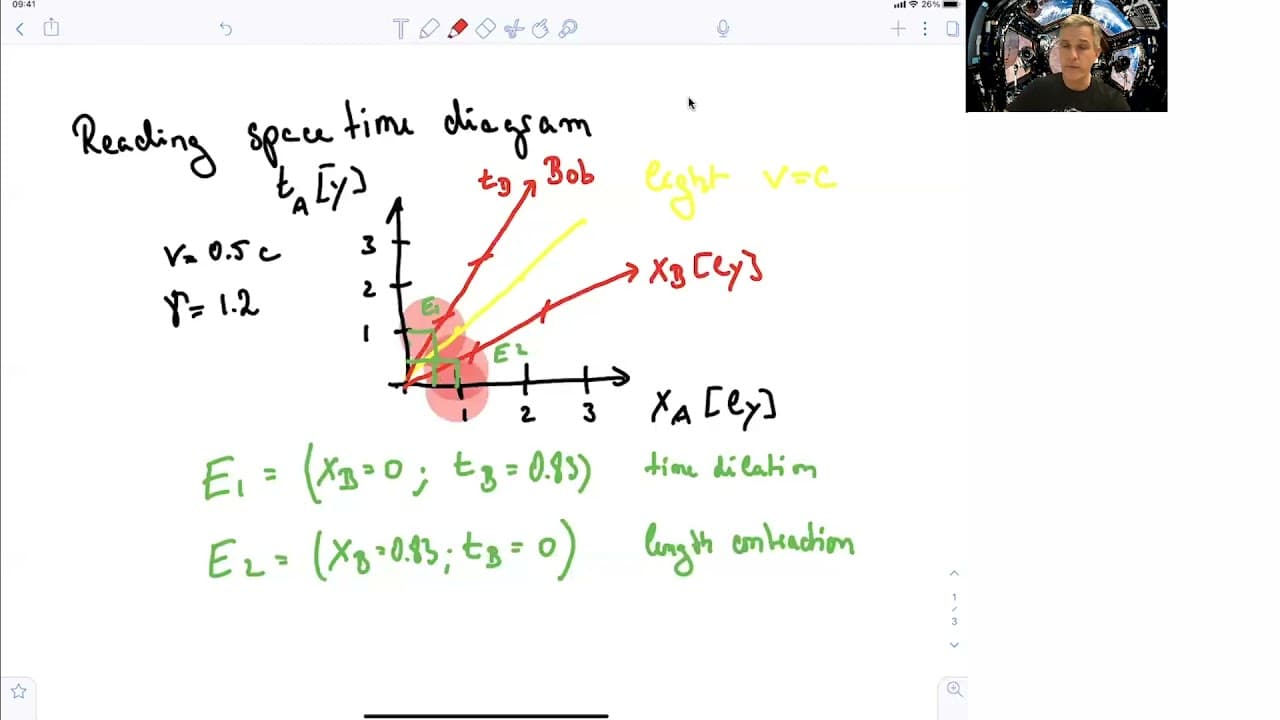
Regions in spacetime diagrams are classified as time-like, light-like, or space-like by the value of c²t² − x². The lesson applies these definitions to 12 events and uses Alice and Bob’s relative velocity of 0.5 times the speed of light, with a gamma factor of 1.2, to illustrate time dilation and length contraction. Read on to see how each region relates to possible causal connections.
Transcript
MARKUS KLUTE: Welcome back to 8.20, Special Relativity. In this section, we want to study space-time diagrams a little bit more in detail, and also define certain regions in space-time diagrams. So let's start again with Alice's space-time diagram here in which we plot or draw Bob's space-time diagram. The relative velocity difference is 0.5 times ... Read More
Key Insights
- ⌛ Relative velocity affects time dilation and length contraction in space-time diagrams.
- 🙂 Time-like events can be causally connected, while space-like events cannot be connected due to the speed of light limitations.
- 🙂 Characterizing events as time-like, light-like, or space-like helps understand their causal relationships.
- 👾 Space-time diagrams provide a visual representation of events in special relativity.
- 👾 The measurement of time and space can differ between different observers.
- 🙂 Light moves at a constant speed and plays an important role in space-time diagrams.
- ⌛ Time dilation and length contraction are fundamental concepts in special relativity.
Install to Summarize YouTube Videos and Get Transcripts
Explore YouTube Video Summarizer or Get YouTube Transcript Extractor
Questions & Answers
Q: How are regions classified in spacetime diagrams?
Events are time-like when c²t² − x² is greater than zero, light-like when it equals zero, and space-like when it is less than zero. The light-like events lie on the yellow world lines of light.
Q: Which of the 12 events are time-like, light-like, or space-like?
Events 2, 5, and 6 are time-like. Events 1, 7, 4, and 9 are light-like, while events 8, 12, 11, 10, and 3 are space-like.
Q: What does a time-like event mean in a spacetime diagram?
A time-like event satisfies c²t² − x² > 0. Starting from the origin, correspondence with a future event is possible only when that event is time-like.
Q: What does a light-like event mean in a spacetime diagram?
A light-like event satisfies c²t² − x² = 0. In the diagram, these events lie on the yellow world lines representing light traveling at speed c.
Q: What does a space-like event mean in a spacetime diagram?
A space-like event satisfies c²t² − x² < 0. The lesson explains that correspondence from the origin to such an event is not possible.
Q: How does the first event demonstrate time dilation?
For event 1, Alice’s time is 1 and Bob’s spatial coordinate is zero, so the event lies on Bob’s timeline. Bob’s clock reads 0.83, or one divided by gamma, which displays time dilation directly.
Q: How does the second event demonstrate length contraction?
For the second event, Alice measures a spatial coordinate of 1 light-year while Bob’s time coordinate is zero. Bob reads a spatial coordinate of 0.83, indicating length contraction.
Q: What relative motion is used for Alice and Bob’s spacetime diagrams?
Alice and Bob have a relative velocity difference of 0.5 times the speed of light. This produces a gamma factor of 1.2 and leads to the illustrated time-dilation and length-contraction measurements.
Summary & Key Takeaways
-
The video introduces Alice's space-time diagram and how Bob's diagram is plotted based on their relative velocity. The world line of light is also included.
-
Two specific events are discussed, one where time dilation is observed and another where length contraction is observed.
-
Another space-time diagram is presented with 12 events, and the concepts of time-like, light-like, and space-like events are explained.
Read in Other Languages (beta)
Share This Summary 📚
Summarize YouTube Videos and Get Video Transcripts with 1-Click
Try YouTube Summary with ChatGPT & Claude or YouTube Transcript Generator
Explore More Summaries from MIT OpenCourseWare 📚


Summarize YouTube Videos and Get Video Transcripts with 1-Click
Try YouTube Summary with ChatGPT & Claude or YouTube Transcript Generator