Cosmic Vision: Witnessing Fireworks
TL;DR
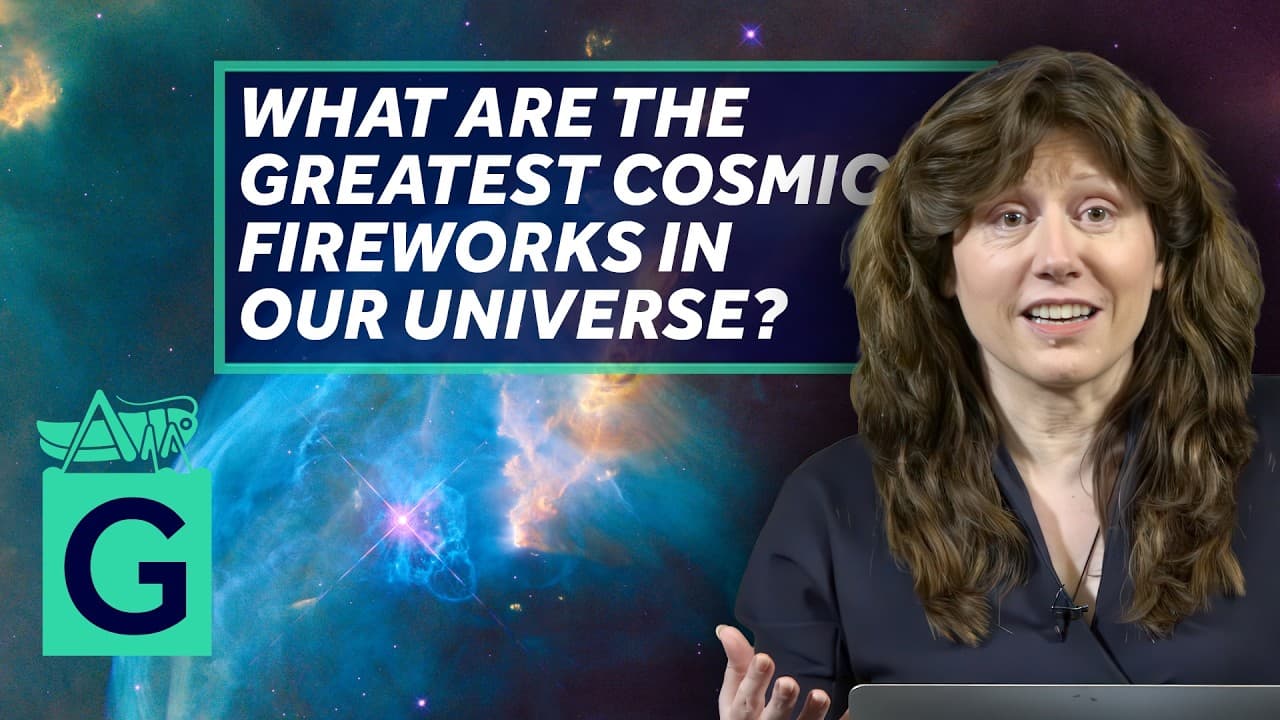
This comprehensive analysis explores the concept of celestial fireworks, including supernovae explosions, comets, and the potential identification of the star of Bethlehem.
Transcript
- Hello everybody and welcome to lecture number three, in this series on cosmic vision. Following on from my previous lecture, which was based around the idea of attentive eyes on the night sky, we're going to be turning our attention today on witnessing fireworks. Now in this country two weeks ago lots of fireworks were set off in the night sky. T... Read More
Key Insights
- 🎆 The annual fireworks tradition in the UK commemorates the thwarted Gunpowder Plot of 1605, highlighting the historical significance of fireworks.
- 🤩 Supernova explosions are rare events that are responsible for ejecting heavy elements into the interstellar medium, influencing the formation of stars and potentially supporting life.
- 🦻 Historical records, such as Chinese observations, provide valuable insights into supernovae and comets throughout history, aiding in the understanding of celestial phenomena.
- 🤩 The identification of the star of Bethlehem remains uncertain, but various astronomical events, such as triple conjunctions and comets, have been proposed as potential explanations.
Install to Summarize YouTube Videos and Get Transcripts
Explore YouTube Video Summarizer or Get YouTube Transcript Extractor
Questions & Answers
Q: What historical event is associated with the 5th of November in the UK?
The 5th of November in the UK is associated with the thwarted Gunpowder Plot in 1605, where Guy Fawkes and his coworkers attempted to blow up Parliament.
Q: What historical event is believed to be the trigger for the annual fireworks tradition in the UK?
The annual fireworks tradition in the UK is believed to commemorate the thwarted Gunpowder Plot of 1605, where Parliament was saved from destruction.
Q: How frequently do supernova explosions occur in our galaxy?
Supernova explosions occur on average once per century in our galaxy, although they are stochastic and unpredictable events.
Q: What is the potential significance of supernova explosions in relation to the creation of heavy elements?
Supernova explosions are responsible for ejecting heavy elements into the interstellar medium, which ultimately contribute to the formation of new stars and even life itself.
Q: Is it possible to observe the remnants of a supernova explosion that occurred in 1054?
Yes, the Crab Nebula, which is also known as Messier 1, is the remnant of a supernova explosion that occurred in 1054 and is observable today.
Q: What is the role of satellite galaxies in relation to the Milky Way?
Satellite galaxies are smaller galaxies that orbit larger galaxies like the Milky Way. They interact gravitationally with the main galaxy and can influence its dynamics.
Q: Can the identification of the star of Bethlehem be definitively determined?
The identification of the star of Bethlehem remains uncertain, but various astronomical events, such as triple conjunctions and comets, have been proposed as potential candidates.
Q: Why did King Herod decree the massacre of male toddlers under the age of three?
King Herod may have feared that a newborn King, as referred to by the magi, posed a threat to his rule. The massacre was an attempt to eliminate any potential rivals.
Summary & Key Takeaways
-
The lecture discusses the historical traditions and significance of fireworks, such as the annual fireworks in the UK on November 5th, commemorating the thwarted Gunpowder Plot in 1605.
-
The focus then shifts to Kepler's supernova, a spectacular supernova explosion that occurred in 1604 and was brighter than any other star in the night sky. The lecture explains the energetics and the role of supernovae in the creation of heavy elements.
-
The lecture explores the potential for black hole formation from supernovae explosions and discusses the rate of supernova explosions in our galaxy, highlighting the rarity of such events.
-
The speaker delves into the historical records of supernovae observations, particularly in Chinese history, and discusses the Crab Nebula as the remains of a supernova explosion in 1054.
-
The content then examines various galaxies, such as the Large and Small Magellanic Clouds, and their satellite galaxies, along with the potential collision of the Milky Way and the Large Magellanic Cloud.
-
The lecture presents Eta Carinae as a massive star system that could potentially go supernova and discusses Betelgeuse as another candidate for a supernova event.
-
The speaker explores the Carina Nebula, its structures, and the spectroscopic observations of Eta Carinae.
-
The lecture provides insights into the possible identification of the star of Bethlehem, considering astronomical events such as triple conjunctions of Jupiter and Saturn and comets observed in Chinese records.
-
The content highlights the historical context and potential interpretations of the celestial events surrounding the birth of Christ and the role of the Magi.
Read in Other Languages (beta)
Share This Summary 📚
Summarize YouTube Videos and Get Video Transcripts with 1-Click
Try YouTube Summary with ChatGPT & Claude or YouTube Transcript Generator
Explore More Summaries from Gresham College 📚
Summarize YouTube Videos and Get Video Transcripts with 1-Click
Try YouTube Summary with ChatGPT & Claude or YouTube Transcript Generator