Animating Elastic Rods With Sound | Two Minute Papers #175
TL;DR
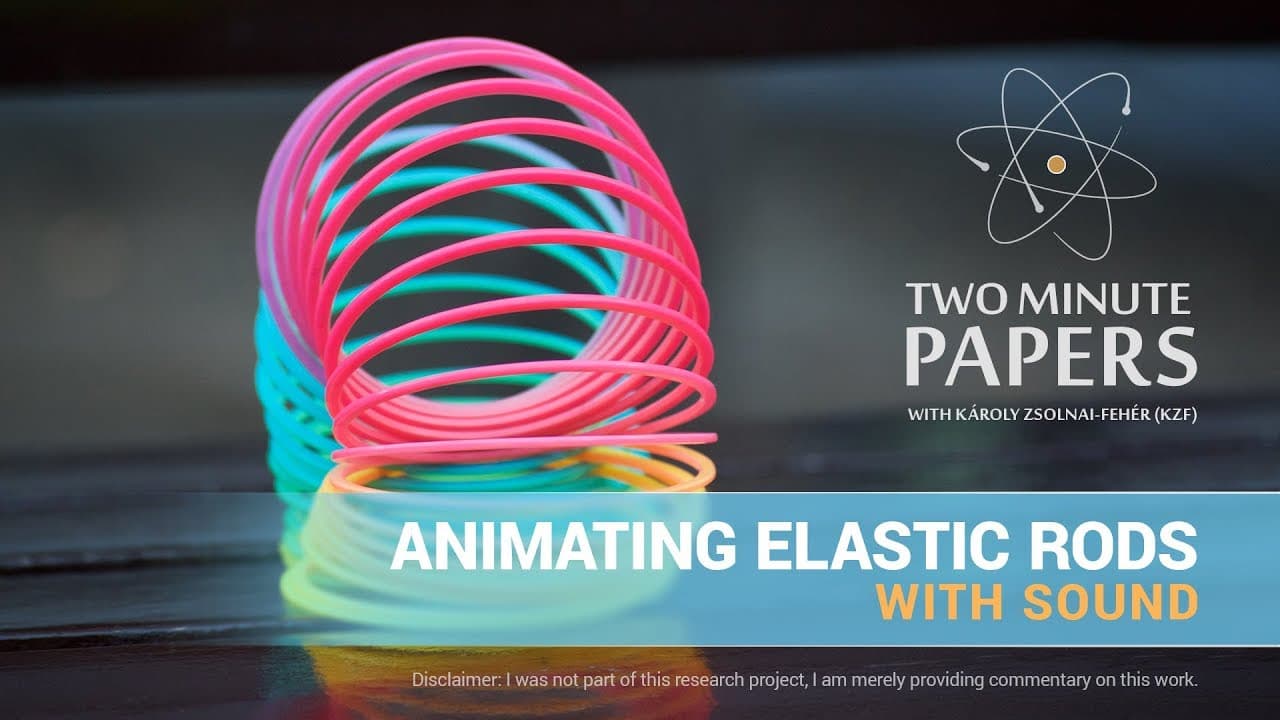
This video discusses a research paper that presents a simulation technique for creating realistic sound effects of virtual elastic rods, including everyone's favorite toy, the walking slinky.
Transcript
Dear Fellow Scholars, this is Two Minute Papers with Károly Zsolnai-Fehér. In the series, we talk a lot about photorealistic rendering and making sure that the appearance of our virtual objects is simulated properly. A lot of works on how things look. However, in order to create a more complete sensorial experience, we also have to simulate how the... Read More
Key Insights
- 👂 Simulating the sound of virtual objects is crucial for creating a complete sensorial experience.
- 👋 The dipole model, typically used for physics applications, proves effective in describing the sound waves of virtual elastic rods.
- 😑 The proposed technique eliminates lengthy pre-computation steps, making it computationally efficient.
- 🥰 Comparisons against the state of the art show that the new technique produces much richer and more realistic sound simulations.
- 👂 Validation against real-world sound samples ensures the accuracy of the algorithm.
- 👂 Science can bring more life to virtual worlds by incorporating realistic sound simulations.
Install to Summarize YouTube Videos and Get Transcripts
Explore YouTube Video Summarizer or Get YouTube Transcript Extractor
Questions & Answers
Q: What is the main challenge in simulating the sound of virtual elastic rods?
The main challenge lies in accounting for the varying sound frequencies over time, as well as the objects' motion and deformations during the simulation.
Q: How does the dipole model contribute to the sound synthesis?
The dipole model, commonly used for approximating electric and magnetic fields, can effectively describe the symmetric sound waves around cross sections of the virtual elastic rods, resulting in realistic sound simulations.
Q: How does the proposed technique compare to previous methods?
The proposed technique eliminates lengthy pre-computation steps present in previous techniques, making it computationally efficient. Comparisons against the state of the art also demonstrate that the sound produced by this new technique is much richer.
Q: How do the researchers validate the sound simulations?
The researchers provide frequency plots that compare the output of their algorithm with real-world sound samples from their lab, ensuring the accuracy and realism of the simulated sound.
Summary & Key Takeaways
-
The video explores a technique for simulating the sound of virtual elastic rods made of different materials like aluminum, steel, oak tree, and rubber.
-
The simulation is challenging due to the varying sound frequencies over time and the objects' motion and deformations.
-
The researchers propose a dipole model, typically used for approximating electric and magnetic fields, to create these sound simulations.
Read in Other Languages (beta)
Share This Summary 📚
Summarize YouTube Videos and Get Video Transcripts with 1-Click
Try YouTube Summary with ChatGPT & Claude or YouTube Transcript Generator
Explore More Summaries from Two Minute Papers 📚






Summarize YouTube Videos and Get Video Transcripts with 1-Click
Try YouTube Summary with ChatGPT & Claude or YouTube Transcript Generator