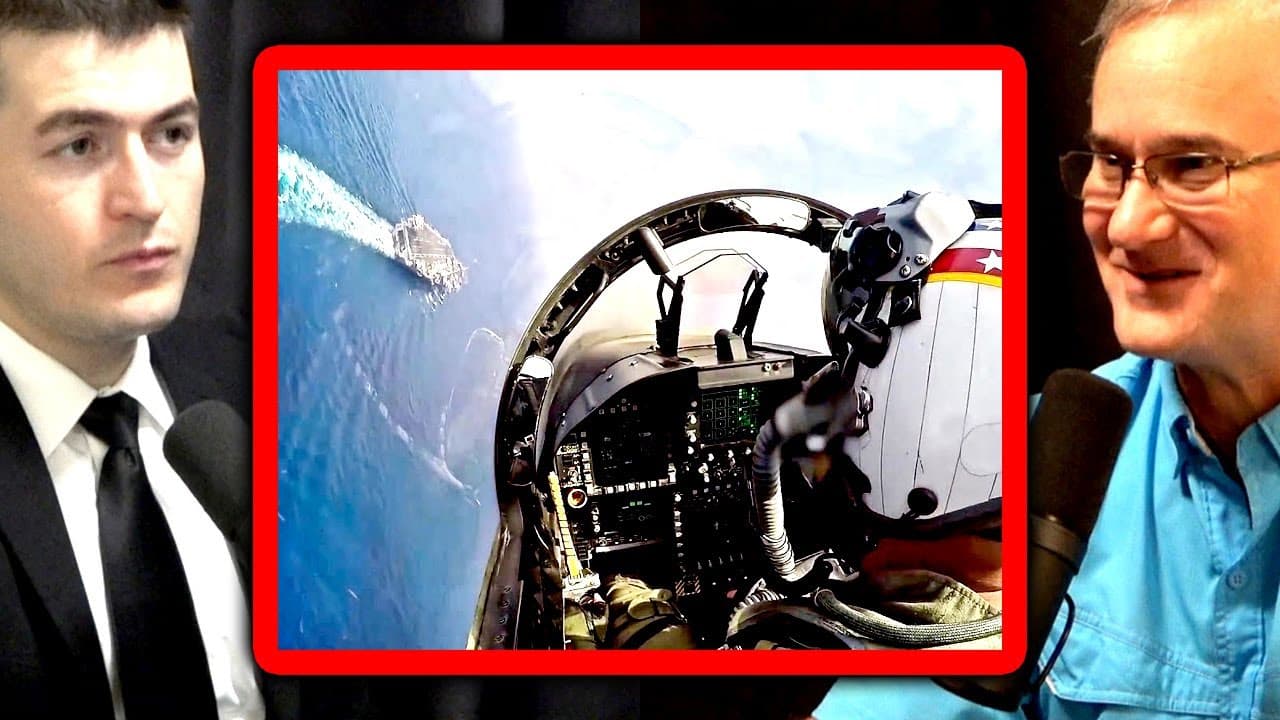
Landing a jet fighter on a carrier is hard | David Fravor and Lex Fridman
TL;DR
Navy carrier pilots experience fear during difficult night landings, but they rely on training and instinct to overcome it.
Transcript
so you never have you experienced fear during flight like um i mean one one way we just offline mentioning mike tyson he talked about like uh as he's uh walking up to the ring he's like he starts out basically in fear and uh yeah worried about how things are going to go i mean it's purely to put into words as fear but as he gets closer and closer t... Read More
Key Insights
- 😨 Navy carrier pilots often experience fear during night landings, especially when conditions such as poor weather and a moving deck are present.
- 🏝️ The difficulty of landing on an aircraft carrier at night is amplified by limited depth perception and the constant movement of the ship.
- 🧑✈️ Landing systems used by navy carrier pilots are not as precise as those used by civilian pilots, adding to the challenge of night landings.
- 😨 Training and instinct play crucial roles in helping navy carrier pilots overcome fear and successfully land in challenging conditions.
- 😨 Maintaining focus and confidence is essential for navy carrier pilots during night landings, as there is no room for fear or hesitation.
- ✋ The high levels of adrenaline experienced during challenging night landings can result in shaking and physical reactions.
- 😨 Overcoming fear in naval aviation is a necessary part of the job, and pilots learn to put on a brave face and carry out their duties.
Install to Summarize YouTube Videos and Get Transcripts
Explore YouTube Video Summarizer or Get YouTube Transcript Extractor
Questions & Answers
Q: How do navy carrier pilots overcome fear during night landings?
Navy carrier pilots rely on training and instinct to overcome fear during night landings. They focus on the part of the brain that goes to training and instinctual solutions to navigate through challenging conditions.
Q: Why are night landings on aircraft carriers particularly difficult?
Night landings on aircraft carriers are difficult due to limited depth perception, constant movement of the ship, and challenging weather conditions. These factors can increase anxiety and heart rates, making the landing process more challenging.
Q: What are the differences between the landing systems used by navy carrier pilots and civilian pilots?
Navy carrier pilots use both automatic and instrument landing systems. However, these systems are considered non-precision approaches and are not as stabilized as the precision approaches used by civilian pilots. The constant movement of the ship further complicates the landing process.
Q: How do navy carrier pilots maintain their focus and confidence during challenging night landings?
Navy carrier pilots maintain focus and confidence by focusing on their training and relying on their instincts. They understand that there is no time to think about fear during the landing process and that they must remain focused and land the aircraft safely.
Summary & Key Takeaways
-
Navy carrier pilots, including new ones, often experience fear during night landings due to challenging conditions such as poor weather and a moving deck.
-
Landing on an aircraft carrier at night requires overcoming limited depth perception and adjusting to the constant movement of the ship.
-
The landing systems used by Navy carrier pilots are not as precise as those used by civilian pilots, adding to the difficulty of landing in adverse conditions.
Read in Other Languages (beta)
Share This Summary 📚
Summarize YouTube Videos and Get Video Transcripts with 1-Click
Try YouTube Summary with ChatGPT & Claude or YouTube Transcript Generator
Explore More Summaries from Lex Clips 📚




Summarize YouTube Videos and Get Video Transcripts with 1-Click
Try YouTube Summary with ChatGPT & Claude or YouTube Transcript Generator