MTI Radar || Block Diagram || Power Amplifier Transmitter | Radar Systems | Lec-33
TL;DR
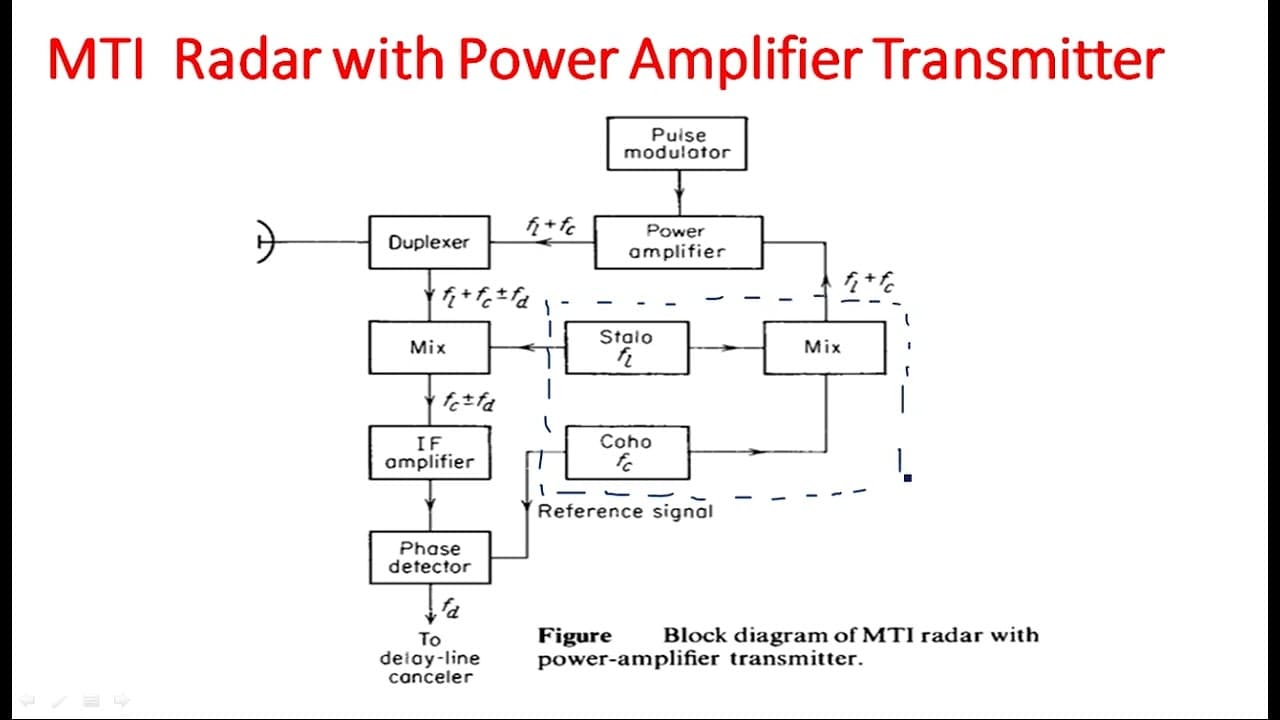
MTA radar identifies moving targets using pulse Doppler technology and can be configured with power amplifier or oscillator transmitters.
Transcript
hi everyone in this video I am going to explain about MTA radar with the power amplifier transmitter so MTA radar we have already seen in the previous video MTA radar stands for moving Target indicator moving Target indicator so moving Target indicator and pulse Doppler radar these two are used to identify the moving targets among the stationary co... Read More
Key Insights
- 💗 MTA radar, designed for moving target detection, leverages pulse Doppler techniques to differentiate between moving and stationary objects.
- ✊ The choice of transmitter (power amplifier vs. power oscillator) impacts the radar’s signal transmission approach and performance.
- 📡 Duplexers are vital in MTA radar systems, enabling effective communication by managing signal flow through a single antenna.
- ✊ The power amplifier in MTA radar cannot generate signals by itself, necessitating additional equipment to provide the required input.
- 📡 A coherent oscillator is used to ensure that the transmitted and retrieved signals remain in phase, which is critical for accurate frequency detection.
- 🎯 Propagation of radar signals is influenced by the movement of targets, with shifts in Doppler frequencies indicating whether targets are approaching or retreating.
- 🎯 The output display, especially on PPI, necessitates converting AC components to DC to produce a clear, interpretable representation of moving targets.
Install to Summarize YouTube Videos and Get Transcripts
Explore YouTube Video Summarizer or Get YouTube Transcript Extractor
Questions & Answers
Q: What is the main purpose of MTA radar?
The primary purpose of MTA radar, or Moving Target Indicator radar, is to identify and track moving targets in the presence of stationary objects, or clutter. By utilizing pulse Doppler technology, MTA radar distinguishes between the signals reflected from moving targets and those from static targets, allowing for accurate tracking and identification.
Q: Can you explain the difference between the two types of MTA radar transmitters?
The two types of MTA radar transmitters include the power amplifier transmitter and the power oscillator transmitter. The power amplifier transmitter relies on external signals that are amplified before transmission, while the power oscillator transmitter generates signals internally using devices like magnetron oscillators. This distinction affects how signals are modulated and transmitted.
Q: How does the duplexer function in MTA radar?
The duplexer is an essential component in MTA radar systems, as it separates the incoming and outgoing signals when using a single antenna. It allows the radar to transmit signals while simultaneously receiving echoes without interference, ensuring clear detection of moving targets without signal overlap from stationary objects.
Q: What role does the delay line canceler play in MTA radar?
The delay line canceler is crucial in MTA radar for converting AC signals into DC signals, facilitating proper signal display on the PPI (Plan Position Indicator). It helps eliminate stationary targets from the moving target displays and converts bipolar video patterns into unipolar patterns, allowing clearer visualization on the radar output.
Summary & Key Takeaways
-
MTA radar, or Moving Target Indicator radar, is designed to distinguish moving targets from stationary clutter, primarily using pulse Doppler technology.
-
There are two configurations of MTA radar: one with a power amplifier transmitter and another with a power oscillator transmitter, each utilizing different methodologies for signal transmission.
-
The discussion includes a detailed explanation of the radar's components, including the duplexer for separating signals during transmission and reception, and the delay line canceler used for converting AC signals to DC for display purposes.
Read in Other Languages (beta)
Share This Summary 📚
Summarize YouTube Videos and Get Video Transcripts with 1-Click
Try YouTube Summary with ChatGPT & Claude or YouTube Transcript Generator