What Are Series Clippers and How Do They Work?
TL;DR
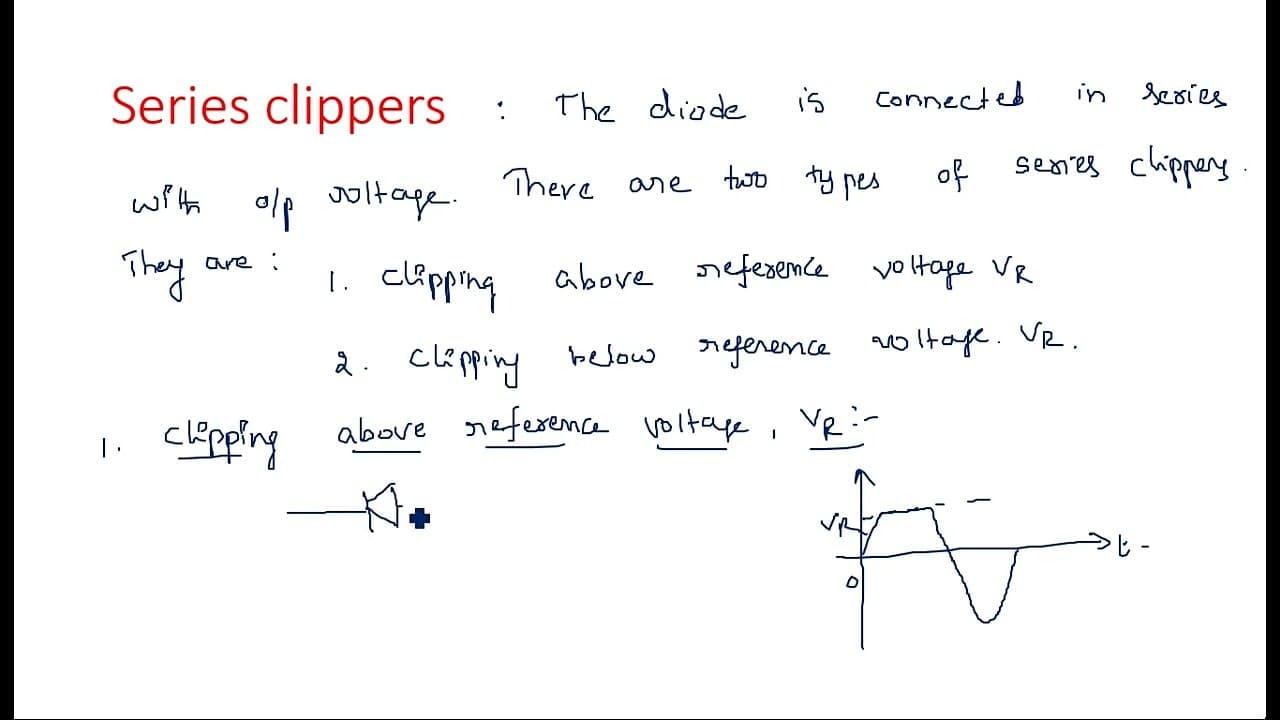
Series clippers are circuits that use diodes in series with the output voltage to modify signal levels. They primarily perform two functions: clipping above reference voltage, where output mirrors input below a certain level, and clipping below reference voltage, where signals above this level are limited. The diode's state determines the output waveform based on the relationship between the input and reference voltage.
Transcript
hi everyone in this video I am going to start the second type of Clippers that is a series type Clippers previously I have explained two types of shunt type Clippers where one is clipping below reference level another one is clipping above reference level okay the main difference between those two diagrams was the diode connection one is in the dow... Read More
Key Insights
- 🅰️ Series type clippers differ from shunt type clippers primarily in diode configuration, which affects output voltage behavior.
- ⚡ Clipping above reference voltage protects devices from high input signals, ensuring safe operation within specified limits.
- ⚡ The behavior of the output waveform is heavily influenced by the state of the diode, depending on input voltage relative to the reference voltage.
- 🎨 Engineers utilize transfer characteristics to predict and visualize circuit behavior, which is crucial in circuit design and analysis.
- ⚡ Understanding the specifics of series clippers is essential for applications such as signal processing, where voltage levels need precise control.
- 👻 The circuit design for series clippers allows for predictable output voltage patterns, essential for various electronic applications.
- 🧡 Series clippers can be pivotal in signal modulation, where certain voltage ranges need to be emphasized or diminished.
Install to Summarize YouTube Videos and Get Transcripts
Explore YouTube Video Summarizer or Get YouTube Transcript Extractor
Questions & Answers
Q: What are the two types of clippers discussed in the video?
The video discusses two types of clippers: series type clippers and shunt type clippers. Series clippers feature a diode connected in series with the output voltage, while shunt type clippers have the diode connected in parallel. This fundamental difference results in various applications and behaviors in electronic circuits.
Q: How does the diode affect the output voltage in the series clipper configuration?
In the series clipper configuration, the diode's state determines the output voltage during different input conditions. When the input voltage is less than the reference voltage (VR), the diode is in an "on" state, allowing the output voltage to equal the input voltage. Conversely, when the input voltage exceeds VR, the diode becomes "off," leading the output voltage to clip at VR.
Q: Can you explain the clipping above reference voltage and its significance?
Clipping above reference voltage occurs when the input signal exceeds a defined voltage (VR). In this state, the diode turns off, preventing higher voltage levels from passing through to the output, effectively "clipping" the signal. This functionality is crucial in circuit design to protect downstream components from excessive voltage and to shape output signals according to specific thresholds.
Q: What role do transfer characteristics play in understanding series clippers?
Transfer characteristics illustrate the relationship between input and output voltages in series clippers. By graphing this relationship, it becomes clear how the output voltage behaves under different input conditions, particularly around the clipping voltage level (VR). Understanding this relationship helps predict circuit behavior and facilitates effective circuit design.
Q: What happens to the output voltage when the input voltage is less than VR?
When the input voltage is less than the reference voltage (VR) in a series clipper, the diode remains in its "on" state. In this scenario, the circuit effectively short-circuits the diode, allowing the output voltage (V naught) to equal the input voltage. This underlines how the series configuration influences voltage behavior during operation below the reference threshold.
Q: How do the two different operational states of the diode impact circuit design?
The two operational states of the diode—on and off—fundamentally dictate the output characteristics of the circuit. Understanding these states allows engineers to design circuits that either limit voltage levels (clipping) or allow full signal transmission, thus providing flexibility in managing signal integrity and component protection within electronic systems.
Summary & Key Takeaways
-
The content discusses series type clippers and contrasts them with shunt type clippers, focusing on diode connection types.
-
Two types of series clippers are explained: clipping above reference voltage and clipping below reference voltage, emphasizing the behavior of diodes in both scenarios.
-
It details circuit configurations and output waveforms based on input voltage conditions, illustrating how output is determined by diode states.
Read in Other Languages (beta)
Share This Summary 📚
Summarize YouTube Videos and Get Video Transcripts with 1-Click
Try YouTube Summary with ChatGPT & Claude or YouTube Transcript Generator