Kelvin double bridge || Electrical Instruments ( EIM ) | Lec - 42
TL;DR
This content explores Kelvin's Double Bridge for precise low resistance measurements.
Transcript
hi everyone in this video i am going to explain kelvin's double bridge in the previous video i have explained the kelvins bridge where we have considered the impact of lead or contact resistance okay that means we have taken the galvanometer position at three different positions and we have taken the lead resistances into consideration and thereby ... Read More
Key Insights
- 😘 Kelvin's Double Bridge is specifically designed for precise measurement of very low resistances, making it a vital tool in electrical engineering.
- 🥺 The setup effectively mitigates the error contributions from both lead and contact resistances, enhancing overall accuracy.
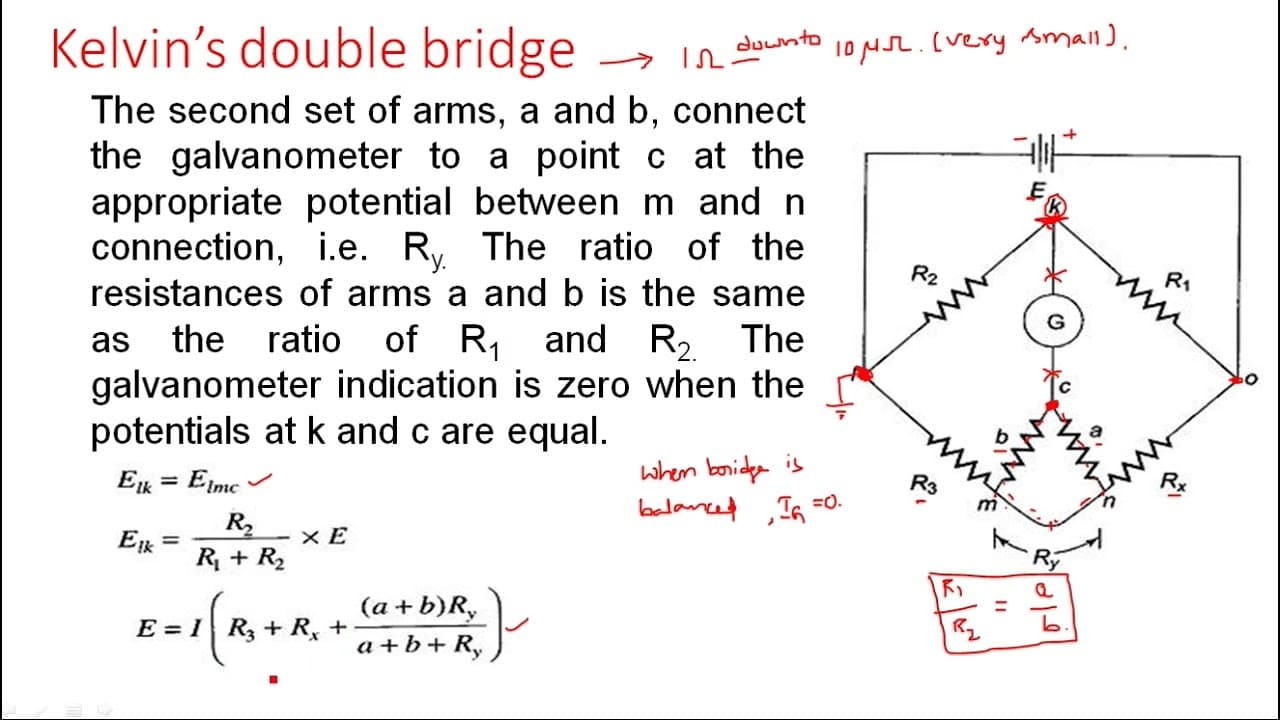
- 🌉 Understanding the bridge balance condition, r1/r2 = a/b, is critical for successfully operating the double bridge.
- 🌉 The video suggests that the application of mathematical equations is central to analyzing and deriving results within the bridge measurement system.
- 🌉 Variations in voltage across different resistors illustrate the interplay between resistance values and balance within the bridge circuit.
- 👻 The arrangement of the additional bridge in Kelvin's Double Bridge allows for more refined measurements than in conventional setups.
- 🦾 Knowledge of the operational mechanics behind the bridge is essential for students and practitioners in electronics and electrical engineering.
Install to Summarize YouTube Videos and Get Transcripts
Explore YouTube Video Summarizer or Get YouTube Transcript Extractor
Questions & Answers
Q: What is the primary advantage of using Kelvin's Double Bridge?
Kelvin's Double Bridge offers significant advantages in measuring very low resistances, such as those around 10 micro-ohms. It enhances accuracy by incorporating considerations for lead and contact resistances, ensuring that measurements remain unaffected by these resistances.
Q: How does the condition r1/r2 = a/b affect the bridge balance?
This condition is crucial for ensuring the bridge balance in Kelvin's Double Bridge. When this condition holds true, it guarantees that the relationship between the resistances leads to the proper null point in the galvanometer, allowing accurate measurement without the influence of contact or lead resistances.
Q: Why is it necessary to consider lead resistance in the Kelvin's measurement technique?
Lead resistance can significantly impact the accuracy of low resistance measurements. By incorporating lead resistance into the calibration of the bridge, the Kelvin's technique ensures that minor fluctuations due to these resistances do not skew the final measurement of the target resistance.
Q: Can Kelvin's Double Bridge be used for measuring high resistances as well?
While the Kelvin's Double Bridge is primarily designed for low resistance measurements, it is theoretically possible to use it for measuring higher resistances. However, this application is not common or optimal due to potential inaccuracies arising from the design and operational principles inherent to the bridge.
Q: What roles do resistors a and b play in Kelvin's Double Bridge?
Resistors a and b form an additional set of arms in the double bridge arrangement that connects to the galvanometer. Their values are integral to maintaining the balance of the bridge and ensuring accurate measurements, as specified by the condition r1/r2 = a/b.
Q: How is the galvanometer's role defined in the bridge balance condition?
The galvanometer indicates balance when there is no current flowing through it, signifying that the voltages across its terminals are equal. This balance allows for the precise measurement of the unknown resistance by equating voltage drops across the various components of the bridge.
Q: What happens if the condition for bridge balance is not met?
If the condition r1/r2 = a/b is not satisfied, the bridge will not achieve balance, leading to a non-zero current in the galvanometer. This condition will result in inaccurate measurements of the unknown resistance, compromising the effectiveness of the Kelvin's Double Bridge technique.
Q: Are the mathematical relationships essential in deriving the unknown resistance?
Yes, the mathematical relationships established during the bridge balance condition are crucial. They help derive the formula for the unknown resistance rx, ensuring that all factors, including the resistances and applied voltage, contribute to an accurate measurement outcome.
Summary & Key Takeaways
-
The video explains the workings of Kelvin's Double Bridge, emphasizing its capability to accurately measure very low resistances, down to 10 micro-ohms.
-
It discusses the importance of accounting for lead and contact resistances in electrical measurements and how this setup mitigates their impact.
-
The content provides a detailed analysis of how Kelvin's Double Bridge functions, including mathematical relationships and the conditions for achieving bridge balance.
Read in Other Languages (beta)
Share This Summary 📚
Summarize YouTube Videos and Get Video Transcripts with 1-Click
Try YouTube Summary with ChatGPT & Claude or YouTube Transcript Generator