While Loops and The Break Statement in Python (Python Tutorial #6)
TL;DR
While loops are an alternative to for loops in Python, allowing for iterative processes when the number of loops is unknown.
Transcript
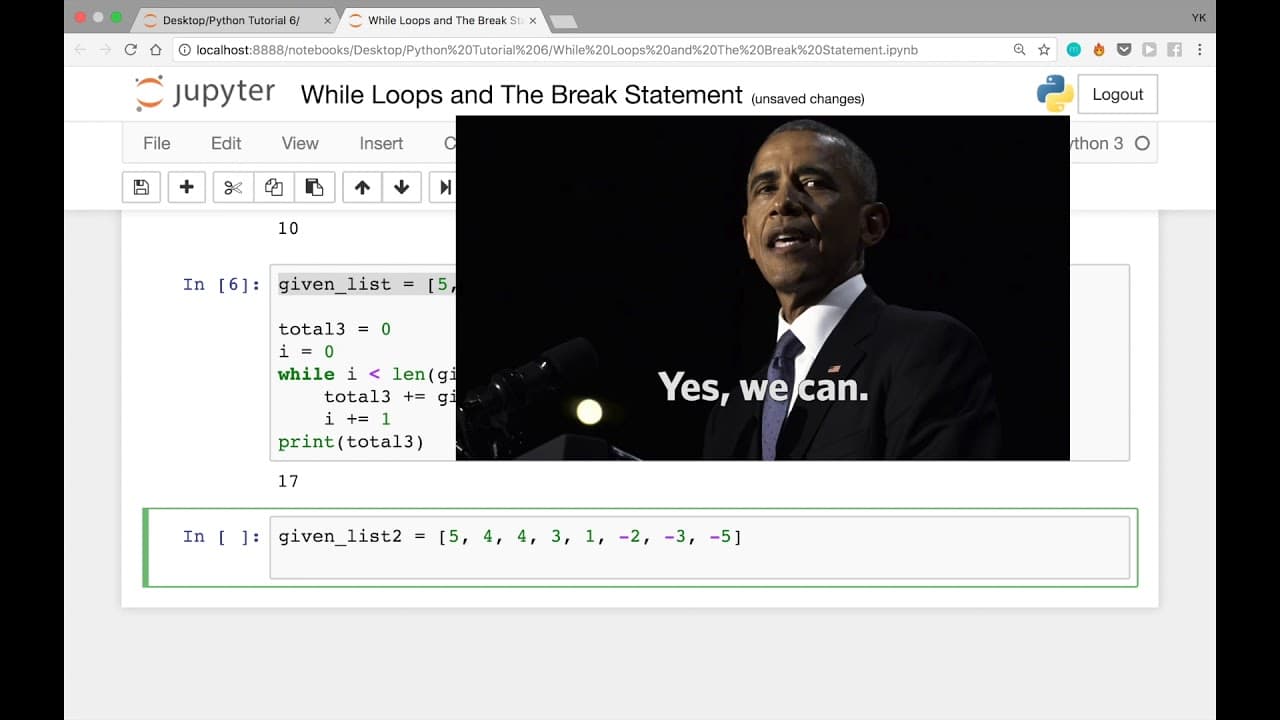
so in the last video we saw how to use for loops but for loops are not the only way to use loops in Python the other common way of using them is called while loops so let's see what it looks like first of all let's recap one of the things we did in the last video we had total being equal to 0 and then we had for I in range 1 comma 5 : 4 spaces tota... Read More
Key Insights
- 🕹️ While loops in Python: The video introduces while loops as an alternative to for loops. It demonstrates how to use a while loop to calculate the sum of integers by iterating through a range.
- 🔁 Difference between for and while loops: The video highlights that for loops are useful when the number of loops needed is known beforehand, while while loops are used when the number of loops is uncertain.
- 📉 Applications of while loops: The video provides an example where a while loop is used to find the sum of positive numbers in a list. It emphasizes that while loops are especially helpful when the number of loops needed is not predetermined.
- 💡 Importance of loop initialization: The video emphasizes the need to initialize the loop index explicitly before the while loop. It highlights that while loops do not automatically initialize the index like for loops do.
- 🔀 Controlling the while loop: The video demonstrates how to control a while loop by using conditions such as "less than" and "greater than." It shows how to increment the loop index within the loop.
- 👍 Advantages of while loops: The video explains that while loops are useful in situations where the number of iterations is unknown. They allow flexibility in looping until a certain condition is met.
- ⚙️ Handling list iteration with while loops: The video provides an example where a while loop is used to iterate over elements in a list. It demonstrates the use of indices and conditions to control the loop.
- ❌ Using break statements: The video introduces the use of break statements to exit a loop prematurely. It shows how break statements can be used to stop iterating through a list when a specific condition is met.
Install to Summarize YouTube Videos and Get Transcripts
Explore YouTube Video Summarizer or Get YouTube Transcript Extractor
Questions & Answers
Q: What is the difference between for loops and while loops?
The main difference between for loops and while loops is that for loops are used when the number of iterations is known beforehand, while while loops are used when the number of iterations is unknown.
Q: Can while loops be used instead of for loops to find the sum of a list?
Yes, while loops can be used to find the sum of a list. However, for loops are typically more efficient and convenient for this task.
Q: How does the break statement work in while loops?
The break statement in a while loop allows you to exit the loop prematurely if a certain condition is met. It breaks out of the loop and continues with the program execution after the loop.
Q: In what situations are while loops particularly useful?
While loops are useful when the number of iterations needed is not known beforehand or when you need to continuously iterate until a certain condition is met.
Q: How do you properly initialize a while loop index?
The while loop index needs to be initialized explicitly before the while loop, usually with a value of 0 or 1, depending on the specific situation.
Q: What happens if the break condition in a while loop is never met?
If the break condition in a while loop is never met, the loop will continue indefinitely, causing an infinite loop. This can lead to the program freezing or crashing.
Q: Can while loops be used instead of for loops for all types of iterative processes?
While loops can be used for most types of iterative processes, but for loops are often preferred for tasks that involve iterating over lists, as they provide a more concise syntax.
Q: Is it possible to use while loops to iterate over a range of values in Python?
Yes, while loops can be used to iterate over a range of values by incrementing or decrementing the loop index within the loop body. However, for loops are generally more suitable for iterating through ranges in Python.
Summary & Key Takeaways
-
While loops are another way to use loops in Python, allowing for iterative processes.
-
While loops require the explicit initialization of the loop index.
-
While loops are useful when the number of loops needed is not predetermined.
Read in Other Languages (beta)
Share This Summary 📚
Summarize YouTube Videos and Get Video Transcripts with 1-Click
Try YouTube Summary with ChatGPT & Claude or YouTube Transcript Generator
Explore More Summaries from CS Dojo 📚

Summarize YouTube Videos and Get Video Transcripts with 1-Click
Try YouTube Summary with ChatGPT & Claude or YouTube Transcript Generator