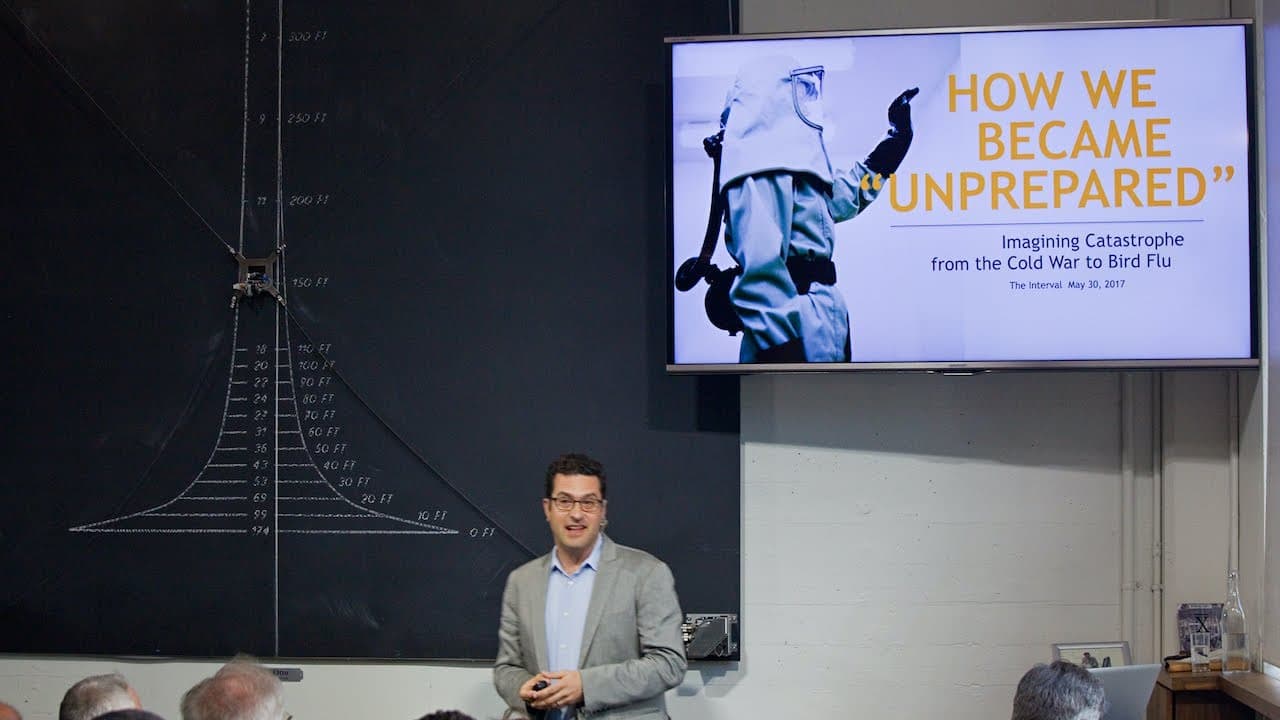
How We Became “Unprepared”: Imagining Catastrophe from the Cold War to Bird Flu | Andrew Lakoff
TL;DR
This talk explores how we approached and prepared for future catastrophes, the different methods and tools used, and the challenges faced in effectively preparing for uncertain events.
Transcript
without much further ado I'm gonna bring our speaker and relay cough who is an anthropologist at USC and is going to talk to us tonight about how we became unprepared big round of applause Fran so first of all I want to thank Michael and all the folks at the interval for not only the invitation but the tremendous work they do to organize to put tog... Read More
Key Insights
- 📚 The history and development of preparedness techniques, such as scenario-based exercises and stockpiling supplies, have shaped our approach to the future and the risks we face.
- 🌍 We have a range of ways to think about and act on the future, and the specific threats we focus on and how we approach them depend on the tools we use to make the future available to us in the present.
- ❓ Evaluating preparedness measures and determining what events to prepare for can be challenging, as it involves making decisions based on potential risks that may or may not occur.
- 💡 The concept of resilience has gained traction in recent years, as it focuses on building the capacity to withstand and bounce back from a wide range of potential shocks and disasters.
- 💉 Post-event evaluations and assessments are important for learning from past experiences and improving preparedness measures for future events.
- 💡 The public's perception and trust in experts can play a significant role in how preparedness measures are received and implemented.
- 🌐 The future of preparedness may involve advancements in technology, such as big data, to improve risk assessment and response strategies. However, the challenges of human behavior and decision making must also be considered.
Install to Summarize YouTube Videos and Get Transcripts
Explore YouTube Video Summarizer or Get YouTube Transcript Extractor
Questions & Answers
Q: What are the challenges in measuring and evaluating preparedness for future catastrophic events?
Measuring and evaluating preparedness for future events is challenging as it involves predicting and preparing for events that may or may not occur, making it difficult to assess the effectiveness of preparedness measures. Additionally, there may be different opinions and criteria for what makes a preparedness measure effective.
Q: How can the public trust experts when it comes to preparedness and response to future catastrophes?
Public trust in experts is crucial for effective preparedness and response. However, transparency and open dialogue between experts and the public are essential in building and maintaining this trust. Public involvement and participation in decision-making processes can also help foster trust and ensure that preparedness measures address public concerns and priorities.
Q: How can the concept of resilience be incorporated into future preparedness efforts?
Resilience, the ability to bounce back from shocks and disasters, is an important aspect of preparedness. Future preparedness efforts can incorporate resilience by focusing on building the capacity of communities and systems to withstand and recover from disasters. This includes promoting decentralized and bottom-up approaches, investing in preventive measures, and addressing underlying vulnerabilities and inequalities.
Q: How can the lessons learned from past events, such as the Ebola epidemic, help improve future preparedness efforts?
Evaluating and learning from past events is crucial for improving future preparedness efforts. Post-hoc assessments can identify strengths and weaknesses in response strategies, highlight areas for improvement, and inform future preparedness plans. It is important to address shortcomings, adapt strategies, and continuously improve preparedness measures based on lessons learned from past events.
Summary & Key Takeaways
-
The history of preparedness can be traced back to the Cold War era and the development of techniques to prepare for war and disasters.
-
Preparedness techniques, such as scenario-based exercises and stockpiling of supplies, were gradually extended to a range of potential events beyond nuclear war.
-
The effectiveness of preparedness measures can be evaluated through post-hoc assessments, but it is difficult to measure preparedness for events that have not yet occurred.
Read in Other Languages (beta)
Share This Summary 📚
Summarize YouTube Videos and Get Video Transcripts with 1-Click
Try YouTube Summary with ChatGPT & Claude or YouTube Transcript Generator
Explore More Summaries from Long Now Foundation 📚
Summarize YouTube Videos and Get Video Transcripts with 1-Click
Try YouTube Summary with ChatGPT & Claude or YouTube Transcript Generator