What Is Electronic Spectroscopy and How Does It Work?
TL;DR
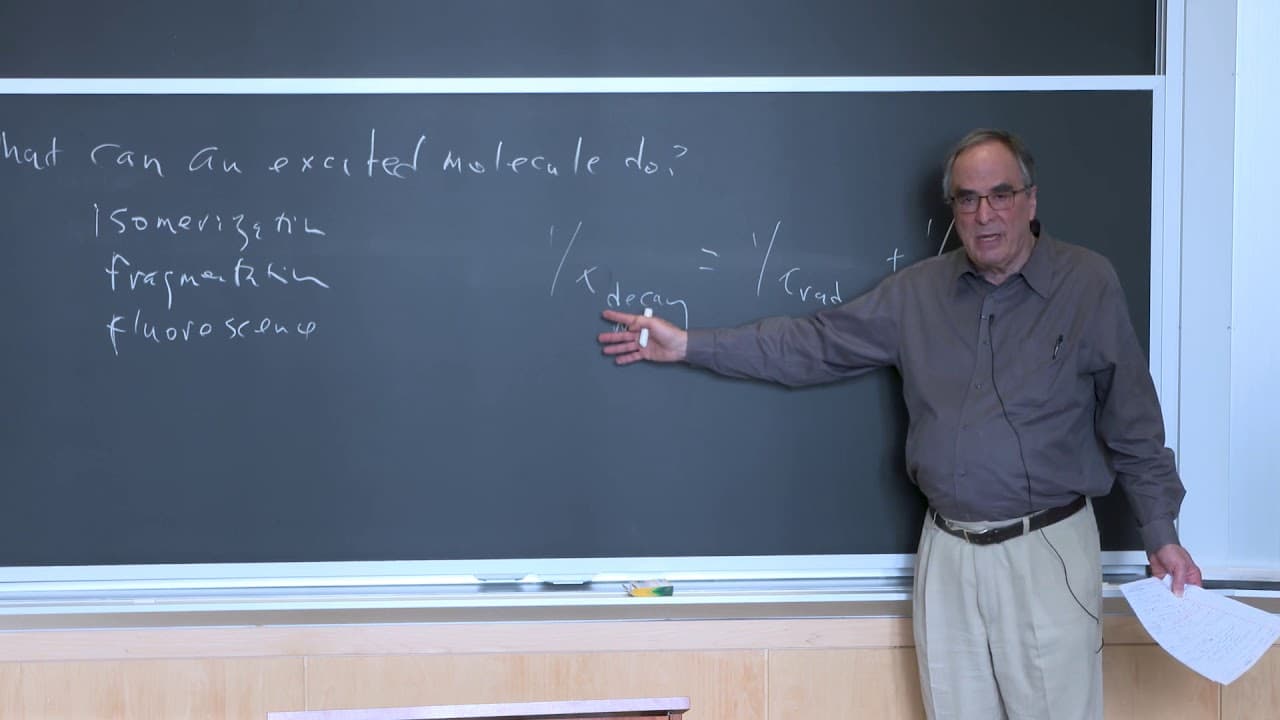
Electronic spectroscopy studies how molecules interact with light to become excited, leading to various processes like isomerization, fragmentation, and fluorescence. Collision-free processes such as intramolecular vibrational redistribution and internal conversion significantly affect how excited molecules decay. Understanding the vibrational density of states and the matrix elements between states is crucial in the dynamics of photochemical reactions.
Transcript
The following content is provided under a Creative Commons license. Your support will help MIT Open Courseware continue to offer high quality educational resources for free. To make a donation or to view additional materials from hundreds of MIT courses, visit MIT OpenCourseware at ocw.mit.edu. PROFESSOR ROBERT FIELD: So last time we talked about i... Read More
Key Insights
- 🈂️ All molecules are attracted to each other, even without charges or dipole moments.
- 🥶 Collision-free processes like intramolecular vibrational redistribution, internal conversion, and intersystem crossing can lead to fast decay rates in excited molecules.
- ❓ Isomerization, fragmentation, and fluorescence are all possible processes when a molecule is excited by a photon.
- 🖐️ The density of vibrational states and the matrix elements between coupled states play crucial roles in the dynamics of photochemistry and isomerization.
Install to Summarize YouTube Videos and Get Transcripts
Explore YouTube Video Summarizer or Get YouTube Transcript Extractor
Questions & Answers
Q: What are intramolecular vibrational redistribution (IVR) and internal conversion (IC)?
IVR is the process of energy redistribution within a molecule's vibrational modes, transferring excitation to different modes. IC involves relaxation from high vibrational levels of an excited state to lower vibrational levels of the same electronic state.
Q: How do collisions affect the decay of excited molecules?
Collisions can remove energy from excited molecules, leading to cooling. They can also facilitate processes like intramolecular vibrational redistribution and collisional relaxation of rotation and vibration.
Q: What is the significance of fluorescence resonance energy transfer (FRET)?
FRET is a dipole-dipole interaction between a donor and acceptor molecule, where the efficiency of energy transfer is dependent on the distance between them. It can be used as a molecular ruler to measure distances in biological systems.
Q: How does the energy gap between excited states affect processes like internal conversion and intersystem crossing?
Internal conversion (IC) is favored when the energy gap between singlet and triplet states is larger, while intersystem crossing (ISC) is favored when the energy gap is smaller. Spin-orbit interactions can also influence the relative importance of IC and ISC.
Summary & Key Takeaways
-
Intermolecular interactions between molecules are universal and all molecules are attracted to each other, even without charges or dipole moments.
-
Photochemistry explores what happens when a molecule is excited by a photon, including processes like isomerization, fragmentation, and fluorescence.
-
Collision-free processes like intramolecular vibrational redistribution, internal conversion, and intersystem crossing can lead to fast decay rates in excited molecules.
Read in Other Languages (beta)
Share This Summary 📚
Summarize YouTube Videos and Get Video Transcripts with 1-Click
Try YouTube Summary with ChatGPT & Claude or YouTube Transcript Generator
Explore More Summaries from MIT OpenCourseWare 📚


Summarize YouTube Videos and Get Video Transcripts with 1-Click
Try YouTube Summary with ChatGPT & Claude or YouTube Transcript Generator