(Q5.) Sample 3 GCC Math 101/120 Common Final Intermediate Algebra
TL;DR
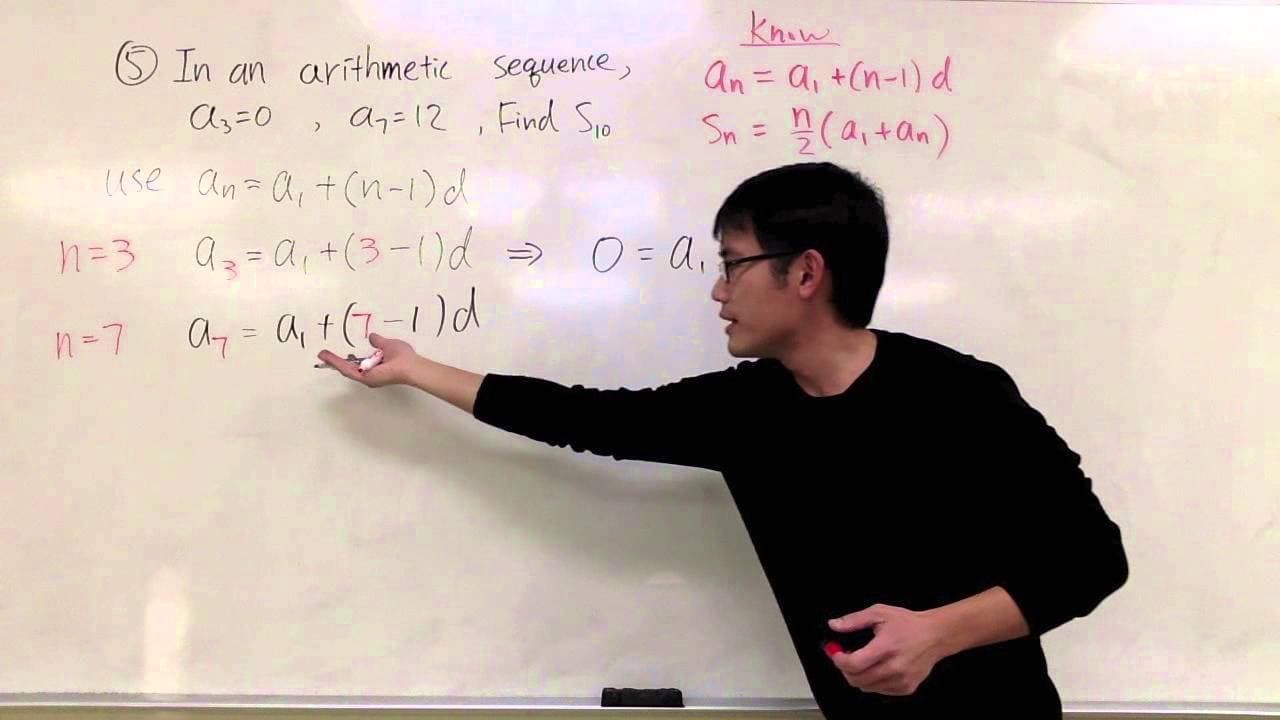
The video explains how to find the sum of the first ten terms of an arithmetic sequence using formulas and solving for a1 and a10.
Transcript
for question number five we have an arithmetic sequence and we know that a3 is equal to zero a7 is equal to 12 and our goal is to find out what s10 is equal to and s10 means the sum of the first ten terms and since we're dealing with the rest of the sequence we should know two formulas to begin with so let me write down what are the formulas that w... Read More
Key Insights
- 🍉 An arithmetic sequence involves adding or subtracting the same number (common difference) to each term.
- 🍉 The instant formula (a_n = a1 + (m-1)d) helps in finding a specific term in the sequence.
- 🤧 The sn formula (sn = n/2(a1 + an)) is used to calculate the sum of the first n terms.
- 😫 By setting up equations and solving for unknowns, the common difference and specific terms can be found.
Install to Summarize YouTube Videos and Get Transcripts
Explore YouTube Video Summarizer or Get YouTube Transcript Extractor
Questions & Answers
Q: What is an arithmetic sequence?
An arithmetic sequence is a sequence of numbers where each term is obtained by adding or subtracting the same number (common difference) from the previous term.
Q: What is the instant formula for arithmetic sequences?
The instant formula for arithmetic sequences is a_n = a1 + (m-1)d, where a_n represents the nth term, a1 is the first term in the sequence, m is the position of the term, and d is the common difference.
Q: What is the sn formula for arithmetic sequences?
The sn formula for arithmetic sequences is sn = n/2(a1 + an), where sn is the sum of the first n terms, a1 is the first term, an is the nth term, and n is the number of terms.
Q: How can we find the value of a1 and d?
By using the given information about specific terms in the sequence (e.g., a3 = 0 and a7 = 12), we can set up equations using the instant formula and solve for a1 and d.
Q: What is the common difference for this arithmetic sequence?
After solving the equations, the common difference (d) is found to be 3.
Q: What is the value of a10?
Plugging in the values for a1, d, and n (a1 = -6, d = 3, and n = 10) into the instant formula, we find that a10 is equal to 21.
Q: How do we calculate the sum of the first ten terms (s10)?
Using the sn formula and substituting the values for a1 and a10, we find that s10 is equal to 75.
Q: Can these formulas be applied to find the sum of terms in any arithmetic sequence?
Yes, the instant formula and sn formula can be used to find the sum of terms in any arithmetic sequence by knowing the first term, common difference, and the number of terms.
Summary & Key Takeaways
-
The video discusses the formulas for arithmetic sequences, including the instant formula (a_n = a1 + (m-1)d) and the sn formula (sn = n/2(a1 + an)).
-
The goal is to find the sum of the first ten terms (s10) of an arithmetic sequence given a3 = 0 and a7 = 12.
-
By using the provided formulas and solving for a1 and a10, the common difference (d) is found to be 3.
-
Plugging in the values, the sum of the first ten terms (s10) is calculated and found to be 75.
Read in Other Languages (beta)
Share This Summary 📚
Summarize YouTube Videos and Get Video Transcripts with 1-Click
Try YouTube Summary with ChatGPT & Claude or YouTube Transcript Generator
Explore More Summaries from blackpenredpen 📚
Summarize YouTube Videos and Get Video Transcripts with 1-Click
Try YouTube Summary with ChatGPT & Claude or YouTube Transcript Generator