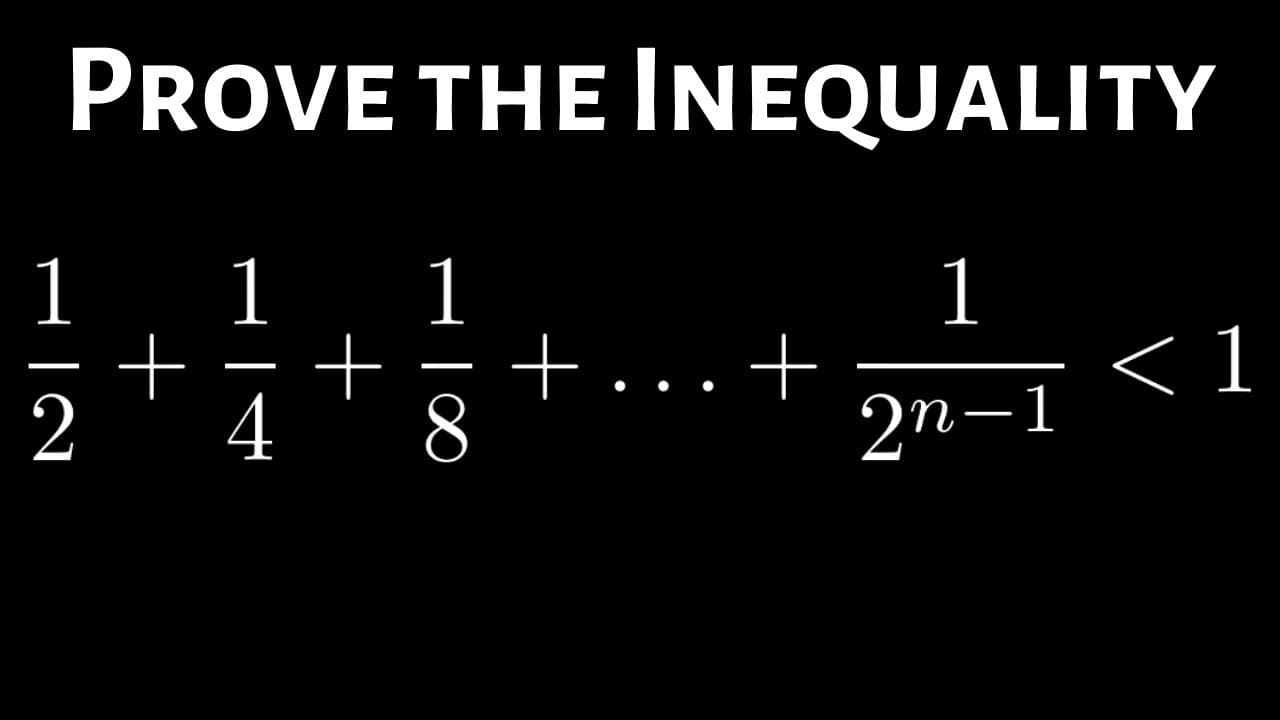
Prove that 1/2 + 1/4 + 1/8 + ... + 1/2^(n - 1) is less than 1
TL;DR
A direct proof is given to show that the sum of a geometric series is less than 1.
Transcript
in this problem we're going to prove that one-half plus one-fourth plus one-eighth plus dot dot dot plus one over two to the n minus one is less than one for all positive integers n greater than one so you know the natural thing to do is to use like an induction proof and we could do this by induction but in this video i want to give like a direct ... Read More
Key Insights
- 🍹 The proof demonstrates a direct method to show that the sum of a geometric series is less than 1.
- 🥳 Using the common ratio of 1/2, the proof manipulates the equation to simplify it and reach the conclusion.
- 🍉 The canceled out terms in the equation represent the geometric progression of the series.
- 👍 The proof highlights the elegance and alternative approach to proving the sum's inequality.
- 👍 Induction can also be used to prove the same result more rigorously.
- 🥳 The geometric series sum is directly linked to the value of the common ratio.
- 🍹 The proof emphasizes the significance of understanding geometric series and their sums in mathematics.
Install to Summarize YouTube Videos and Get Transcripts
Explore YouTube Video Summarizer or Get YouTube Transcript Extractor
Questions & Answers
Q: What is the goal of the proof presented in the video?
The goal is to prove that the sum of the series 1/2 + 1/4 + 1/8 + ... + 1/(2^n-1) is less than 1 for all positive integers n.
Q: How is the sum denoted in the proof?
The sum is denoted as 's' in the proof.
Q: What is the common ratio of the geometric series?
The common ratio of the geometric series is 1/2.
Q: Why does the equation simplify to s = 1 - 1/(2^n-1)?
This equation is obtained by subtracting s from 1/2s and canceling out terms, leaving 1 - 1/(2^n-1).
Q: Is the sum of the series always less than 1 according to the proof?
Yes, the proof shows that the sum of the series is always less than 1 for all positive integers n.
Summary & Key Takeaways
-
The goal is to prove that the sum of the series 1/2 + 1/4 + 1/8 + ... + 1/(2^n-1) is less than 1 for all positive integers n.
-
A direct proof is presented, without using induction, by assigning the sum as 's'.
-
Multiplying s by 1/2, which is the common ratio of the series, and subtracting s from 1/2s, the equation simplifies to s = 1 - 1/(2^n-1).
-
It is shown that since 1/(2^n-1) is a number smaller than 1, the sum s is also less than 1.
Read in Other Languages (beta)
Share This Summary 📚
Summarize YouTube Videos and Get Video Transcripts with 1-Click
Try YouTube Summary with ChatGPT & Claude or YouTube Transcript Generator
Explore More Summaries from The Math Sorcerer 📚




Summarize YouTube Videos and Get Video Transcripts with 1-Click
Try YouTube Summary with ChatGPT & Claude or YouTube Transcript Generator