Humans are rats trapped in a maze | Balaji Srinivasan and Lex Fridman
TL;DR
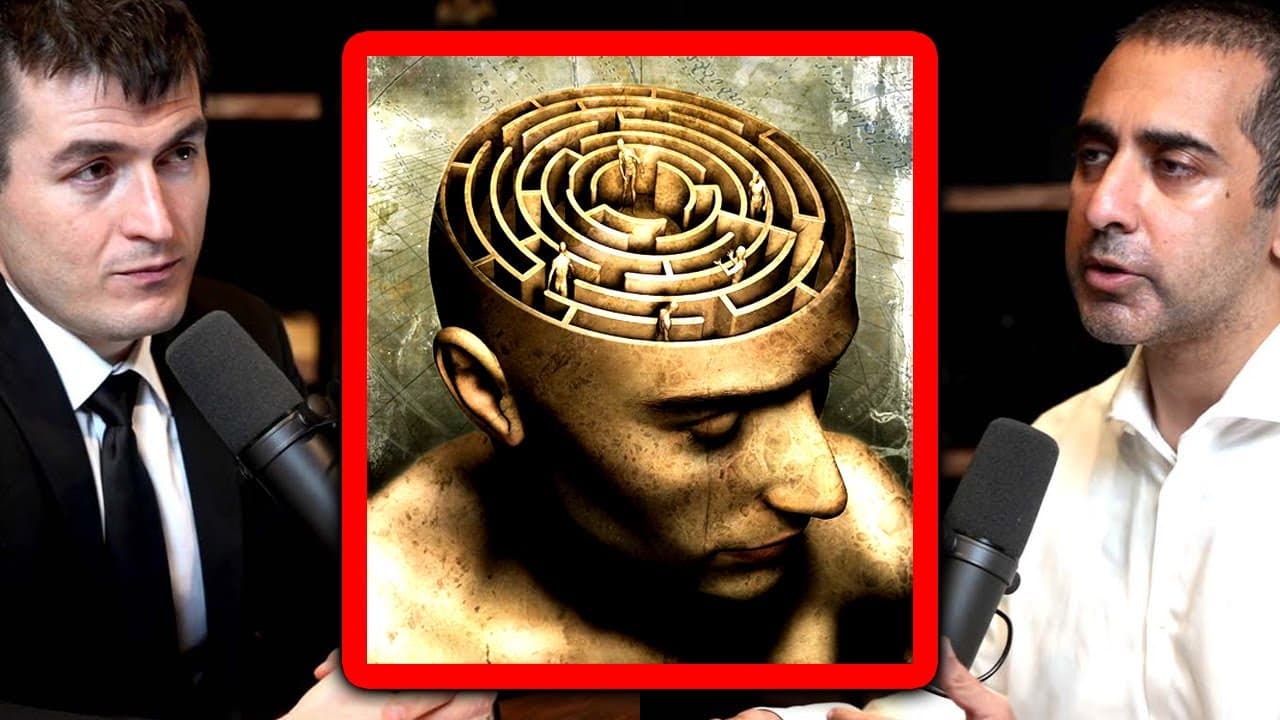
The content discusses the prime number maze analogy and the idea that many patterns in life may be beyond human cognition, as well as delving into the limits and possibilities of human understanding of the universe.
Transcript
at the core of your belief system is something you call the a prime number maze I'm curious I'm curious we gotta start there sure if we can start anywhere with mathematics let's go all right great a rat can be trained to turn at every even number or every third number in a maze to to get some cheese but evidently it can't be trained to turn at prim... Read More
Key Insights
- 🤨 The prime number maze analogy raises questions about the limits and possibilities of human cognition and understanding.
- ⛔ The speaker considers the limits of human cognition to be more of a bug than a feature, as great ideas and advancements often come from those who can see beyond these limits.
- 🛟 There may be patterns in life that are beyond human comprehension, indicating that there are still many unknowns and mysteries surrounding the universe.
- 💡 The simulation hypothesis and the idea of reality as a computational nature are also briefly discussed.
- 🍂 The effectiveness of math in describing the world is acknowledged, but there are still areas where math falls short.
- ❓ Unresolved problems in physics, such as Sony luminescence, highlight the existence of phenomena that are not fully understood.
Install to Summarize YouTube Videos and Get Transcripts
Explore YouTube Video Summarizer or Get YouTube Transcript Extractor
Questions & Answers
Q: What is the prime number maze analogy and what does it represent?
The prime number maze analogy suggests that humans, like rats, may be incapable of comprehending certain complex patterns, represented by the prime numbers. This analogy questions the limits of human cognition and understanding.
Q: Are there patterns in life that are beyond human understanding?
Yes, according to the content, there may be patterns in life that are too complex for human cognition to fully grasp. The prime number maze serves as an example of such patterns.
Q: Are the limits of human cognition a feature or a bug?
The speaker believes that the limits of human cognition are mostly a bug. They admire mathematicians and physicists who have been able to see beyond these limits and make significant advancements in knowledge and understanding.
Q: Can humans never figure out certain aspects of the universe?
While there may be things that are unknowable or unprovable in the universe, the content suggests that it is important for humans to continue pushing for approximate solutions and expand the boundaries of their knowledge.
Summary & Key Takeaways
-
The prime number maze analogy suggests that humans, like rats, may be trapped in patterns they cannot fully comprehend.
-
It raises the question of how many patterns in life are too complex for human cognition to understand.
-
The content also discusses the limits of human cognition as a bug rather than a feature.
Read in Other Languages (beta)
Share This Summary 📚
Summarize YouTube Videos and Get Video Transcripts with 1-Click
Try YouTube Summary with ChatGPT & Claude or YouTube Transcript Generator
Explore More Summaries from Lex Clips 📚



Summarize YouTube Videos and Get Video Transcripts with 1-Click
Try YouTube Summary with ChatGPT & Claude or YouTube Transcript Generator