What Are the Main Memory Technologies in Computing?
TL;DR
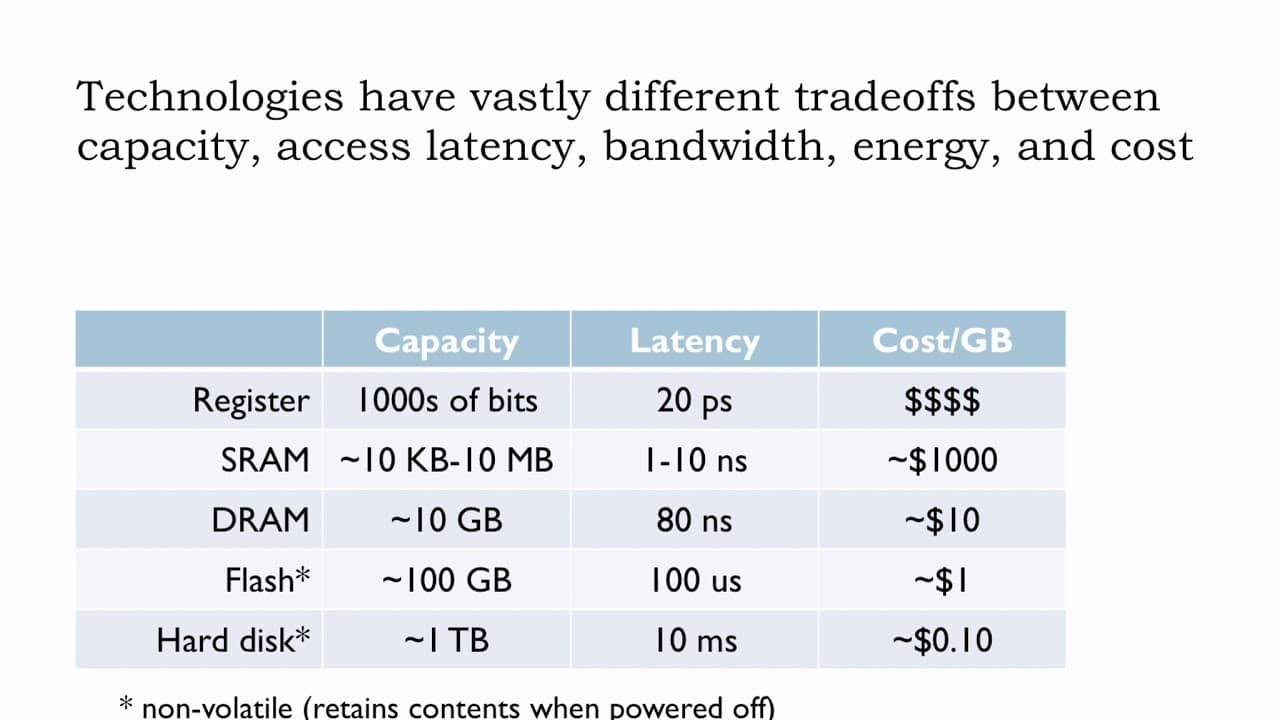
Main memory technologies in computing include registers, SRAM, DRAM, flash memory, and hard disk drives. Registers provide low latency but limited capacity, while SRAM and DRAM offer varying trade-offs between capacity and latency. Flash memory and hard disks serve as non-volatile storage, balancing high capacity with slower access times, contributing to the overall performance and architecture of computer systems.
Transcript
In the last lecture we completed the design of the Beta, our reduced-instruction-set computer. The simple organization of the Beta ISA meant that there was a lot commonality in the circuity needed to implement the instructions. The final design has a few main building blocks with MUX steering logic to select input values as appropriate. If we were ... Read More
Key Insights
- 👍 The design of the Beta computer prioritized simplified instructions, but main memory access proved to be the most costly component.
- 💻 The performance of modern computers is limited by the bandwidth between the CPU and main memory, known as the "memory bottleneck."
- 🍉 Memory technologies like registers, SRAMs, DRAMs, flash memory, and hard disk drives each have their own tradeoffs in terms of capacity, latency, energy efficiency, and cost.
- ♿ Register files offer low-latency access but limited capacity, while static and dynamic memories provide larger capacities at the cost of longer access latencies.
- 🪘 Increasing memory capacity leads to longer access latencies due to increased circuitry area and longer signal lines.
Install to Summarize YouTube Videos and Get Transcripts
Explore YouTube Video Summarizer or Get YouTube Transcript Extractor
Questions & Answers
Q: Why is main memory access the most costly and time-consuming part of executing instructions?
Main memory access is costly because it requires the CPU to fetch instructions and load/store data. The time taken to access main memory can be significant compared to other operations in the CPU, causing performance bottlenecks.
Q: How do registers differ from other memory technologies?
Registers are built from sequential logic and offer very low latency access to a limited amount of data. Registers are primarily used for frequently accessed variables and provide faster processing.
Q: Why do memory technologies like SRAM and DRAM have tradeoffs in terms of capacity and access latency?
Increasing the memory capacity leads to longer access latencies. This is because more bits in the memory circuitry require longer signal lines, leading to slower performance due to increased capacitive loads.
Q: What are the advantages of using flash memory and hard disk drives for non-volatile storage?
Flash memory and hard disk drives provide non-volatile storage, meaning data is preserved even when the power is turned off. Hard disk drives offer massive amounts of long-term storage at low cost, while flash memory provides improved latency and high capacity.
Summary & Key Takeaways
-
The design of the Beta computer focused on reducing instruction set complexity, but main memory access proved to be the most costly and time-consuming part of the execution process.
-
The performance of modern computers is limited by the bandwidth between the CPU and main memory, known as the "memory bottleneck."
-
Different memory technologies, such as registers, SRAMs, DRAMs, flash memory, and hard disk drives, provide varying capacities, latencies, and energy efficiencies.
Read in Other Languages (beta)
Share This Summary 📚
Summarize YouTube Videos and Get Video Transcripts with 1-Click
Try YouTube Summary with ChatGPT & Claude or YouTube Transcript Generator
Explore More Summaries from MIT OpenCourseWare 📚


Summarize YouTube Videos and Get Video Transcripts with 1-Click
Try YouTube Summary with ChatGPT & Claude or YouTube Transcript Generator