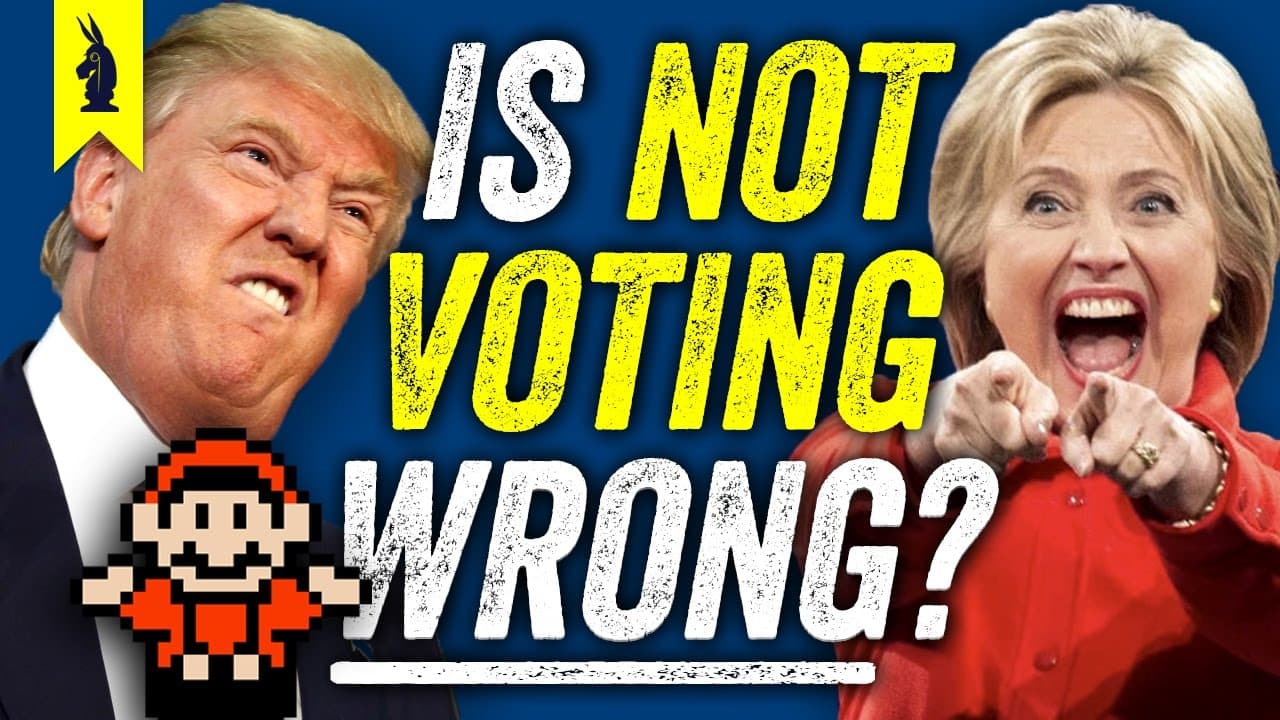
Is It WRONG If You Don't Vote? (Trump vs. Hillary) – 8-Bit Philosophy
TL;DR
Fear-based voting may undermine democratic values and processes.
Transcript
Our elections seem to be getting scarier and scarier, dear viewer. Democrats warn of a petty racist, ready to press the nuclear launch button with his tiny, tiny hands. Republicans warn of a corrupt tyrant, ready to take away your guns and freedom. With options as scary as these, it seems that, today, more and more people are ready to vote against ... Read More
Key Insights
- 😨 The perception of political adversaries as inherently evil may stoke fear and hinder honest discussions about policy.
- 🥺 The strategy of voting against perceived threats can lead to a toxic political atmosphere, where compromising values becomes commonplace.
- 😈 Jacques Ranciere’s philosophy highlights the danger of sacrificing principles in the name of combatting an adversary labeled as evil.
- 😑 Historically, the practice of voting for the "lesser evil" has been ingrained in American politics, creating a cycle of fear-driven choices.
- 😨 Voting decisions made under fear can diminish accountability for elected officials, as their perceived necessity complicates criticism of their actions.
- 😨 As voters prioritize feared outcomes over candidates' merits, democratic ideals may erode from within over time.
- ➗ Continuous acceptance of compromised values can reshape political landscapes, breeding further division and conflict.
Install to Summarize YouTube Videos and Get Transcripts
Explore YouTube Video Summarizer or Get YouTube Transcript Extractor
Questions & Answers
Q: Why do people increasingly vote against candidates they fear?
In a polarized political environment, individuals often feel compelled to choose the lesser of two evils. This fear of potential consequences—like losing freedoms or economic stability—can drive voters to prioritize stopping a feared opponent over supporting a candidate they truly believe in.
Q: How does consequentialist ethics influence voter behavior?
Consequentialist ethics judge the morality of actions by their outcomes rather than intents. This perspective leads voters to believe that casting a ballot for a third-party candidate supports the feared opponent, justifying voting for less desirable candidates to prevent worse outcomes.
Q: What are Jacques Ranciere's views on the morality of political maneuvers?
Ranciere critiques the use of ethical frameworks that portray political adversaries as ultimate evils. He suggests this mindset can justify extreme measures, thus undermining democratic processes. Ultimately, it makes people accept harmful tactics or sacrifices in pursuit of victory over perceived evil.
Q: Are the values of honesty and justice sacrificed in fear-based voting?
Yes, adopting a mentality where the end justifies the means can lead to a gradual erosion of values like honesty and justice. Voters may overlook dishonesty and questionable tactics needed to win elections, which cumulatively deteriorates the integrity of the democratic process over time.
Q: What are the potential consequences of viewing political opponents as evil?
Treating political rivals as embodiments of evil can justify extreme measures, from dishonesty in campaigns to outright illegal conduct. This mindset may shift focus from principled debate to using calculated warfare strategies, weakening the foundations of democratic discourse and engagement.
Q: Can a refusal to vote be a valid option?
Refusing to vote can be considered a moral stance against the fear-driven political climate. By abstaining from participating in an election seen as unethical or forced, individuals may seek to uphold their values, although they risk allowing the feared candidate to prevail.
Q: How can fear-based voting affect future political climates?
If voters continue to engage in fear-based voting, political discourse may become increasingly toxic. Candidates might feel pressured to appeal to negative narratives rather than constructive policies, leading to ongoing cycles of distrust and disengagement from healthy democratic practices.
Summary & Key Takeaways
-
The current political climate fosters fear-driven voting, where individuals often vote against candidates they fear rather than for those they support, eroding democratic principles.
-
Jacques Ranciere argues that viewing political opponents as ultimate evil leads to destructive practices that compromise values, as people justify morally questionable actions to defeat them.
-
This fear-based approach may encourage voters to abandon their principles, leading to a cycle where dishonesty and injustice become acceptable as they pursue a perceived greater good.
Read in Other Languages (beta)
Share This Summary 📚
Summarize YouTube Videos and Get Video Transcripts with 1-Click
Try YouTube Summary with ChatGPT & Claude or YouTube Transcript Generator