How Do Evaporation and Condensation Work?
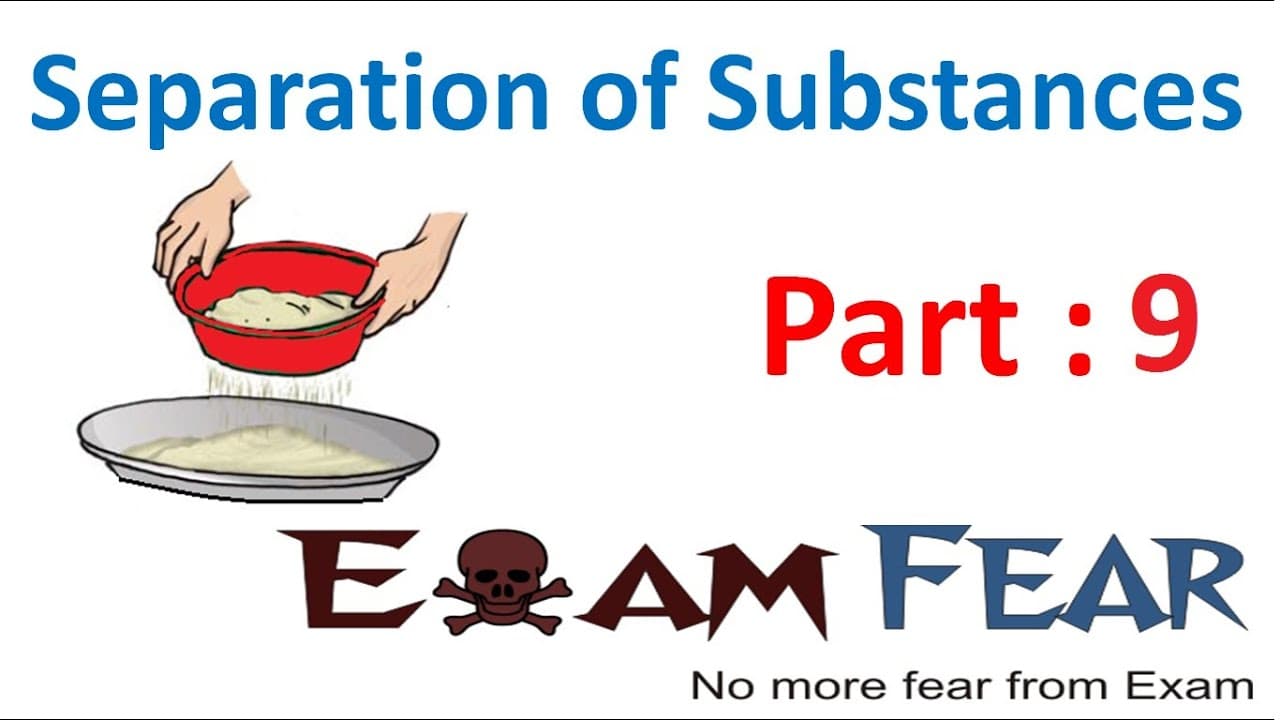
TL;DR
Evaporation is the heating of water to create vapour, which can separate soluble substances like salt and sugar. Conversely, condensation occurs when vapour cools and reverts to liquid water, demonstrating these reversible processes in everyday life.
Transcript
hello friends this video on separation of substances part nine is brought to you by exam viewer.com no more fear from exam so now the next process that we will talk about is evaporation so evaporation is a process in which water is heated to get converted into water vapor so what is the form of water normally the water which we drink that is liquid... Read More
Key Insights
- 💦 Evaporation is the process of heating water to convert it into water vapor.
- 💦 Evaporation can be used to separate soluble substances, like salt and sugar, from water.
- 💦 Condensation is the opposite process of evaporation, where water vapor is cooled to convert it back into liquid water.
- 🌊 Evaporation is used to obtain salt from the sea by allowing sea water to stand in shallow pits under the sun.
- 😎 Condensation can be observed in everyday situations, such as when hot utensils are covered with cool lids or when cold glasses of water are kept outside.
- 💦 Evaporation and condensation are important natural processes for water cycle and for separating substances.
- 🫗 Evaporation and condensation are reversible processes, with evaporation converting liquid water to vapor and condensation converting vapor to liquid.
Install to Summarize YouTube Videos and Get Transcripts
Explore YouTube Video Summarizer or Get YouTube Transcript Extractor
Questions & Answers
Q: What is evaporation and how does it help separate substances?
Evaporation is the process of heating water to convert it into water vapor. It helps separate soluble substances from water by evaporating the liquid water and leaving behind the dissolved substances, such as salt or sugar.
Q: What is condensation and how does it relate to evaporation?
Condensation is the process of cooling water vapor to convert it back into liquid water. It is the reverse of evaporation. When water vapor is cooled, it condenses into water droplets. This process is important for converting water vapor back into liquid water.
Q: How is evaporation used to obtain salt from the sea?
Evaporation is used to obtain salt from the sea by creating shallow pits near seashores. Sea water is allowed to stand in these pits under the sun, and over time, the water evaporates, leaving behind heaps of salt. Further purification is then done to obtain common salt.
Q: Can condensation be observed in everyday situations?
Yes, condensation can be observed in everyday situations. For example, when you cook something and cover the hot utensil with a cold lid, you can see droplets of water forming on the inner surface of the lid. Similarly, when you take a cold glass of water from the refrigerator and keep it outside, you can observe water droplets forming on the outer surface of the glass.
Summary & Key Takeaways
-
Evaporation is the process of heating water to convert it into water vapor.
-
Evaporation can be used to separate soluble substances, such as salt and sugar, from water.
-
Condensation is the opposite process of evaporation, where water vapor is cooled to convert it back into liquid water.
Read in Other Languages (beta)
Share This Summary 📚
Summarize YouTube Videos and Get Video Transcripts with 1-Click
Try YouTube Summary with ChatGPT & Claude or YouTube Transcript Generator
Explore More Summaries from LearnoHub - Class 11, 12 📚

Summarize YouTube Videos and Get Video Transcripts with 1-Click
Try YouTube Summary with ChatGPT & Claude or YouTube Transcript Generator