Are we in STAGE 2 of the Bear Market?
TL;DR
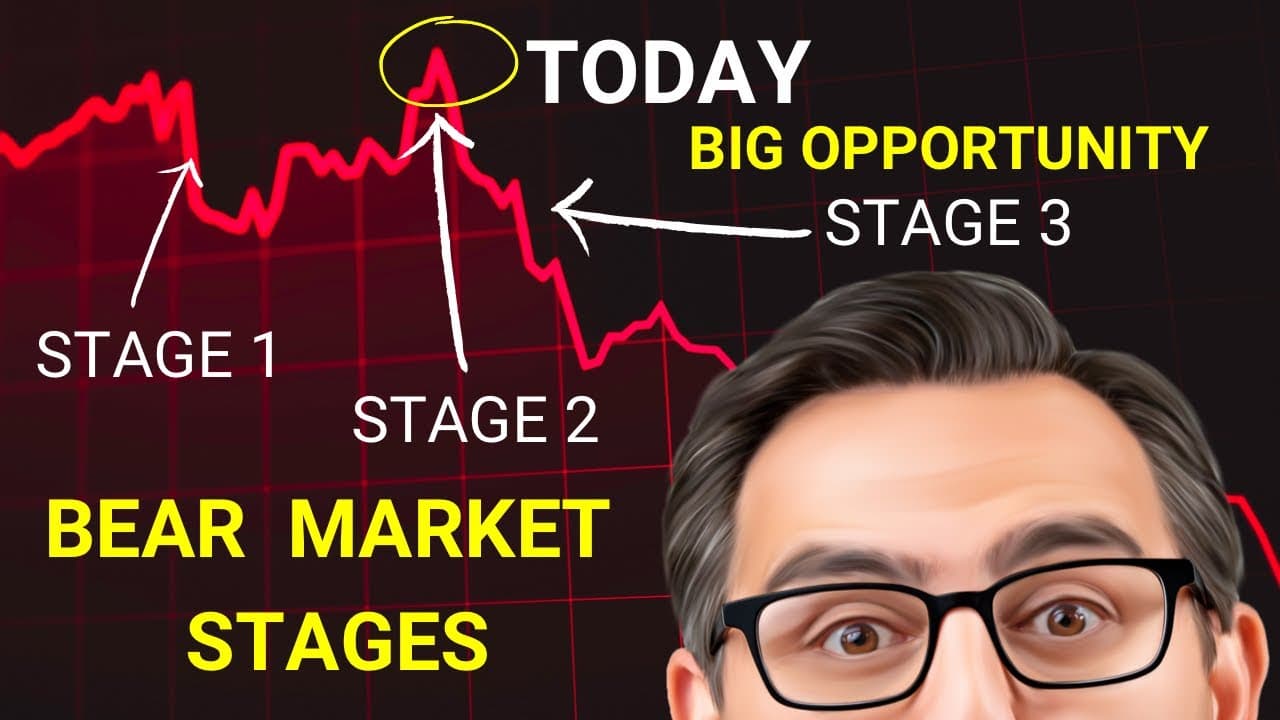
The content discusses the three stages of a bear market: the high-flyer stage, the reversion stage, and the capitulation stage.
Transcript
all right guys there are three stages essentially to Bear Market a lot of people would agree now how you word them how you label them up to you A lot of people different versions stage one it's kind of like the High Flyers the Market's going crazy there's High investor sentiment like MO when we hear all of our friends talking about specific stocks ... Read More
Key Insights
- ✋ The three stages of a bear market are the high-flyer stage, reversion stage, and capitulation stage.
- ✋ High investor sentiment and speculation drive the gains in the high-flyer stage.
- 🙈 The reversion stage sees the market correcting and consolidating, trying to return to historical levels.
- 🌸 The capitulation stage is characterized by widespread loss of faith in the market and potential crashes.
- 🧔 The timing and severity of these stages can vary, but historical patterns suggest they occur in most bear markets.
- 🎚️ Paying attention to valuation levels and overall market sentiment can help identify where the market is in these stages.
- 😚 Investing during the reversion stage, when stocks are closer to their fair value, may present better opportunities.
Install to Summarize YouTube Videos and Get Transcripts
Explore YouTube Video Summarizer or Get YouTube Transcript Extractor
Questions & Answers
Q: What is stage one of a bear market, and why do certain stocks experience rapid gains?
Stage one is characterized by high investor sentiment and speculation. Some stocks, often called high-flyers, experience rapid gains due to factors like celebrity endorsements or popular trends.
Q: How does the reversion stage differ from the high-flyer stage?
In the reversion stage, the market starts to decline, and there may be volatility as the market tries to return to historical levels. It is a period of correction and consolidation.
Q: What is the final stage of a bear market, and what happens during this period?
The final stage is the capitulation stage, where investors lose faith in the market. It is characterized by a widespread belief that stocks will never recover, leading to potential massive sell-offs and a crash.
Q: How can investors determine when a bear market is close to bottoming out?
One indicator is when even the high-flying stocks, like Tesla and Apple, start to experience significant declines. It suggests that the market is nearing the point of capitulation and a potential bottom.
Summary & Key Takeaways
-
Stage one of a bear market is characterized by high investor sentiment and rapid gains, often driven by speculation on certain stocks.
-
Stage two is the reversion stage, where the market begins to decline and show volatility, but it is not yet at its bottom.
-
Stage three is the capitulation stage, where investors lose faith in the market, leading to a potential crash.
Read in Other Languages (beta)
Share This Summary 📚
Summarize YouTube Videos and Get Video Transcripts with 1-Click
Try YouTube Summary with ChatGPT & Claude or YouTube Transcript Generator
Explore More Summaries from Everything Money 📚




Summarize YouTube Videos and Get Video Transcripts with 1-Click
Try YouTube Summary with ChatGPT & Claude or YouTube Transcript Generator