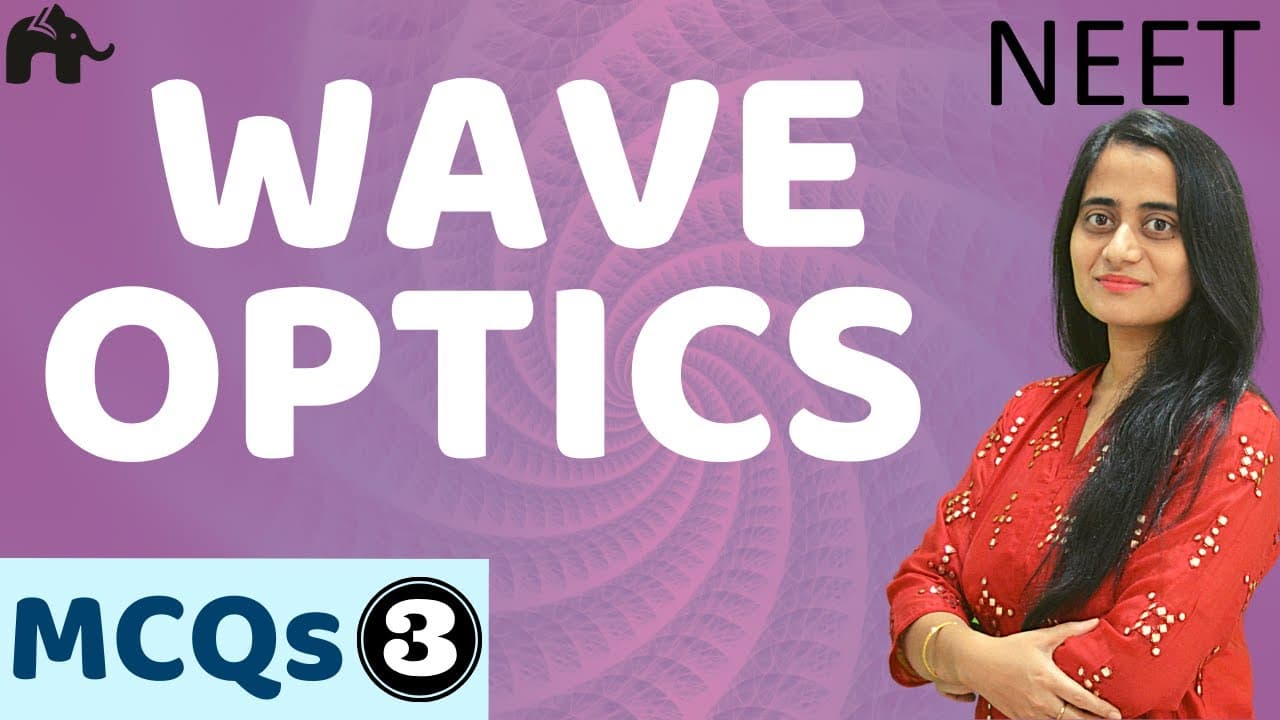
Wave Optics NEET Physics MCQs #3| JEE
TL;DR
This video discusses multiple choice questions on wave optics, focusing on topics such as path difference, phase difference, intensity, and polarization.
Transcript
hello everyone I hope all of you are doing good or Artemis video may discuss Carnevale Hapgood MCQs jana key multiple choice questions on wave optics though wave optics get copies are they ask you questions how many choose near hanjo pitch lipids lipids layers can meet key papers me I had to Yap Kalyug Behati a revision B rahaga or absolutely certa... Read More
Key Insights
- ⏫ Intensity in Young's double slit experiment is influenced by path difference and phase difference.
- 😁 Coherent monochromatic beams superposed result in a pattern with maximum and minimum intensities determined by phase difference.
- 🥳 Wave amplitudes can be calculated using the intensity ratio between bright and dark fringes.
- ⏫ Wavelength is directly proportional to the fringe width in Young's double-slit experiment.
- 🙂 The intensity of emergent polarized light depends on the angle difference between polarizers.
- 🥳 Fringe width ratio can be determined based on the ability of different wavelengths to produce photoelectric effect.
- ❓ Photoelectric effect occurs when the wavelength is below the threshold frequency.
Install to Summarize YouTube Videos and Get Transcripts
Explore YouTube Video Summarizer or Get YouTube Transcript Extractor
Questions & Answers
Q: How does the intensity of light change based on the path difference in Young's double slit experiment?
The intensity of light in Young's double slit experiment is affected by the phase difference. As the phase difference changes, the intensity also changes.
Q: What is the phase difference when the path difference in Young's double slit experiment is lambda/4?
The phase difference is pi/2 when the path difference is lambda/4 in Young's double slit experiment.
Q: Why do coherent monochromatic beams of different intensities superposed result in a pattern with maximum and minimum intensities?
The resultant pattern in coherent monochromatic beams is due to the interference of waves. The maximum and minimum intensities occur based on the phase difference between the beams.
Q: How can the value of wave amplitudes ratio be determined when the intensity ratio between bright and dark fringes is given?
The value of the wave amplitudes ratio can be determined using the intensity ratio. By comparing the square of amplitudes, the ratio can be calculated.
Q: What is the relation between the wavelength lambda and fringe width beta in Young's double-slit experiment?
The wavelength lambda is directly proportional to the fringe width beta in Young's double-slit experiment.
Q: How does the intensity of emergent polarized light change based on the angle of the second polarizer?
The intensity of emergent polarized light from the second polarizer depends on the angle difference between the two polarizers, as determined by Malus' law.
Q: How can the fringe width ratio be determined when the wavelengths lambda1 and lambda2 can or cannot produce photoelectric effect?
The fringe width ratio can be determined by comparing the wavelengths and their relation to the threshold frequency for photoelectric effect.
Q: What is the correct relation between beta1 and beta2 in relation to lambda1 and lambda2 for photoelectric effect to occur?
The correct relation between beta1 and beta2 is beta1 is to beta2 as lambda1 is to lambda2, indicating that lambda1 can produce photoelectric effect while lambda2 cannot.
Summary & Key Takeaways
-
The video presents a series of multiple choice questions related to wave optics, covering topics such as intensity of light in Young's double slit experiment and coherent monochromatic beams.
-
It explains the relationship between path difference and intensity and how phase difference affects intensity in Young's double slit experiment.
-
The video also discusses the intensity and amplitude ratio in two coherent waves and the intensity of emergent polarized light through polarizers at different angles.
Read in Other Languages (beta)
Share This Summary 📚
Summarize YouTube Videos and Get Video Transcripts with 1-Click
Try YouTube Summary with ChatGPT & Claude or YouTube Transcript Generator
Explore More Summaries from LearnoHub - Class 11, 12 📚


Summarize YouTube Videos and Get Video Transcripts with 1-Click
Try YouTube Summary with ChatGPT & Claude or YouTube Transcript Generator