What Are Sequential Logic Circuits and How Do They Work?
TL;DR
Sequential logic circuits utilize memory elements like flip-flops to store past outputs, making them dependent on both current inputs and previous states. Two main types are static and dynamic SEMA circuits, with key timing concepts including setup time, hold time, and propagation delay being crucial for reliable operation.
Transcript
hi everyone in this video you are going to learn about the sequential logic circuit designing of SEMA circuitry in the previous video I have given you the examples of static CMOS circuit design and dynamic SEMA circuit design I have already explained how to design the static SEMA circuit and what are the basic differences between static and dynamic... Read More
Key Insights
- 🤝 Static SEMA circuits deal with fixed inputs and dependent outputs, enhancing predictability in functioning.
- 🥺 Dynamic SEMA circuits incorporate clock-driven inputs, allowing for temporal changes and reflecting past states, leading to more complex logic operations.
- 🐬 Memory elements like flip-flops are essential for retaining past outputs, which define the behavior of sequential logic circuits.
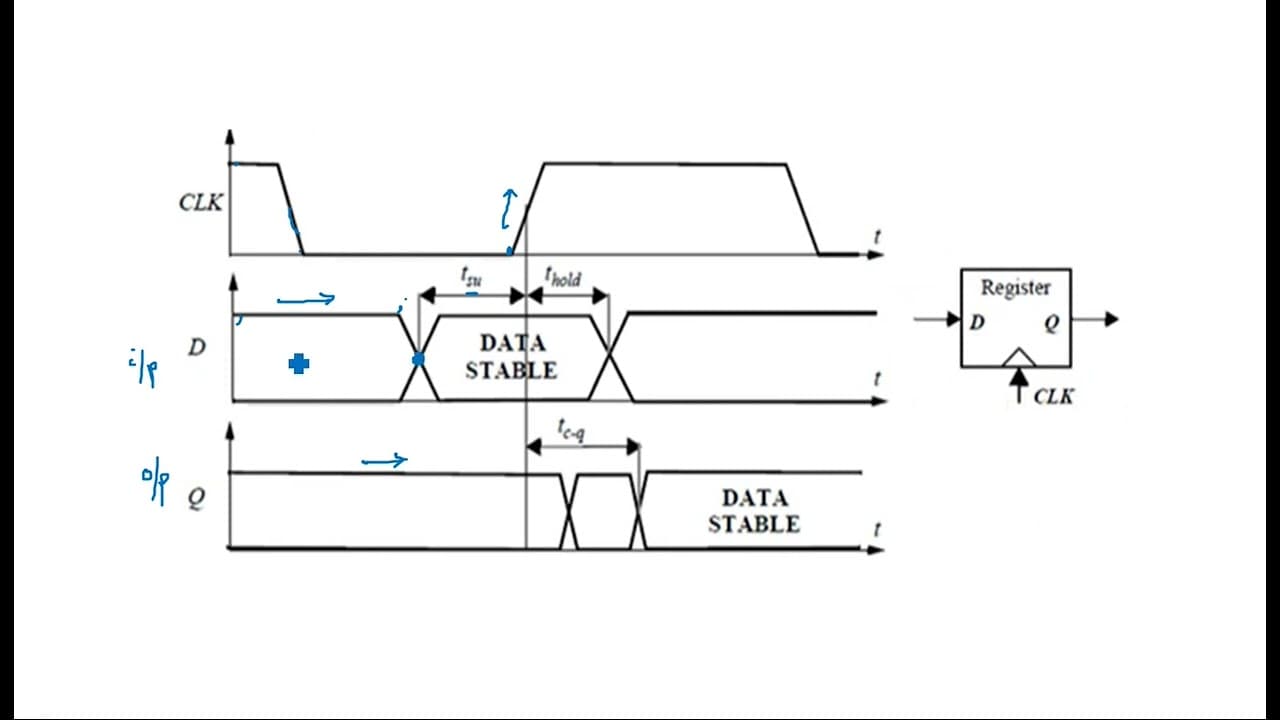
- ⌛ Timing parameters including setup time, hold time, and propagation delay play critical roles in the reliable operation of sequential circuits.
- 🈸 The correct application of these timing concepts is necessary to minimize errors and ensure circuit reliability.
- 🐬 Both latches and flip-flops serve different purposes within circuit design, each with distinct characteristics affecting their implementation.
- 🤩 Understanding the interaction of combinational logic with memory elements is key to achieving efficient circuit design.
Install to Summarize YouTube Videos and Get Transcripts
Explore YouTube Video Summarizer or Get YouTube Transcript Extractor
Questions & Answers
Q: What differentiates static from dynamic SEMA circuits?
Static SEMA circuits rely on fixed inputs that do not change over time, making their outputs dependent solely on the current state of inputs. In contrast, dynamic SEMA circuits utilize continuously changing inputs controlled by clock signals, which allows for varied output depending on both present inputs and past states, creating a more complex system.
Q: What are the roles of flip-flops in sequential logic?
Flip-flops serve as memory elements in sequential logic circuits, enabling the storage and retrieval of previous output states. They are crucial in ensuring that the circuit can react to past inputs alongside current signals, thereby facilitating functions that depend on historical data rather than just immediate inputs.
Q: How is setup time defined in sequential logic?
Setup time is the interval before a clock's transition during which data inputs must remain stable to ensure correct operation. It is crucial that the inputs are valid prior to the clock signal changing states, as this guarantees that the correct data is transferred to the output in the clock pulse following the transition.
Q: What is hold time and why is it important?
Hold time is the period after a clock signal transitions in which the data input must remain stable to ensure reliable operation. It ensures that the output reflects the correct data after the clock change, preventing errors that could arise from premature changes in input values.
Q: How does propagation delay affect sequential circuits?
Propagation delay is the time it takes for a change in input to be reflected at the output. It is critical to consider propagation delays when designing sequential circuits to ensure that the signals are processed correctly within the required timing constraints, thus avoiding errors in data transfer.
Q: What is the difference between a latch and a flip-flop?
A latch is a level-triggered device, meaning its output can change based on input levels as long as a control signal is active. Conversely, a flip-flop is edge-triggered, changing output only on specific transitions of the clock signal, thus offering more precise control in timing-sensitive applications.
Summary & Key Takeaways
-
The video provides an overview of sequential logic circuits, emphasizing the differences between static and dynamic SEMA circuitry, including their functionalities.
-
It discusses the components involved in sequential logic design, focusing on the role of memory elements, particularly flip-flops, and how they interact with combinational circuits.
-
Key timing concepts such as setup time, hold time, and propagation delay are defined and explained, emphasizing their importance in sequential circuit operations.
Read in Other Languages (beta)
Share This Summary 📚
Summarize YouTube Videos and Get Video Transcripts with 1-Click
Try YouTube Summary with ChatGPT & Claude or YouTube Transcript Generator