Series are NOT scary! (Part 1: test for divergence, telescoping, geometric, p-series)
TL;DR
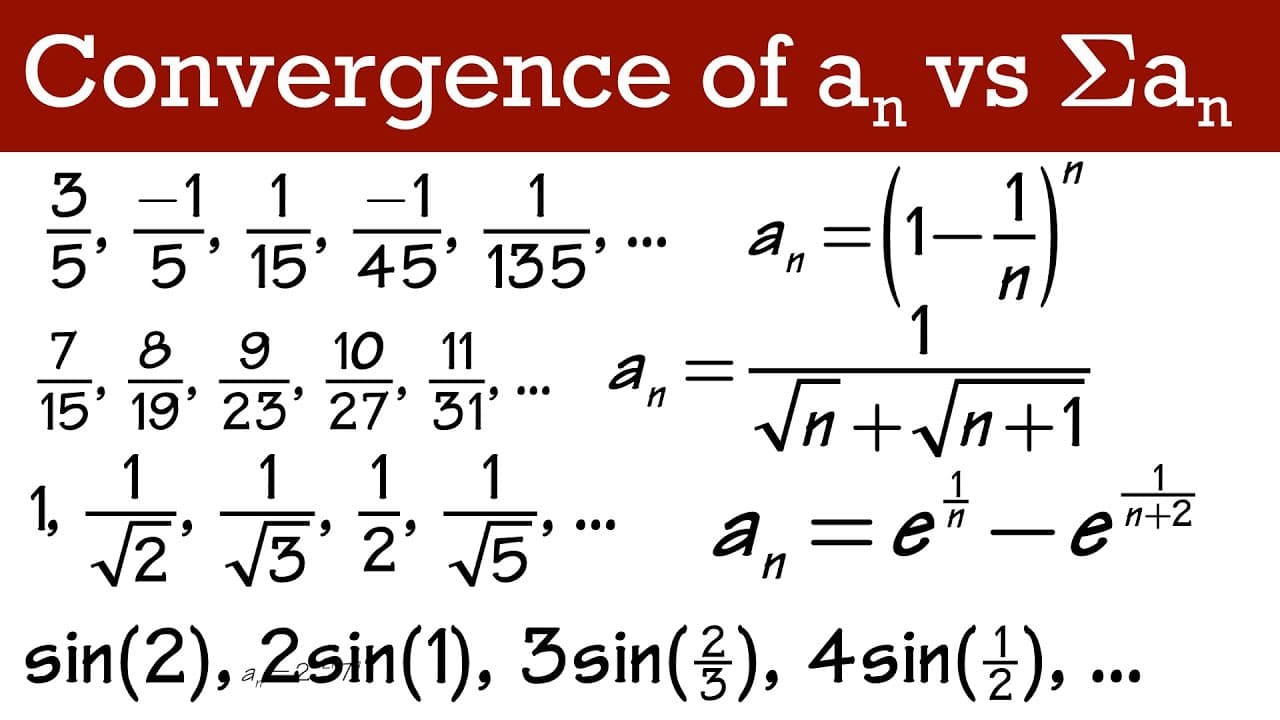
Learn about the convergence of sequences and series in Calculus 2 through an analysis of different examples.
Transcript
so okay good afternoon ladies and gentlemen today we are going to do a blindfold no just kidding but anyway today we'll be doing uh i want to do maybe like a few parts for this especially for calculus 2 students the title you can see already series is not scary so this is the first part i want to just show you guys the fundamental um first we will ... Read More
Key Insights
- ❓ The convergence of a sequence and a series are different concepts that are important to understand in Calculus 2.
- 🏆 Various tests, such as the test for divergence, geometric series test, telescoping series test, and p-series test, can be utilized to determine convergence or divergence.
- 🥳 The importance of limits and common ratios in analyzing convergence is emphasized.
Install to Summarize YouTube Videos and Get Transcripts
Explore YouTube Video Summarizer or Get YouTube Transcript Extractor
Questions & Answers
Q: What is the difference between convergence of a sequence and convergence of a series?
Convergence of a sequence refers to the behavior of the individual terms in a sequence, while convergence of a series refers to the behavior of the sum of the terms in a series.
Q: What is the test for divergence?
The test for divergence states that if the limit of the terms in a sequence is not equal to zero, then the corresponding series diverges.
Q: How does the geometric series test work?
The geometric series test states that a series converges if the absolute value of the common ratio is less than 1, and it diverges if the absolute value of the common ratio is greater than or equal to 1.
Q: What is the telescoping series test?
The telescoping series test applies to series in which the terms cancel each other out, resulting in a finite number as the sum.
Q: How does the p-series test determine convergence?
The p-series test states that a series converges if the exponent of the terms is greater than 1, and it diverges if the exponent is less than or equal to 1.
Summary & Key Takeaways
-
The video discusses the difference between convergence of a sequence and convergence of a series in Calculus 2.
-
Various convergence tests are explored, including the test for divergence, the geometric series test, the telescoping series test, and the p-series test.
-
The concepts of limits and common ratios are used to determine convergence or divergence.
-
The video provides step-by-step explanations and examples to help students understand the material.
Read in Other Languages (beta)
Share This Summary 📚
Summarize YouTube Videos and Get Video Transcripts with 1-Click
Try YouTube Summary with ChatGPT & Claude or YouTube Transcript Generator
Explore More Summaries from blackpenredpen 📚
Summarize YouTube Videos and Get Video Transcripts with 1-Click
Try YouTube Summary with ChatGPT & Claude or YouTube Transcript Generator