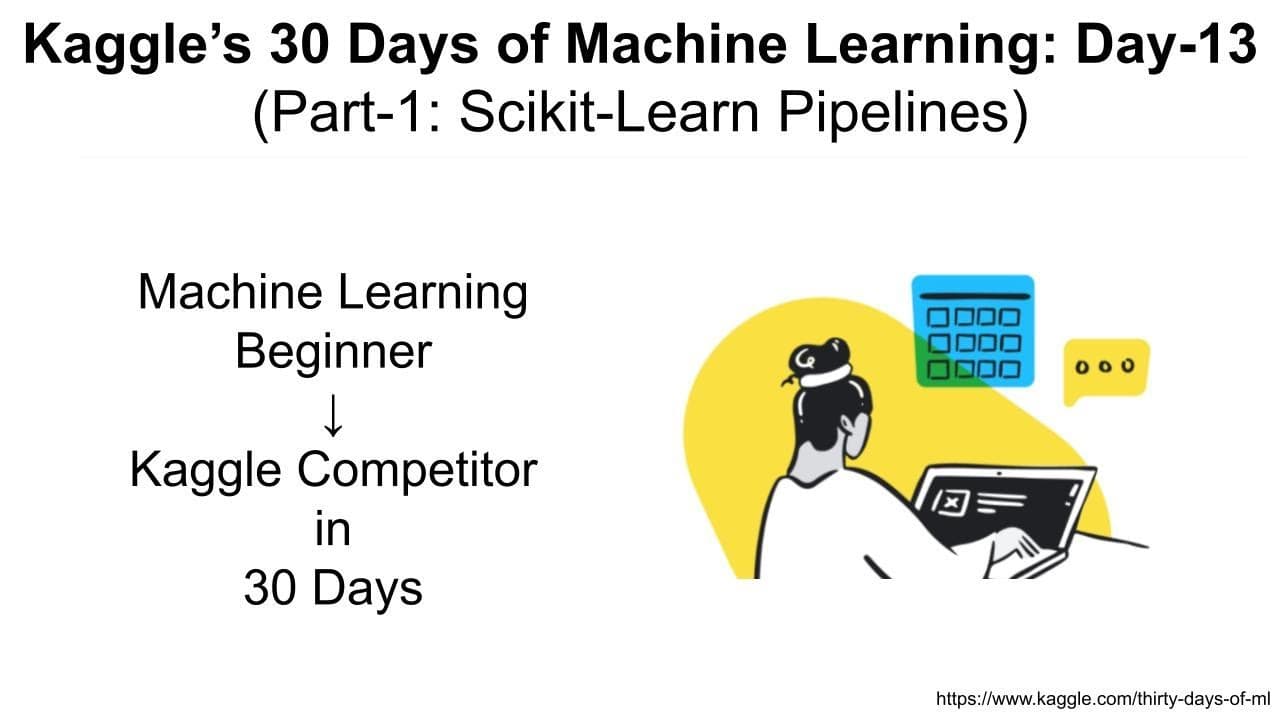
Kaggle's 30 Days Of ML (Day-13 Part-1): Scikit-Learn Pipelines
TL;DR
Learn about the concept of pipelines and column transformers, a way to organize data preprocessing and modeling code in machine learning, to write cleaner code, have fewer bugs, and make it easier for productionizing models.
Transcript
hello everyone and welcome to my youtube channel today is day 13 of kaggle's 30 days of machine learning challenge and today is the second last day of uh the first two weeks and from day 15 we will start the competition and tomorrow you will get your certificate for intermediate machine learning course so today we are going to look at two things th... Read More
Key Insights
- 👨💻 Pipelines and column transformers help organize data preprocessing and modeling code, making it easier to write cleaner and more efficient code.
- 👻 Pipelines allow the sequential execution of preprocessing and modeling steps, simplifying the code and reducing the chances of introducing bugs.
- 👨💻 Column transformers bundle together specific data preprocessing steps for different types of columns, such as numerical and categorical data, improving code reusability and efficiency.
- 🤝 Using pipelines and column transformers can improve the efficiency and scalability of machine learning workflows, especially when dealing with large datasets.
- 👨💻 Preprocessing data using pipelines and column transformers can significantly reduce the code complexity and make it easier to maintain and debug.
- 😒 The code example demonstrates how to use pipelines and column transformers to preprocess data and build a machine learning model, providing a practical implementation of the concepts.
- 🎰 Improving the performance of machine learning models can be achieved by experimenting with different preprocessing steps, model algorithms, and hyperparameters within the pipeline framework.
Install to Summarize YouTube Videos and Get Transcripts
Explore YouTube Video Summarizer or Get YouTube Transcript Extractor
Questions & Answers
Q: What are pipelines in machine learning?
Pipelines are a way to organize data preprocessing and modeling code in machine learning, making it easier to write cleaner code, reduce bugs, and simplify model deployment and validation. They allow sequential execution of preprocessing and modeling steps.
Q: What is the purpose of column transformers?
Column transformers bundle together different data preprocessing steps for specific columns, such as imputing missing values and applying one-hot encoding to categorical data. This allows for cleaner code and efficient handling of different types of data in machine learning.
Q: How does the code example demonstrate the use of pipelines and column transformers?
The code example shows how to use pipelines and column transformers to preprocess data by imputing missing values and applying one-hot encoding to categorical data. It then builds a machine learning model using the preprocessed data, simplifying the code and improving efficiency.
Q: What are the benefits of using pipelines and column transformers in machine learning?
Using pipelines and column transformers helps simplify the code, reduce bugs, and streamline the process of preprocessing data and building models. It also makes it easier to deploy models and validate their performance.
Summary & Key Takeaways
-
Pipelines are a simple way to organize data preprocessing and modeling code in machine learning, making the code cleaner, reducing bugs, and simplifying model deployment and validation.
-
Column transformers bundle together different data preprocessing steps, such as imputing missing values and applying one-hot encoding to categorical data.
-
The code example demonstrates how to use pipelines and column transformers to preprocess data and build a machine learning model, reducing the code complexity and improving efficiency.
Read in Other Languages (beta)
Share This Summary 📚
Summarize YouTube Videos and Get Video Transcripts with 1-Click
Try YouTube Summary with ChatGPT & Claude or YouTube Transcript Generator
Explore More Summaries from Abhishek Thakur 📚


Summarize YouTube Videos and Get Video Transcripts with 1-Click
Try YouTube Summary with ChatGPT & Claude or YouTube Transcript Generator